

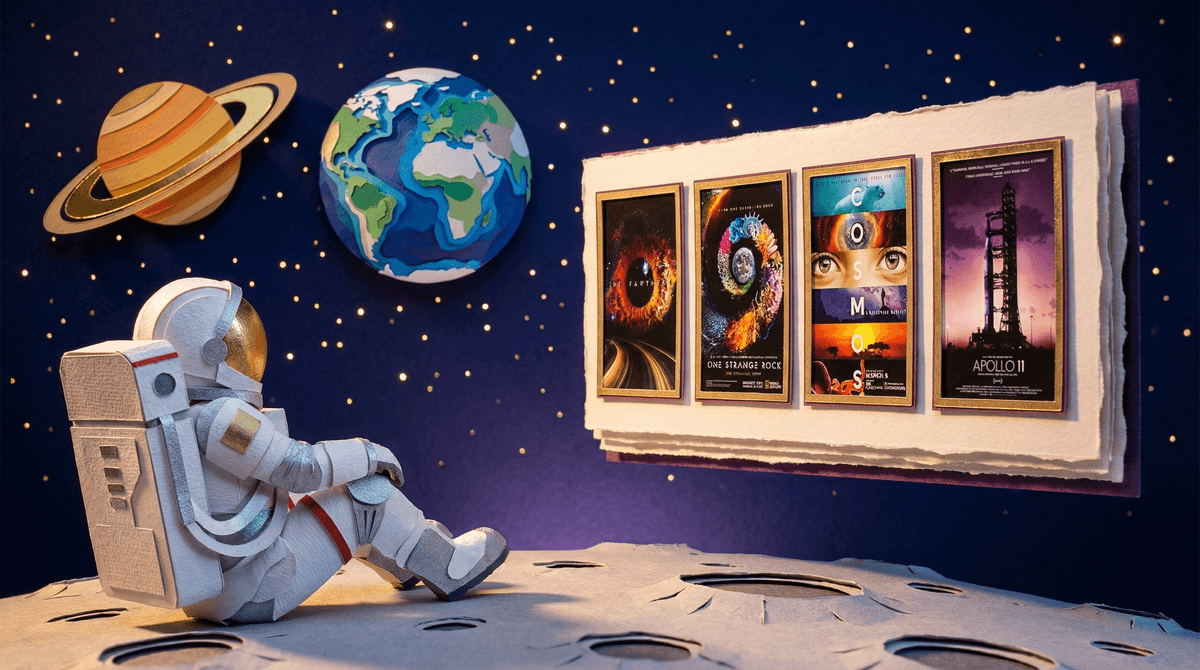
Space documentaries are films that explore everything from our solar system to distant galaxies, black holes to Mars missions, astronaut life to the search for alien civilizations. The good ones make complex astrophysics feel accessible, spark genuine curiosity about the universe, and leave kids (and adults) staring at the night sky with fresh wonder.
The really good ones do all that without dumbing things down or relying on cheesy CGI that looks like a Windows 95 screensaver.
Here's the thing: not all space documentaries are created equal. Some are legitimately mind-blowing. Others are 90 minutes of slow pans across stock NASA footage with dramatic music. And some—looking at you, Ancient Aliens—are just... not it.
This guide focuses on the legitimately great ones that will actually inspire scientific thinking rather than conspiracy theories about how extraterrestrials built the pyramids.
Space content has this unique ability to make kids feel small and significant at the same time. It's humbling (we're a tiny speck in an incomprehensibly vast universe) and empowering (humans figured out how to leave our planet and explore it).
Unlike a lot of screen time that's purely passive consumption, good space documentaries tend to spark questions, inspire drawing and creative play, and lead to actual conversations. Kids will come away asking about gravity, wanting to know if we'll really colonize Mars, or wondering what happens inside a black hole.
Plus, space content tends to be screen time that grandparents, science-minded relatives, and educators actively support. It's one of those rare wins where entertainment value and educational value actually overlap.
Ages 5-8: Gateway to the Cosmos
One Strange Rock (National Geographic, 2018)
Hosted by Will Smith, this series makes Earth feel like the most remarkable planet in the universe (because it is). Each episode focuses on a different aspect of what makes our planet unique, told through the eyes of astronauts. The visuals are stunning, and it's accessible enough for younger kids while still being interesting for adults. Some episodes are more engaging than others, but the pilot about breathable air is genuinely fascinating.
The Planets (BBC, 2019)
Brian Cox does what he does best: makes you care deeply about rocks floating in space. This series gives each planet its own episode, with CGI that actually holds up and storytelling that feels epic rather than textbook-y. The Mars episode is particularly good for kids obsessed with the Red Planet.
Ages 9-12: Ready for Real Science
Cosmos: A Spacetime Odyssey (2014, hosted by Neil deGrasse Tyson)
The modern reboot of Carl Sagan's classic series is spectacular. Each episode tackles big questions—how did life begin, what are stars made of, how do we know what we know? Tyson is an engaging host, the "cosmic calendar" concept (compressing all of time into one year) is brilliantly done, and the animated segments about historical scientists are genuinely interesting. Some episodes touch on evolution and deep time in ways that are matter-of-fact and science-based.
Fair warning: a few episodes deal with darker historical topics (persecution of scientists, extinction events). Preview if your kid is sensitive to that stuff.
A Year in Space (PBS, 2016)
This documentary follows astronaut Scott Kelly during his year-long mission aboard the International Space Station. It's less about distant galaxies and more about the reality of living in space—the boredom, the wonder, the physical toll, the view of Earth from orbit. For kids who think they want to be astronauts, this is essential viewing. It's honest about how hard it is while still making it seem worth it.
Ages 13+: The Deep End
The Farthest: Voyager in Space (PBS, 2017)
This documentary about the Voyager missions is genuinely moving. It follows the spacecraft from their 1977 launch through their journey past Jupiter, Saturn, Uranus, and Neptune, and eventually into interstellar space. The scientists and engineers who built Voyager are now elderly, reflecting on their life's work still hurtling through space. It's about human ambition, scientific achievement, and our drive to explore. Not a dry moment in it.
Apollo 11 (2019)
This documentary is just restored archival footage and audio from the 1969 moon landing mission—no narrator, no modern interviews, no dramatic reenactments. It's pure cinema, and it's breathtaking. The 70mm footage looks better than most modern films. For teens who think space exploration is boring or old news, this makes it feel immediate and thrilling. It's a masterclass in documentary filmmaking.
Black Holes: The Edge of All We Know (Netflix, 2020)
This follows two parallel stories: scientists trying to capture the first image of a black hole (spoiler: they succeed, and it's incredible), and Stephen Hawking's final work on black hole theory. It gets into genuinely complex physics but makes it comprehensible. Great for teens ready for real science rather than pop-science simplification.
Ancient Aliens and similar "documentaries" on History Channel are not documentaries—they're entertainment that undermines scientific thinking and often relies on racist assumptions about ancient civilizations. Hard pass.
The Space Between Us (2017) is a narrative film, not a documentary, and it's also just... not good. If your kid wants space fiction, go with The Martian or Interstellar instead.
The best way to watch these isn't just passive viewing. Try:
- Pause and discuss: When something wild comes up (like the scale of the universe or the speed of light), pause and talk about it. "What would that actually feel like?" "How do scientists know that?"
- Follow up with hands-on stuff: After watching, pull up Google Earth to see the ISS location, use a stargazing app to identify constellations, or watch a SpaceX launch livestream together
- Connect to current events: Space exploration is happening now. The James Webb telescope is sending back images, Mars rovers are active, private companies are launching missions. These documentaries provide context for understanding current news.
Space documentaries are some of the highest-quality screen time available. They're visually stunning, intellectually engaging, and genuinely inspiring. Unlike a lot of kids' content that talks down to its audience, the best space documentaries treat viewers—regardless of age—as capable of understanding complex ideas.
Start with something age-appropriate but don't be afraid to let your kids reach a bit beyond their level. A 10-year-old might not understand every concept in Cosmos, but they'll absorb more than you think, and the sense of wonder translates at any age.
And honestly? These are just as much for you as for your kids. When's the last time you thought about the fact that we're on a rock hurtling through space at 67,000 miles per hour? Space documentaries remind us that reality is stranger and more magnificent than most fiction.
If your kid gets hooked on space content, check out the Brains On! Space podcast episodes for audio content, or explore NASA's website for kids which has free games, activities, and real mission updates.
And if you're looking for more documentary recommendations beyond space, we've got guides on the best nature documentaries and educational YouTube channels that don't suck.