

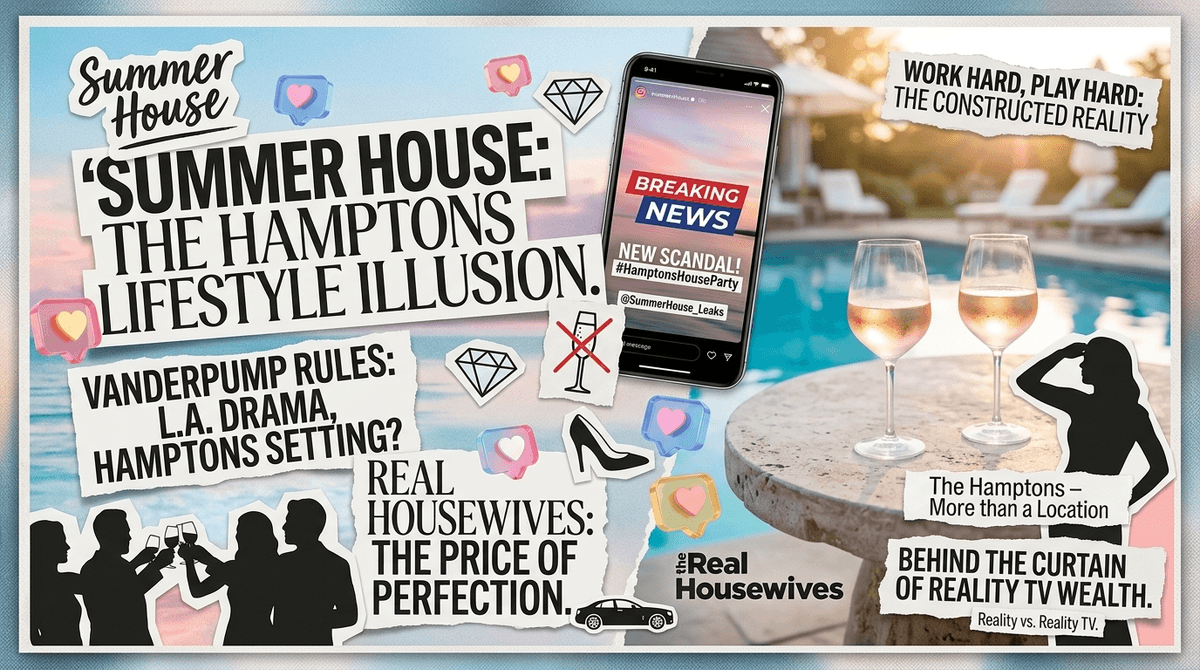
"Summer House" and the Hamptons "Work Hard, Play Hard" Illusion
Summer House on Bravo is not a show for kids — and honestly, it's barely a show for adults who want to feel good about humanity — but if it's playing in your house or your teens are watching it on their own, there's actually a lot worth talking about.
Summer House is a Bravo reality series following attractive twenty- and thirty-somethings sharing a Hamptons house, and the 2026 season leans hard into divorce drama, social media feuds, and a "Scandoval"-style betrayal storyline. It's TV-14 at minimum but plays more like TV-MA in practice — heavy drinking, relationship implosions, and Instagram drama are the main plot engines. Not appropriate for younger kids, and worth a conversation if your teenager is watching.
Screenwise Parents
See allSummer House is a Bravo reality show that's been running since 2017, following a rotating cast of young professionals who rent a massive Hamptons house together every summer weekend. The premise is basically: everyone works hard in NYC all week, then descends on the Hamptons to drink aggressively, hook up, fight, cry, and repeat. It's aspirational in the most exhausting way possible.
The 2026 season has gotten notable attention — covered by outlets like Just Jared and Marie Claire — because it features some genuinely high-profile cast drama: a mid-season divorce storyline, a social media scandal that fans are already calling the "Scandoval of the Hamptons" (a reference to the Vanderpump Rules cheating saga that broke the internet a few years back), and the usual Instagram-fueled he-said-she-said that plays out both on-camera and in cast members' Stories.
Here's the thing about Summer House: it's not just passive entertainment. It's a show that actively models a specific lifestyle — one where alcohol is the social lubricant for literally every emotion, where relationship drama is entertainment, and where a person's Instagram presence is treated as a legitimate measure of their worth and power.
That's the "Work Hard, Play Hard" illusion the show is selling. The cast frames their weekend chaos as earned — they work in finance or PR or whatever, so they deserve to black out by Saturday afternoon. It's a narrative that's genuinely appealing to a certain demographic, including older teens who are starting to think about what adult life looks like.
In our Screenwise community data, 92% of families report that streaming TV is a regular part of their household media diet, with kids averaging about 4 hours of screen time on weekdays and 5 hours on weekends. Reality TV — especially Bravo content — is a meaningful chunk of that. And while only 5% of kids in our community are on Instagram, the show's drama is deeply Instagram-native: cast members subtweet each other, post cryptic Stories, and the off-screen social media behavior is as much a part of the storyline as what's filmed.
That's a lot of modeling happening, even if your kid is "just watching."
Let's be specific, because vague content warnings aren't useful.
The divorce storyline involves a cast couple whose relationship publicly implodes mid-season, including accusations of infidelity that play out across both the show and their respective social media accounts. It's messy, it's real, and it's handled with exactly the sensitivity you'd expect from a Bravo production — which is to say, not much.
The "Scandoval of the Hamptons" refers to a betrayal arc involving a close friend group fracture, again with heavy social media overlap. If your teen watched Vanderpump Rules during the original Scandoval era, they'll recognize the format immediately.
Alcohol is everywhere. This is not a show that treats drinking as a background detail. It is the foreground. Drinking to cope, drinking to celebrate, drinking to avoid a hard conversation — it's the cast's primary emotional regulation strategy, and the show doesn't really interrogate that.
The Instagram angle is genuinely interesting from a media literacy standpoint. Cast members have large followings and use their platforms to shape narratives, respond to fan theories, and occasionally throw shade at each other between episodes. For a teenager who's already navigating social media dynamics at school, this is basically a masterclass in how social media can be weaponized — for better or worse.
No judgment — Summer House is genuinely entertaining, and older teens watching Bravo is not a crisis. But it's worth being intentional about what they're absorbing.
Some conversations worth having:
-
The "work hard, play hard" framing is doing a lot of work on this show. Ask your teen: does that logic hold up? Is blowing everything off on weekends actually a reward for working hard, or is it a coping mechanism that the show just glamorizes?
-
The divorce and betrayal storylines are emotionally complex. If your teen is watching, they're forming ideas about how adults handle conflict, loyalty, and heartbreak. That's worth talking about — not to lecture, but to hear what they actually think.
-
The Instagram-as-weapon dynamic is something they're probably already experiencing in smaller ways at school. Talking about social media drama
 through the lens of a TV show can actually be lower-stakes than talking about their own feed.
 -
Ask what they find appealing about the show. The Hamptons lifestyle is aspirational in a specific way — it's worth understanding if your teen is drawn to the aesthetics, the drama, the relationships, or something else entirely.
Under 13: Hard no. The drinking alone makes this a skip, and the relationship content is not developmentally appropriate.
Ages 13-15: This is where it gets parent-dependent. The content is more TV-MA than the official rating suggests. If your teen stumbles onto it, that's a conversation — not a catastrophe — but it's not something to put on together as family entertainment.
Ages 16+: Older teens watch this kind of content, and that's honestly fine with some context. The show is a useful lens for talking about alcohol culture, relationship dynamics, and how social media shapes (and distorts) real-life conflict.
Summer House doesn't exist in isolation — it's part of a larger Bravo universe that includes Vanderpump Rules, The Real Housewives franchise, and Winter House. These shows cross-pollinate constantly, which means if your teen is watching one, they're probably aware of several others.
The Bravo brand is built on a specific formula: aspirational settings, attractive people, manufactured conflict, and social media amplification. It's effective television. It's also a pretty consistent delivery mechanism for normalized heavy drinking, performative wealth, and the idea that public drama is just how adults relate to each other.
Learn more about reality TV and teen media literacy if you want to go deeper on this.
Q: Is Summer House on Bravo appropriate for teenagers?
It depends on age and maturity, but the show plays more mature than its official rating. Heavy alcohol use, relationship infidelity, and social media drama are central storylines — fine for older teens with context, but not a great unmonitored watch for younger teens.
Q: What is the "Scandoval of the Hamptons" on Summer House 2026?
It's a fan nickname for the major betrayal/friendship fracture storyline in the 2026 season, drawing a comparison to the infamous Vanderpump Rules Scandoval cheating scandal. It involves cast members, social media, and the kind of messy fallout Bravo has built its brand on.
Q: How much drinking is in Summer House?
A lot. Alcohol is not a background detail on this show — it's the primary social activity in virtually every scene. If you're concerned about what your teen is absorbing about drinking culture, this is a real consideration.
Q: Can I use Summer House to talk to my teen about social media?
Actually, yes — this is one of the more useful angles on the show. The cast's Instagram behavior is woven into the storylines, and it's a lower-stakes way to talk about how social media can be used manipulatively than trying to dissect your kid's own feed.
Q: Is Summer House better or worse than other Bravo shows for teens?
It's roughly in the same tier as Vanderpump Rules — heavy drinking, relationship drama, social media overlap. The Real Housewives franchises vary widely. None of them are designed with teen audiences in mind, and all of them model adult conflict in ways worth discussing.
Summer House is entertaining, it's well-produced, and the 2026 season has enough genuine drama to keep people talking. It's also a show that consistently glamorizes heavy drinking, treats Instagram clout as a form of social currency, and packages real human pain as weekend entertainment.
If it's in your house — whether you're watching it yourself or your teen has found it — the content isn't the crisis. The conversation is the opportunity. The "work hard, play hard" framing the show sells is worth interrogating out loud, especially with teenagers who are starting to build their own ideas about what adult life looks like.
See how to talk to teens about reality TV and drinking culture if you want help starting that conversation.