

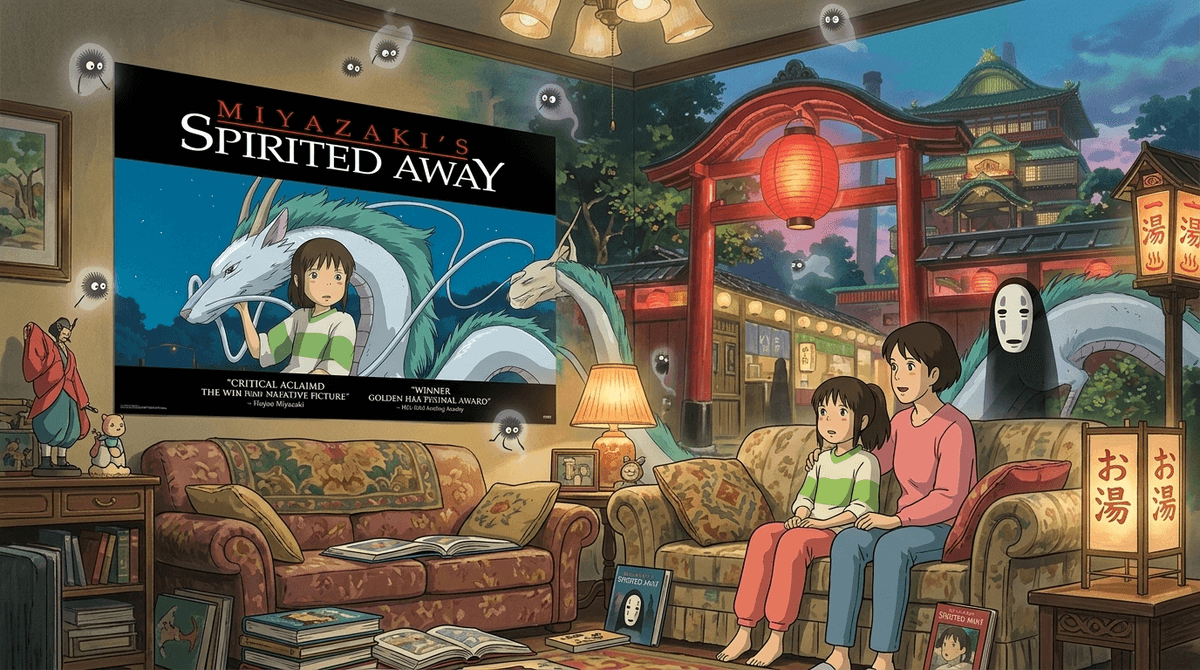
TL;DR: Spirited Away is widely considered one of the greatest animated films of all time, but it’s a far cry from the sanitized "princess finds a prince" trope. It’s a surreal, beautiful, and occasionally unsettling journey through a Japanese spirit realm. It’s best for ages 8 and up, though brave 6-year-olds can handle it with a parent nearby. If your kid is already into Roblox or weird internet lore, they’ll likely find the "Ohio-level" strangeness of this movie fascinating rather than frightening.
Quick links to get you started:
Released in 2001 by the legendary Studio Ghibli and directed by Hayao Miyazaki, Spirited Away follows 10-year-old Chihiro. While moving to a new neighborhood, her family takes a wrong turn and stumbles into a seemingly abandoned theme park.
Things escalate quickly: her parents eat mysterious food and turn into literal giant pigs, the sun sets, and the park fills with spirits, monsters, and gods. To save her parents and return to the human world, Chihiro has to take a job at a massive bathhouse for the gods, run by a terrifying sorceress named Yubaba.
It’s a coming-of-age story wrapped in a fever dream. It’s not "brain rot" content; it’s high art that happens to be accessible to children.
Kids today are used to fast-paced, loud, "look-at-me" content. Spirited Away is different. It has "Ma"—the Japanese concept of emptiness or quiet moments.
Kids are drawn to the autonomy Chihiro has to find. She starts as a whiny, scared kid (totally relatable) and has to navigate a high-stakes workplace, make allies, and solve problems without her parents. In a world where we often over-schedule our kids' lives, seeing a 10-year-old navigate a magical bathhouse is peak wish fulfillment.
Also, the character designs are just cool. From the Radish Spirit to the soot sprites (which also appear in My Neighbor Totoro), the visuals are captivating in a way that CGI often misses.
While Spirited Away is rated PG, "PG" meant something a little different in the early 2000s. Here is the breakdown:
Ages 5-7: The "Maybe" Zone
For some kids, the scene where the parents transform into pigs—complete with snout-snorting and clothes ripping—is straight-up nightmare fuel. There’s also a character named No-Face who eventually goes on a bit of a "swallow-everyone-whole" rampage. If your child is sensitive to "scary" visuals or body horror, wait a year or two. Start with Ponyo instead.
Ages 8-12: The Sweet Spot
This is the perfect age. They are old enough to understand the subtext (greed, environmentalism, identity) and young enough to still be swept up in the magic. They’ll appreciate the weirdness without being traumatized by the darker elements.
Ages 13+: Still Essential
Even for teens who think they’re "too old" for cartoons, Spirited Away holds up. It’s a great entry point into more mature anime like Princess Mononoke or The Boy and the Heron.

If you’re expecting a Disney-style musical where the villain gets defeated in a final boss battle, you’re going to be confused. Studio Ghibli movies don’t always have "villains" in the traditional sense. Even Yubaba, the primary antagonist, has layers.
The Scares:
- The Pig Scene: It’s visceral. Chihiro’s parents are consumed by greed (and literal food). It’s a heavy metaphor for consumerism that might fly over a kid's head, but the visual of Mom and Dad turning into farm animals is intense.
- No-Face: He’s a lonely spirit who tries to buy friendship with gold. When that doesn't work, he starts eating people. He gets big, bloated, and chases Chihiro. It’s suspenseful, but he eventually "vomits" out the bad stuff and returns to being a peaceful companion.
- Blood: There is a scene where a dragon (Haku) is injured and bleeding significantly. It's not "slasher movie" gore, but it’s more than you’d see in a typical G-rated movie.
The Themes: The movie is deeply rooted in Japanese Shintoism—the belief that everything in nature has a spirit. This is why the "Stink Spirit" (which turns out to be a polluted River Spirit) is such a pivotal scene. It’s a fantastic way to talk to your kids about environmentalism and how we treat the world around us.
Since Spirited Away is a bit more complex than your average Saturday morning cartoon, it’s a great opportunity for some "active mediation" (a fancy way of saying "talking to your kids about what they just watched").
- On Identity: Yubaba steals Chihiro’s name and renames her "Sen." Talk about why our names and where we come from are important. How does Chihiro keep from forgetting who she is?
- On Greed: The parents turn into pigs because they eat food that doesn't belong to them. No-Face causes chaos by offering gold to people who are greedy. What is the movie trying to say about "wanting more"?
- On Bravery: Chihiro is terrified for the first 20 minutes of the movie. She’s shaking and crying. But she does the work anyway. This is a great "definition of courage" moment—being scared but doing it anyway.
If your family loved the vibe of Spirited Away, you’ve just opened a massive door. Here’s where to go next:
The ultimate "cozy" movie. No villains, just two sisters moving to the country and meeting a giant forest spirit. It’s the cinematic equivalent of a warm blanket.
A bit more "steampunk" and romantic. It features a walking castle, a fire demon named Calcifer, and a curse that turns a young girl into an old woman.
A wonderful story about a young witch starting her own business. It deals with burnout and finding your "spark" in a way that is surprisingly relevant to modern kids.
Based on the book The Borrowers, this is a smaller-scale (literally) story about tiny people living under the floorboards. It’s visually stunning and very gentle.
Spirited Away is a 10/10 must-watch, but it requires a parent who is willing to sit through some "what is happening right now?" moments. It’s not a movie you just put on in the background while you fold laundry; it’s a movie you watch together.
It challenges kids to think about work, respect, and the environment, all while taking them on a visual journey that makes most modern animation look lazy. If your kid can handle a little bit of "weird," this will likely become a core memory for them.
Next Steps:
- Check if it's streaming (usually on Max in the US or Netflix internationally).
- Grab some snacks (maybe not the "pig-transforming" kind).
- Watch the dubbed version first if your kids are younger; the English voice cast (featuring Daveigh Chase and Suzanne Pleshette) is actually fantastic.