

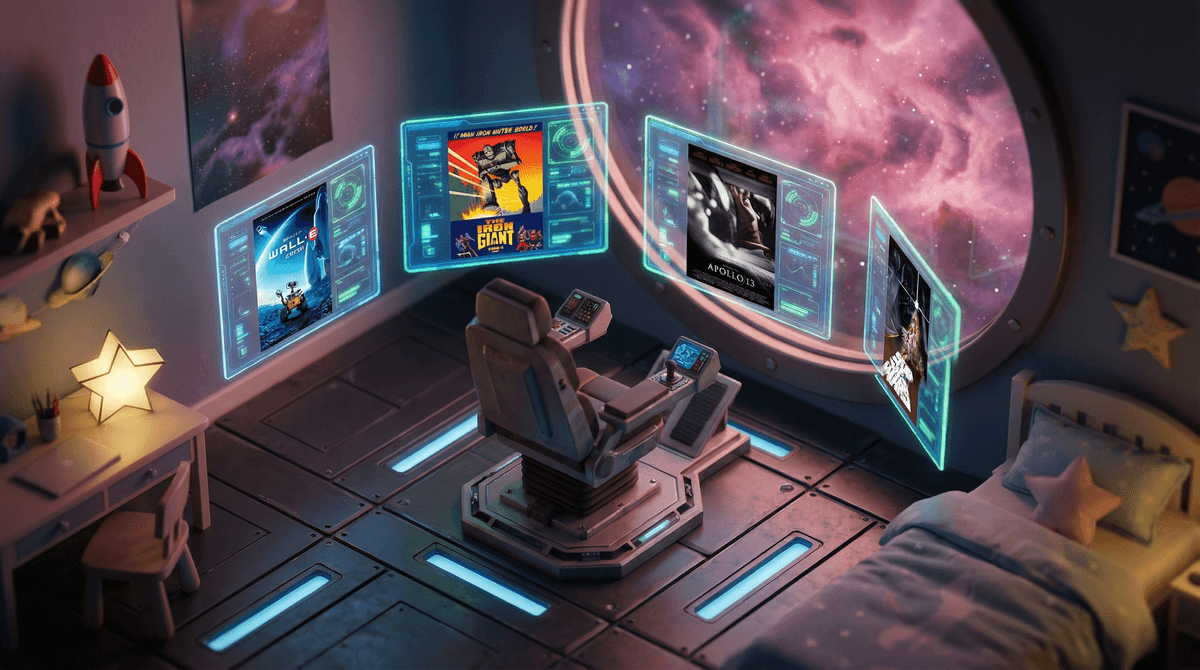
Space movies are exactly what they sound like—films set in the cosmos, featuring astronauts, aliens, robots, or intergalactic adventures. But here's the thing: not all space movies are created equal when it comes to kids. Some are gentle explorations of wonder and curiosity (Wall-E, Apollo 13). Others are intense, violent sci-fi epics that'll have your 7-year-old sleeping in your bed for a week (Alien, looking at you).
The challenge? Space is inherently vast and mysterious, which means these movies can swing wildly between "educational and inspiring" and "existentially terrifying." Your kid might be ready for the awe of watching astronauts float through the International Space Station, but not ready for the cosmic horror of being alone in the void.
Kids are naturally drawn to space. It's the ultimate frontier—literally everything unknown is out there. Space movies tap into:
Pure wonder: Stars, planets, galaxies—it's all visually stunning and inherently magical Adventure without limits: In space, anything is possible (no pesky laws of physics to worry about) The hero's journey: Most space movies follow characters overcoming impossible odds Cool tech: Spaceships, robots, laser weapons—what's not to love?
But also, let's be real: kids love space movies for the same reason they love dinosaurs and deep-sea creatures. It's big, it's unknowable, and it makes them feel small in a way that's thrilling rather than scary (when done right).
Here's the breakdown by age, with actual recommendations:
Ages 3-6: Gentle Wonder
At this age, you want visually engaging stories with minimal peril and lots of heart.
Wall-E (G) - The gold standard. A lonely robot cleaning up Earth falls in love and goes to space. Minimal dialogue, maximum emotion. Some kids find the first act (Wall-E alone on Earth) a bit slow, but most are captivated.
Shaun the Sheep Movie: Farmageddon (G) - An adorable alien crash-lands on a farm. Slapstick humor, zero dialogue, perfect for short attention spans.
The Little Prince (PG) - Beautiful animation, philosophical without being heavy. The space sequences are dreamy and gentle.
Ages 7-10: Building Complexity
Now you can introduce more plot, mild peril, and bigger themes.
E.T. the Extra-Terrestrial (PG) - The classic for a reason. Yes, there are some tense moments (government agents, E.T. getting sick), but the emotional core is friendship and connection. Most 8-year-olds can handle it.
Lilo & Stitch (PG) - Technically an alien movie! Stitch crash-lands in Hawaii, chaos ensues. Funny, heartfelt, with themes about family that hit hard.
The Iron Giant (PG) - A giant robot from space befriends a boy during the Cold War. There's a weapons subplot and some intense moments, but it's fundamentally about choosing who you want to be. Have tissues ready.
Apollo 13 (PG) - For kids interested in real space exploration. It's tense (you know, because they almost died), but it's also a masterclass in problem-solving and teamwork. Best for mature 9-10 year olds who can handle suspense.
Ages 11-13: Ready for the Big Leagues
Preteens can handle more complexity, some violence, and bigger existential themes.
Star Wars: A New Hope (PG) - The OG space opera. Yes, there's violence (Stormtroopers getting shot, Alderaan exploding), but it's not graphic. Most 11-year-olds are ready. Just maybe skip showing them the prequels until they're old enough to appreciate how bad they are.
The Martian (PG-13) - An astronaut gets stranded on Mars and sciences the hell out of his survival. Some language (hence the PG-13), but it's fundamentally optimistic and celebrates intelligence. Great for kids who love problem-solving.
Interstellar (PG-13) - This one's divisive. It's long (nearly 3 hours), emotionally heavy, and the science gets dense. But for the right kid—one who's ready to grapple with time dilation and the idea of sacrificing everything for humanity—it's transcendent. Not for everyone, though.
Hidden Figures (PG) - The true story of Black women mathematicians at NASA during the Space Race. Inspiring, educational, and tackles racism and sexism in an age-appropriate way.
The "scary space" problem: Space movies often include isolation, the threat of suffocation, or the vastness of the unknown. For anxious kids, this can be legitimately frightening. Pay attention to how your kid handles suspense before diving into something like Gravity (which, frankly, most kids under 14 should skip—it's relentlessly tense).
The science question: Some space movies are scientifically accurate (Apollo 13, The Martian), others are pure fantasy (Star Wars, Guardians of the Galaxy). Both are fine! Just be clear with your kid about which is which. You don't want them thinking lightsabers are just around the corner.
Violence levels vary wildly: Wall-E has zero violence. Star Wars has blaster fights and exploding planets. Ender's Game has child soldiers and genocide (maybe save that one for high school). Check ratings and read parent reviews before committing.
Existential themes: Many space movies ask big questions—Are we alone? What's our purpose? What happens when we die? These can spark amazing conversations, but they can also keep a sensitive 10-year-old up at night. Know your kid.
Space movies can be incredible tools for inspiring curiosity, teaching science, and sparking wonder. But they're also a genre where "kids movie" can mean anything from "adorable robot love story" to "psychological thriller about dying alone in the void."
Start with the gentle stuff—Wall-E, Shaun the Sheep—and work your way up. Pay attention to your kid's anxiety levels around suspense and isolation. And when in doubt, watch it yourself first or check out detailed parent reviews .
.
The right space movie at the right age? That's the stuff that creates lifelong astronauts, scientists, and dreamers. Just maybe skip 2001: A Space Odyssey until college. Trust me on this one.
Want more recommendations? Check out our guides on science movies for kids or adventure movies that aren't just explosions.
Curious about space-themed games? Kerbal Space Program is basically rocket science for kids (and adults who failed physics).
Need help navigating streaming services? We've got you covered with what's actually worth watching on Disney+ and Netflix shows that won't rot their brains.