

Beyond Captain Underpants: Finding Short Story Collections That Don't Talk Down to Your 10-Year-Old
TL;DR: Your fourth or fifth grader is ready for stories with real emotional depth, nuanced characters, and themes that matter—not just fart jokes and easy morals. These anthologies deliver literary quality without being stuffy, covering everything from identity and social change to friendship and growing up, all in digestible short-story format.
Top picks:
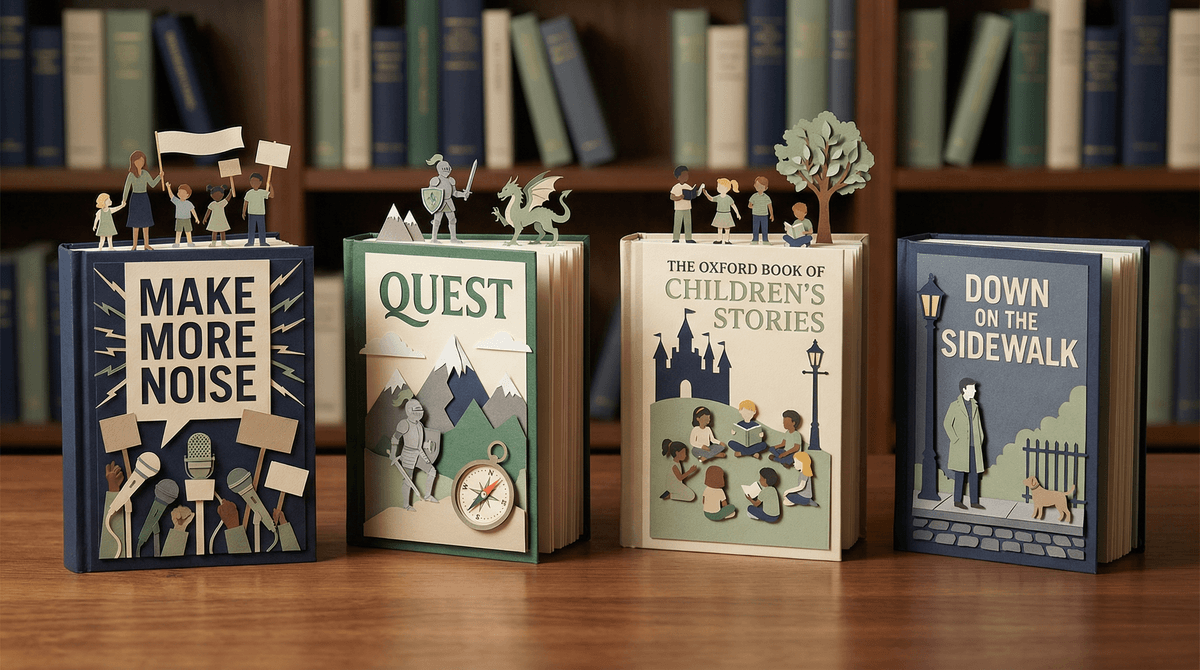
- Make More Noise – diverse voices exploring identity and equality
- Quest edited by Daniel Hahn – balanced mix of realistic and subtle fantasy
- The Oxford Book of Children's Stories – timeless tales with literary craft
- Down on the Sidewalk – award-winning fiction about childhood
- Snapshots – contemporary stories about relationships and values
There's this weird gap in kids' literature around age 10. Your kid has outgrown Dog Man and can handle chapter books just fine, but so much of what's marketed to "middle grade" still feels... pandering. Like someone decided that stories for this age group need to be either laugh-out-loud silly or wrapped in a very tidy moral lesson, with no room for the messy, complicated stuff that actually makes literature worth reading.
Meanwhile, your 10-year-old is navigating real friendships, noticing social hierarchies, asking questions about fairness and identity, and absolutely capable of sitting with ambiguity. They don't need every story to end with "and that's why we should always be kind!" They can handle nuance.
Short story anthologies are perfect for this moment. They let kids sample different voices and styles without committing to a 300-page novel. They're great for reluctant readers who feel accomplished finishing something in one sitting. And when curated well, they can introduce sophisticated themes and literary craft without being intimidating or boring.
The trick is finding collections that respect your kid's intelligence.
We're not talking about dumbed-down vocabulary or stories that exist only to teach a lesson. Meaningful fiction for 10-year-olds should:
- Feature complex characters with real motivations, not just archetypes
- Explore emotions beyond happy/sad/mad – loneliness, pride, ambivalence, hope
- Trust kids to sit with questions rather than wrapping everything up neatly
- Use rich language that stretches their reading muscles
- Reflect diverse experiences so kids see both mirrors and windows
- Tackle real issues – identity, justice, loss, change – in age-appropriate ways
Basically, the opposite of "annoying kid content" that treats 10-year-olds like they're still in preschool.
This anthology was compiled to mark 100 years of women's suffrage, and it's genuinely excellent. The collection brings together contemporary authors writing about identity, friendship, and social change from perspectives that don't usually dominate kids' bookshelves.
Why it works: The stories are written for ages 8+, so your 10-year-old can read them independently, but the themes are sophisticated enough to spark real conversations. You get stories about girls (and boys) figuring out who they are, standing up for what matters, and navigating a world that doesn't always make space for them. It's the kind of book that can sit on the coffee table and lead to "hey, can we talk about this?" moments.
The diversity here isn't performative – it's baked into the storytelling. Different cultures, family structures, abilities, and experiences show up naturally, which means your kid gets to see how wide the world actually is.
Age sweet spot: 9-12, perfect for independent fourth and fifth graders
This is a beautifully balanced collection for ages 7+, which means it's accessible for younger readers but has enough depth to keep 10-year-olds engaged. Daniel Hahn has a sharp editorial eye – every story here has strong character work, vivid description, and thoughtful plot development.
What sets it apart: The mix of realistic drama and subtle fantasy means there's something for different moods. Not every kid wants magical adventures all the time, and not every kid wants straight-up contemporary realism. Quest gives you both, and the quality bar is consistently high across the board.
The stories are also the right length – manageable for a single sitting but substantial enough to feel like a real reading experience. Great for bedtime reading or quiet afternoons.
Age sweet spot: 8-11, especially good for kids who like variety
This is the classic anthology that belongs on every family bookshelf. Yes, some of these stories are older, but that's actually part of the value – your kid gets a sense of how storytelling has evolved and what makes certain tales timeless.
Why it matters: Reading older stories alongside contemporary ones helps kids develop literary literacy. They start to notice how narrative craft works, what makes a story feel universal versus dated, and how different cultures tell stories. Plus, frankly, some of these tales are just better written than a lot of what's published today.
Oxford's curation is thoughtful – they've included stories from different cultures and time periods, and the selection preserves the literary quality that makes these worth reading decades or centuries later.
Age sweet spot: 9-13, great for strong readers
This one's a bit of a reach – it was originally published for slightly older readers – but for 10-year-olds who are ready for a challenge, it's gold. These are Flannery O'Connor Award-winning stories about children and childhood, written with real literary craft.
What makes it special: The language isn't simplified. The emotions aren't sanitized. These stories treat childhood as a legitimate subject for serious literature, which means your kid gets to see their own experiences reflected back with the weight and nuance they deserve.
At 254 pages, it's substantial but not overwhelming. The stories are lyrical and emotionally resonant – they'll stretch your reader's capacity for complex storytelling without being inaccessible.
Age sweet spot: 10-12, best for advanced or enthusiastic readers
Part of the Cambridge School Anthologies series, this collection is aimed at ages 11-14 but works beautifully for mature 10-year-olds. The 162-page format makes it approachable, and the contemporary stories tackle personal thoughts, relationships, and broader values in ways that feel relevant to kids' actual lives.
Why it's useful: The classroom-friendly format means there are often discussion questions or prompts included, which can be great for families who like to talk about what they're reading together. The stories are modern enough that kids won't feel like they're reading "old people books," but substantive enough to offer real literary value.
Age sweet spot: 10-13, especially good for kids who like realistic fiction
If your kid loves one of these collections, you might wonder whether to stick with anthologies or move to novel series. Both have value!
Anthologies are great for:
- Sampling different authors and styles
- Building stamina without overwhelming commitment
- Introducing new genres or themes
- Reluctant readers who want quick wins
Series are better for:
- Deep character development over time
- Building investment and anticipation
- Developing sustained reading habits
- Kids who love getting attached to characters
Many families do both – anthologies for variety, series for depth.
Don't force discussion. Put the book where your kid can access it, maybe read one story aloud at bedtime, and let them discover the rest on their own. Some kids want to talk about every story; others prefer to process internally. Both are fine.
Mix old and new. Reading The Oxford Book of Children's Stories alongside Make More Noise gives kids a sense of how storytelling evolves while showing them what stays constant.
Let them skip around. Unlike novels, anthologies don't need to be read cover-to-cover in order. If your kid wants to read the fantasy story first and save the realistic one for later, that's perfect. Agency over reading choices builds lifelong readers.
Use them as bridges. Short stories can introduce kids to authors they might want to explore further in novel form. If they love a particular story, search for more books by that author.
Your 10-year-old is ready for stories that matter – fiction that explores real emotions, tackles meaningful themes, and uses language that doesn't condescend. These anthologies deliver exactly that, offering literary quality in bite-sized pieces that feel manageable and rewarding.
Start with Make More Noise or Quest if you want contemporary, diverse voices. Try The Oxford Book of Children's Stories if you want timeless classics. Reach for Down on the Sidewalk if your kid's ready for a literary challenge.
And if you're looking for even more options, check out this list of excellent short stories for middle school – many work beautifully for mature 10-year-olds with a bit of guidance.
The goal isn't to turn your kid into a literary snob. It's to show them that books can be interesting – that stories can surprise them, challenge them, and reflect their actual experiences back in ways that feel true. That's what meaningful fiction does, and your 10-year-old is absolutely ready for it.