

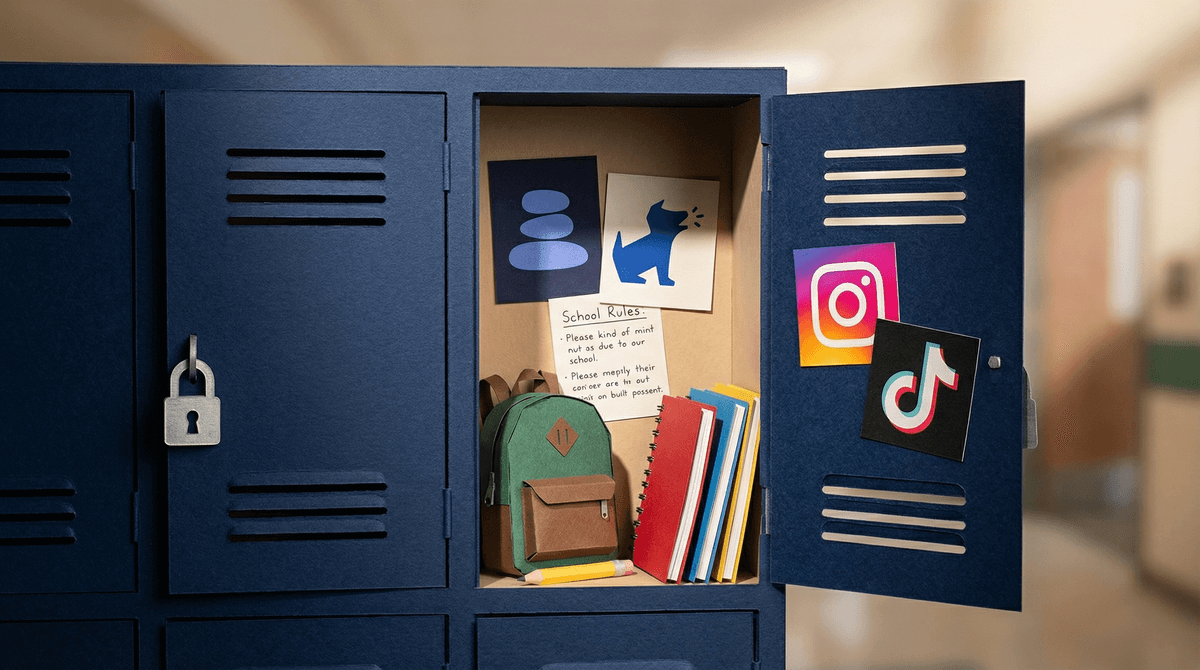
Schools across the country are implementing stricter cell phone policies—and if your kid's school hasn't sent home a letter yet, they probably will soon. We're talking everything from "phones in lockers all day" to "Yondr pouches" (those magnetic locking cases) to "visible = confiscated."
The shift is dramatic. Just a few years ago, most schools had a "just keep it in your backpack" vibe. Now? Seven states have passed laws restricting phone use in schools, and districts everywhere are following suit—even without legislation forcing their hand.
Some schools are going full phone-free (locked up from bell to bell). Others allow phones in hallways but not classrooms. A few are trying "phone hotels" (those pocket chart things) or designated phone breaks. And yes, some schools are still in the "we trust you to self-regulate" camp, though that's becoming increasingly rare.
Look, I get it—your first instinct might be "but what if there's an emergency?!" We'll get to that. But here's what schools are seeing that's driving these changes:
The focus problem is real. Teachers report that even when phones are supposedly "put away," kids are constantly checking them. One buzz, one notification, and attention is gone. Research backs this up—just having a phone nearby, even face-down, reduces cognitive capacity. It's like trying to focus while someone's tapping your shoulder every 30 seconds.
Social media drama is bleeding into classrooms. That Instagram beef from lunch period? It's now playing out via AirDrop and group chats during math class. Teachers are spending more time managing digital drama than teaching actual content.
The bathroom situation. Kids are spending 20+ minutes in bathrooms scrolling TikTok. Some schools have literally had to implement bathroom sign-out sheets because half the class is "using the restroom" at once.
Mental health concerns. There's growing evidence that constant phone access during school hours is linked to increased anxiety, depression, and social comparison. The American Psychological Association has noted that adolescent mental health has declined significantly alongside smartphone adoption—and schools are trying to create at least one phone-free zone in kids' lives.
It's working elsewhere. Countries like France, Finland, and the Netherlands have implemented school phone bans with positive results. Early data from U.S. schools shows similar trends: better focus, more face-to-face interaction, fewer disciplinary issues.
This is the big one, right? Every parent's nightmare scenario is needing to reach their kid during a crisis—or worse, their kid needing to reach them.
Here's the reality: In actual emergencies, phones have been more problematic than helpful. During lockdowns, students texting parents has created chaos—parents showing up at schools, overwhelming 911 systems, and making it harder for first responders to do their jobs. Schools and law enforcement actually recommend that students NOT use phones during emergencies.
For everyday emergencies (kid feels sick, forgot their inhaler, family situation), schools still have office phones. Yes, it's less convenient than texting. But it worked for literally all of human history until 2010, and it still works now.
That said—this fear is valid. You're not being helicopter-y for feeling weird about being unreachable to your kid for 7 hours. It's an adjustment.
Let's be honest about the tradeoffs:
What they're losing:
- The ability to coordinate plans between classes
- Quick photo/video documentation of school moments
- Using their phone as a calculator, camera, or research tool
- That feeling of connection and control that comes from phone access
- The ability to text you "I forgot my cleats" at 10am
What they're potentially gaining:
- Actual face-to-face conversation at lunch
- Better focus in class (whether they want it or not)
- Relief from the pressure to constantly check and respond
- More present engagement with the actual humans around them
- Practice with boredom (which, turns out, is when creativity happens)
The research on this is genuinely interesting—when schools go phone-free, many kids report feeling relieved. Like, they wanted boundaries but couldn't create them themselves. The social pressure to be constantly available is intense , and school policies give them an excuse.
If your school is implementing a new phone policy (or you're considering advocating for one), here's how to make it less painful:
Before school starts:
- Talk about WHY the policy exists—not as punishment, but as a focus tool
- Practice phone-free time at home (dinner, homework, weekend mornings)
- Set up a communication plan: "If you need me, go to the office. If I need you, I'll call the office."
- Get them a watch if time-checking is their main phone use (just a regular watch, not a smartwatch—those are often included in bans)
During the adjustment period:
- Expect some anxiety and pushback—this is normal
- Don't immediately rescue them by texting the office constantly
- Ask specific questions: "What did you do at lunch without phones?" "Did you notice anything different in class?"
- Acknowledge it's hard while holding the boundary
If your kid has legitimate phone-dependent needs:
- Medical devices (diabetes monitors, etc.) are almost always exempted
- Anxiety about emergencies can be addressed with a school counselor
- Kids with IEPs or 504 plans may need accommodations—work with the school
Oh, you thought you found the loophole? Schools are onto it. Many phone policies now include smartwatches, especially ones that can text, access social media, or receive calls. The Apple Watch is basically a tiny phone, and schools know it.
Some schools allow basic fitness trackers (like Fitbits that only track steps). Others ban anything that connects to the internet. Check your specific school policy—this is a moving target.
Some parents are thinking: "What if I just use parental controls to lock their phone during school hours?"
Sure, you could. Apps like Bark or Apple's Screen Time can do this. But here's the thing: if the school policy is "phones must be physically locked up or in lockers," your kid still needs to comply. And honestly? There's something valuable about the physical separation that software controls don't replicate.
Plus, if you're the only parent doing this while the school allows phones, your kid will resent you. If the school is already enforcing it, you're just adding an extra layer of complexity.
Real talk: this is going to be weird socially at first. Kids are used to coordinating everything via text. "Meet me by the gym" happens in group chats, not face-to-face planning.
But here's what schools are seeing after a few months: kids adapt. They make plans in person. They use actual words to communicate. They—and I know this sounds like boomer fantasy—talk to each other at lunch.
There will be a transition period where your kid complains that "everyone else's parents are letting them keep their phones" (they're not) or "I'm the only one who has to follow this rule" (they're not). Hold steady.
School phone policies aren't about being anti-technology or punishing kids. They're about creating a learning environment where focus is possible and social interaction happens in real time.
Will your kid be annoyed? Probably. Will they survive? Absolutely. Will they secretly be a little relieved to have a break from the constant pressure to be online? Maybe more than you think.
The research is increasingly clear: phones in schools are a net negative for learning and well-being. Your kid doesn't need to agree with the policy to benefit from it.
If your school has a new phone policy:
- Read the actual policy (they're usually on the school website)
- Talk to your kid about it before the first day—don't let it be a surprise
- Set up your communication backup plan
- Give it at least a month before deciding it's not working
If your school doesn't have a phone policy:
- Learn more about the research behind phone-free schools
- Talk to other parents—there's often more support for this than you'd think
- Bring it up at a PTA meeting or with administrators
- Start with your own family rules as a pilot
Either way:
- Model phone-free time at home (you can't expect them to do what you won't)
- Create phone-free zones (dinner table, car rides, family game night)
- Talk about why focus matters and how phones interrupt it
- Acknowledge that this is hard—for all of us
The goal isn't to demonize phones. It's to create boundaries that let kids (and adults) be present in the moments that matter. School is one of those moments.