

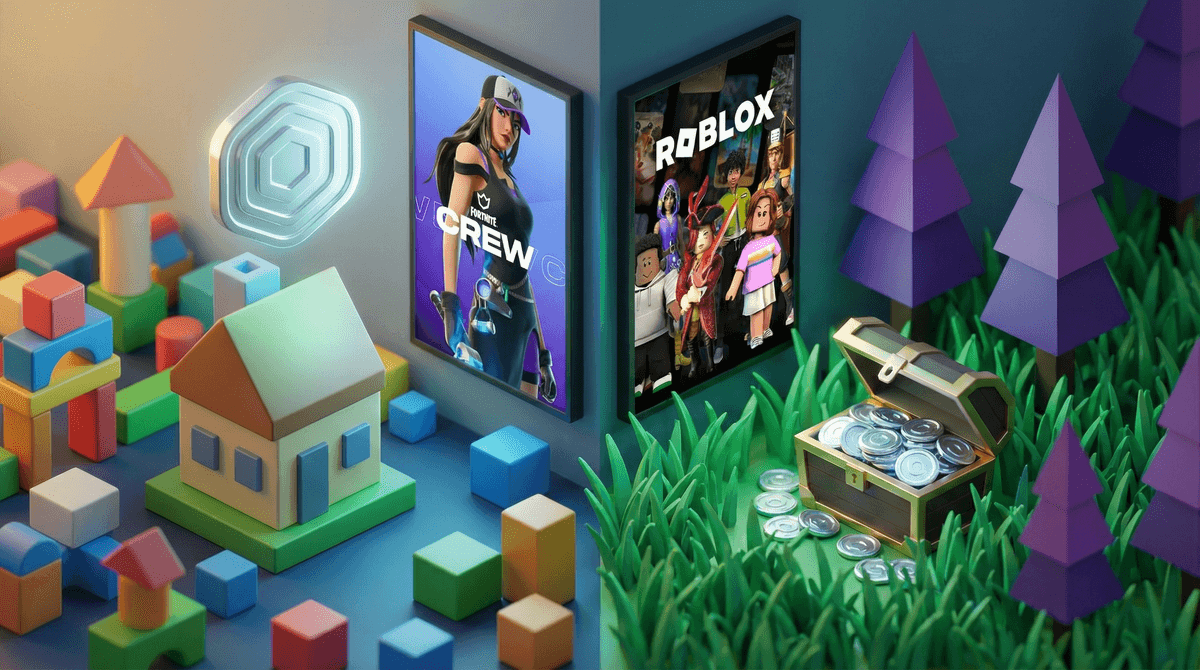
Let's start with the basics: Robux is the virtual currency in Roblox, and V-Bucks are what you spend in Fortnite. They're essentially gift cards that only work in one specific digital universe.
Here's what they actually cost:
- Robux: About 400 Robux for $4.99, or you can get better rates with Roblox Premium subscriptions
- V-Bucks: Usually 1,000 V-Bucks for $7.99, with bulk discounts for larger purchases
Screenwise Parents
See allThe thing is, these currencies are deliberately priced to obscure their real value. That 800 V-Buck skin? That's actually about $6.40. But when you're thinking in V-Bucks instead of dollars, it somehow feels less expensive. This isn't accidental—it's a psychological trick that works on adults too (hello, casino chips).
In both Roblox and Fortnite, these currencies unlock social currency. Your kid isn't just buying a cool outfit—they're buying identity, status, and belonging.
In Roblox, Robux lets kids:
- Customize their avatar with clothes, accessories, and animations
- Access premium games and experiences
- Buy game passes that unlock special abilities
- Trade and create (if they're aspiring game developers)
In Fortnite, V-Bucks are all about:
- Battle Pass access (seasonal content that unlocks challenges and rewards)
- Skins (character outfits that everyone can see)
- Emotes (dances and celebrations)
- Pickaxes, gliders, and other cosmetic items
The important thing to understand: none of these purchases affect gameplay. You can't buy your way to victory. But to kids, looking cool and fitting in with their friends' aesthetic choices feels just as important as winning.
By middle school, about 70% of kids are playing Roblox or Fortnite regularly. And the pressure to spend is real.
The average kid spends between $20-50 per month on gaming currencies, though this varies wildly. Some kids never spend a dime. Others rack up hundreds in accidental or impulse purchases.
Here's what concerns me more than the dollar amount:
The FOMO is engineered. Both games use limited-time offers, rotating shops, and seasonal exclusives to create urgency. Miss today's item? It might never come back. This teaches the opposite of thoughtful spending.
The math is deliberately confusing. Converting Robux or V-Bucks back to real dollars requires actual calculation. Many kids (and honestly, many adults) don't do this mental math before clicking "buy."
The spending is invisible. Unlike handing over cash at a store, digital purchases feel abstract. There's no physical exchange, no wallet getting lighter, no change counting.
Ages 8-10: At this age, kids are just learning about money. If they're playing these games, I'd recommend:
- Set up a prepaid card or gift card system only
- Make purchases together so you can talk through the value
- Establish a monthly budget (maybe $10-15) and help them track it
- Use it as a math lesson—calculate cost per Robux/V-Buck together
Ages 11-13: Middle schoolers can handle more autonomy but still need guardrails:
- Consider tying gaming currency to chores or allowance
- Require a 24-hour waiting period before any purchase over $10
- Teach them to calculate real cost: "That's three hours of babysitting money"
- Let them make some regrettable purchases—buyer's remorse is a powerful teacher
Ages 14+: Teens can learn real financial literacy through gaming currency:
- Give them a fixed monthly entertainment budget they manage
- Encourage them to earn their own money for extras
- Discuss opportunity cost: "Would you rather have that skin or save toward [something bigger]?"
- If they're creating in Roblox, help them understand the creator economy

Turn off one-click purchasing immediately. Both platforms allow you to require password or authentication for every purchase. This prevents accidental clicks and impulse buys.
The "free" Robux/V-Bucks offers are always scams. If your kid is searching for free currency, they're likely to encounter phishing sites, malware, or scams. Have this conversation early.
Battle Passes can be good value—if they'll actually play. For $10-12, a Fortnite Battle Pass provides months of content. But only if your kid actually completes the challenges. Same with Roblox Premium—it can be worth it for active players.
You can set spending limits. Both platforms offer parental controls for spending. Use them. Learn more about Roblox parental controls.
Some kids are actually learning entrepreneurship. In Roblox especially, kids can create games and earn Robux. Some teens are making real money through the DevEx program. If your kid shows interest in creating, this might be worth exploring.
Robux and V-Bucks aren't inherently bad. They're tools that can teach financial literacy, delayed gratification, and value assessment—or they can teach impulse spending and FOMO-driven decisions.
The difference is whether you're actively parenting through it or just handing over the credit card to stop the nagging.
Start with clear boundaries, transparent conversations about real costs, and age-appropriate autonomy. Expect some mistakes—they're cheaper lessons now than when they're 22 with their first credit card.
-
Check your current setup: Do you have purchase authentication turned on? Do you know how much your kid has spent in the last month?
-
Have the conversation: Sit down and calculate together what their recent purchases cost in real money. No judgment, just information.
-
Establish a system: Whether it's a monthly budget, gift cards only, or earned currency through chores, pick something that fits your family values.
-
Use Screenwise: Take our survey to see how your family's gaming spending compares to others in your community, and get personalized recommendations for your specific situation.
And remember: you're not a bad parent if your kid has a Fortnite skin collection. You're also not a bad parent if you say no to all of it. You're just trying to figure out this weird new world where money isn't real and avatars matter. Welcome to the club.