

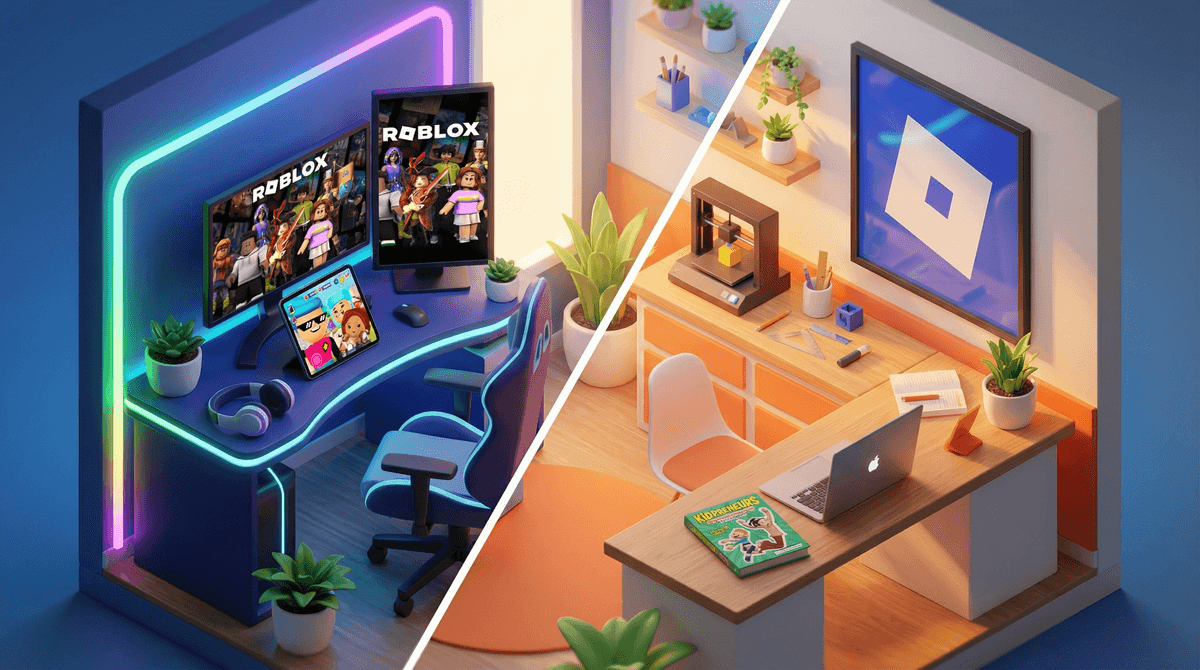
You know what I'm talking about. Your kid can recite every item in the Adopt Me! shop catalog, has memorized the exact spawn times for rare pets in Pet Simulator, and can explain the economic intricacies of limited items with the passion of a Wall Street trader. They'll spend three hours perfecting their avatar but can't remember to brush their teeth.
That hyperfocus? That's Roblox energy. And here's the thing—it's not inherently bad. In our community data, 60% of kids are actively playing on Roblox servers, so if this is your household, you're definitely not alone. The question isn't whether to shut it down entirely (though sometimes we fantasize about it), but how to channel that intense interest into something that builds real skills.
Roblox hits different than traditional gaming because it's not just one game—it's thousands of experiences, many created by other kids and teens. When your child is obsessed with Roblox, they're often obsessed with:
- Creation and building - Roblox Studio lets them make actual games
- Social connection - It's where their friends hang out after school
- Economic systems - Trading, selling, earning Robux
- Achievement and progression - Leveling up, collecting items, completing challenges
- Identity expression - Avatar customization is serious business
The intensity isn't random. These are the same drives that fuel entrepreneurs, designers, and creators. The trick is redirecting that energy before it becomes purely consumptive.
Here's what most parents miss: if your kid is spending hours in Roblox, they're already showing you what interests them. They're giving you a roadmap.
Loves building elaborate houses in Bloxburg? That's architecture and interior design interest.
Obsessed with running a successful restaurant or shop? That's entrepreneurship and customer service.
Constantly scripting new game mechanics? That's computational thinking and problem-solving.
Trading limited items for profit? That's economics and negotiation (and yes, sometimes it's concerning , but it's still a teachable moment).
The goal isn't to replace Roblox entirely—it's to build bridges between their digital passion and real-world skills.
For the Builders (Ages 8-14)
If they love creating in Roblox Studio, introduce them to:
- Physical building challenges - LEGO architecture sets, cardboard construction projects, or even helping redesign their room
- Real coding - Scratch is a natural next step, or Python for older kids
- Game design courses - Many libraries and community centers offer game design workshops
- YouTube tutorials - Help them learn Blender for 3D modeling (yes, it's free)
The bridge conversation: "I noticed you spent two hours building that obstacle course. Want to learn how to make 3D models that you could actually use in other games too?"
For the Entrepreneurs (Ages 9-15)
If they're running virtual businesses or trading items:
- Real-world business projects - Help them start a small business (lemonade stand, pet sitting, selling crafts on Etsy)
- Financial literacy - Open a savings account, teach budgeting, discuss how Robux spending compares to real money
- Business books for kids - The Lemonade War series or Kidpreneur
- Market research - Have them analyze what makes certain Roblox games successful
The bridge conversation: "You're really good at figuring out what people want to buy in your shop. What if we tried that with something in real life?"
For the Social Players (Ages 7-13)
If Roblox is primarily their social hub:
- In-person gaming clubs - Schools and libraries often have Minecraft or board game clubs
- Creative collaborations - Group art projects, neighborhood plays, band practice
- Sports or activity groups - The social aspect matters more than the specific activity
- Hosting IRL hangouts - Game nights, movie nights, craft sessions
The bridge conversation: "I know you love playing with your friends online. What if we invited them over to make something together in person?"
Start with "yes, and" instead of "no, but": Don't position real-world activities as replacements for Roblox. Position them as expansions of what they already love.
Use their screen time as leverage (carefully): "You can earn extra Roblox time by spending an hour on your coding project" works better than "less Roblox, more coding."
Invest in the transition: If they need a Raspberry Pi for a project or supplies for a business idea, consider it an investment in redirecting that energy productively.
Connect with other parents: With 55% of kids gaming regularly in our community, there are definitely other families trying to channel this same energy. Organize group activities.
Be patient with the process: The goal isn't an overnight transformation. It's slowly building real-world skills alongside their digital interests.
Your kid's Roblox obsession isn't something to just tolerate or eliminate—it's information. They're showing you they can focus intensely, learn complex systems, and pursue goals persistently. Those are incredible skills.
The average screen time in our community is 4.2 hours daily, and a chunk of that is likely Roblox. Instead of fighting that reality, work with it. Build bridges between their digital passion and real-world opportunities.
Some kids will naturally transition toward more creation-focused activities. Others will always prefer playing. Both are okay. The goal is simply ensuring they're building transferable skills along the way, whether that's through Roblox Studio, starting a small business, or learning to code.
This week: Observe what your kid actually does in Roblox for a few days. Don't just see "playing Roblox"—see the specific activities. Building? Trading? Socializing? Competing?
Then: Pick ONE bridge activity that connects to their specific interest. Just one. Start there.
Need help figuring out what might work for your specific situation? See how to redirect your kid's Roblox habits about your kid's particular Roblox habits and get personalized suggestions.
The obsession isn't the problem. It's just energy looking for direction. Let's help it find some.