

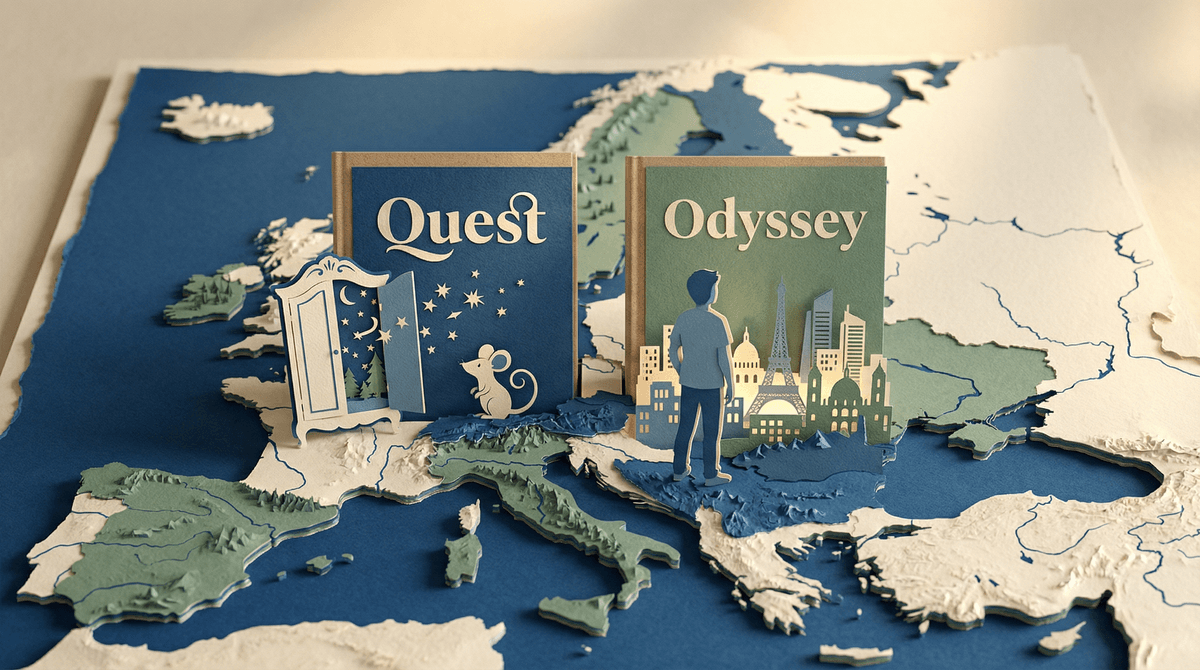
Quest & Odyssey: European Journey Stories That Open Young Readers' Worlds
TL;DR: These two short-story collections from the Aarhus 39 project bring together emerging European writers under 40 to tell original stories about journeys—both literal and metaphorical. Quest (ages 11+) delivers seventeen fantastical tales with talking mice and magical wardrobes, while Odyssey (YA) offers twenty-one more mature stories exploring migration, identity, and coming-of-age. Both are edited by translator Daniel Hahn and published by Alma Books. At £6-7 each, they're an affordable way to expose kids to diverse European voices and cultures.
If you're looking for something beyond the usual American or British children's literature—something that opens a window into how kids and teens across Europe think, dream, and navigate their worlds—these two collections are genuinely special.
The Aarhus 39 project launched at the 2017 Hay Festival with a simple but ambitious goal: gather thirty-nine emerging writers from across Europe (all under 40) and ask them to write original short fiction on the theme of journey. The result is two volumes that feel like literary passports, moving readers from the Russian countryside to modern Rome, from Iceland to Cyprus, from the Basque Country to the Czech Republic.
Most short-story collections for kids are either all fantasy or all realism, all one culture or heavily weighted toward English-language authors. Quest and Odyssey break that mold entirely. You get Basque writers alongside Icelandic ones, Czech storytellers next to Italian voices. The stories themselves range from whimsical to heartbreaking, from talking field mice to teenagers grappling with displacement.
Daniel Hahn, who edited both volumes, is a translator and writer with serious credentials in bringing international voices to English-speaking readers. His curation here is thoughtful—each story is short (10-15 pages), making them perfect for bedtime reading or classroom use, but they're not dumbed down or sanitized. These are real stories with real stakes, just told in digestible chunks.
This 288-page collection is aimed at middle-grade readers (Y6/P7 and up) and leans heavily into the fantastical. The seventeen stories here feature invisible friends, flying kraiks, white elephants, runaway books, and yes, magical wardrobes. But even when the settings are pure fantasy—"dark bedrooms to new dimensions and fantasy realms"—the emotional core is grounded in real kid experiences: loneliness, curiosity, the desire to escape or explore.
What I love about Quest is that it doesn't talk down to its audience. These aren't simple moral fables. They're complex, sometimes strange, often surprising stories that trust kids to sit with ambiguity and wonder. Your 11-year-old might not "get" every story on first read, and that's okay—these are stories that reward rereading and discussion.
Perfect for: Kids who loved The Chronicles of Narnia or A Wrinkle in Time, or anyone ready to graduate from Percy Jackson into something with more literary heft. Also great for reluctant readers—the short format means they can finish a complete story in one sitting and feel accomplished.
The YA volume is 224 pages with twenty-one stories, and this is where things get real. The journey theme expands to include migration, sexuality, identity, displacement, and coming-of-age in all its messy complexity. The tone shifts from playful to dramatic to genuinely poignant, and the settings range from inner-city grit to exotic locales to the interior landscapes of teenage consciousness.
Contributors include Pekka Hiltunen, Finn-Ole Heinrich, Salla Simukka (who Finnish readers might recognize from the Snow White trilogy), and Victor Dixen. The stories tackle mature themes—not gratuitously, but honestly. There's sex and violence and pain, but always in service of character and story.
Perfect for: Teens who are ready for something beyond The Hunger Games or Six of Crows. Also excellent for high school English classes looking to diversify their curriculum beyond the usual American/British canon.
Quest (11+): Generally safe for the stated age range. The fantasy elements might be intense for sensitive kids (there are some darker moments), but nothing graphic or traumatizing. Good bridge between middle-grade fantasy and more complex YA.
Odyssey (YA): The mature themes here—sexuality, migration trauma, identity struggles—mean you'll want to consider your individual teen. A mature 13-year-old might handle it fine; a sheltered 16-year-old might need some context. The stories don't shy away from difficult realities, which is part of their power, but that also means they're not for everyone. If you're unsure, read a few stories yourself first and gauge whether they match your family's values and your teen's readiness.
Cultural context matters: These stories assume a baseline familiarity with European geography and culture that American kids might not have. That's actually a feature, not a bug—it's a chance to pull out a map, talk about different countries, discuss how migration works in Europe versus the US. But be prepared to provide some context.
Translation quality: All stories are translated into English, and the quality is consistently high (thanks to Hahn's editorial oversight). But translation always involves choices, and some cultural references might not land perfectly for English-speaking readers. Again, that's okay—it's part of the learning experience.
Discussion starters: The short format makes these perfect for book clubs or parent-child reading. Finish a story, talk about it over dinner. "What did you think the white elephant represented?" "Why do you think the character made that choice?" These stories reward conversation.
Where to buy: Both volumes are available directly from Alma Books as well as major UK retailers and libraries. Quest is £7.19 (ISBN 9781846884269) and Odyssey is £6.39 (ISBN 9781846884290). That's ridiculously affordable for the quality and scope you're getting.
Look, we all know we should expose our kids to diverse voices and perspectives. But these collections aren't just checking boxes—they're genuinely excellent literature that happens to come from across Europe. The stories are weird and wonderful and sometimes challenging, and they expand what "children's literature" can be.
In an era when American kids are increasingly siloed in their media consumption—YouTube algorithms feeding them more of the same, Netflix recommendations stuck in a loop—books like these offer something genuinely different. They show kids that there are other ways of thinking, other ways of telling stories, other ways of being in the world.
Plus, let's be honest: if your kid is going to spend hours building worlds in Minecraft or exploring fantasy realms in Zelda, wouldn't it be great if they also had some exposure to how European writers imagine fantasy and adventure? These stories offer fresh narrative structures and cultural touchstones that American fantasy often lacks.
Quest and Odyssey aren't perfect for every kid—some will find the stories too strange, too literary, too "foreign." But for the right reader, these collections are transformative. They're the kind of books that stick with you, that change how you think about stories and the world.
At under £15 for both volumes, they're worth taking a chance on. Start with Quest if your kid is 11-13 and loves fantasy. Jump to Odyssey if you've got a teen ready for more complex, realistic fiction. Or buy both and make it a family reading project—one story a week, map on the table, conversation over dinner.
These books won't replace Harry Potter or Percy Jackson in your kid's heart, but they might sit alongside them as something equally valuable: a reminder that the world is bigger and stranger and more wonderful than any single culture can capture.
Next Steps:
- Check your local library first—they might have copies
- Order directly from Alma Books or your preferred retailer
- Start with Quest if you're unsure which to try first
- Explore other international children's literature to keep the momentum going
- Find more short story collections for middle grade readers