

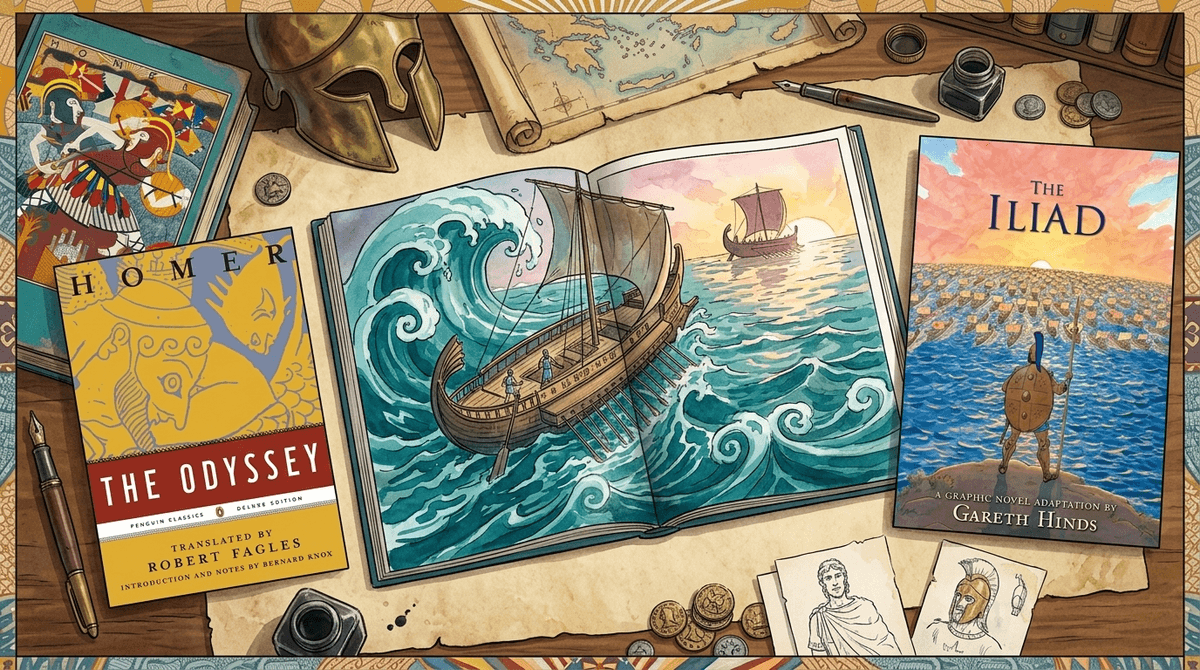
Gareth Hinds’ The Odyssey isn't some "Junior Classics" watered-down version of Homer; it’s a cinematic, watercolor-drenched translation that makes 3,000-year-old poetry feel like a prestige HBO miniseries. It is the ultimate homework shortcut that actually builds a kid’s literary street cred, though it doesn’t shy away from the fact that the Bronze Age was a brutal, bloody, and occasionally scantily-clad place.
Gareth Hinds’ The Odyssey is a stunningly faithful graphic novel adaptation that makes the epic poem accessible and genuinely exciting for middle and high schoolers. It’s a masterpiece of visual storytelling, but parents should be ready for some "ancient world" intensity: graphic mythological violence (eye-gouging, monster-munching) and a brief, stylized depiction of the Sirens. If your kid is moving past Percy Jackson and wants the real deal, this is the gold standard.
And if your kid is heading to theaters for Christopher Nolan's 2026 film adaptation, remember it's rated R — this graphic novel is the gentler way into the same story.
Screenwise Parents
See allLet’s be real: reading a standard translation of The Odyssey can be a slog for a 12-year-old. The "epithets" and the non-linear structure often leave kids (and plenty of adults) checking out by Book 4. Hinds solves this by using the medium of the graphic novel to do the heavy lifting of the "epic" scale.
When Homer spends three pages describing a ship, Hinds gives you a breathtaking two-page spread of the Mediterranean. It allows the reader to focus on the actual meat of the story: Odysseus’s questionable leadership, his desperate need to get home to Penelope, and the fact that Greek gods are basically impulsive toddlers with nuclear-level powers. According to Screenwise data, graphic novels like this are often the "bridge" that keeps reluctant readers engaged with classical curriculum instead of just reading the SparkNotes.
If you’re wondering if this is "safe" for your kid, you have to remember that the source material is essentially the original action-horror movie. Hinds doesn't sanitize it, but he handles it with artistic intent rather than cheap shock value.
This is usually the first "whoa" moment. The Cyclops eats a few of Odysseus’s men, and Hinds doesn't blink—you see the giant snacking on a human limb. The subsequent blinding of the Cyclops with a sharpened, heated stake is rendered in visceral detail. It’s bloody, it’s intense, and it’s exactly what happens in the poem. If your kid has seen a Marvel movie, they can handle it, but it’s definitely "PG-13" in its impact.
The Sirens and the "Scantily Clad" Factor
The Sirens are a frequent point of parent curiosity. In this version, they are depicted as bird-like creatures with the heads and torsos of women. They are technically topless, but Hinds renders them in a way that feels more like a "National Geographic" or classical sculpture vibe than anything sexualized. The focus is on their eerie, hypnotic power and the danger they pose to the crew. It’s a faithful interpretation of the mythology, handled with maturity.
The Bloodbath at the End
The "Slaughter of the Suitors" in the final acts is a high-body-count finale. Arrows through necks, spears through chests—Odysseus isn't a "turn the other cheek" kind of guy. It’s a grim, justice-fueled massacre that reinforces the stakes of the story.
What makes this book worth the shelf space is how it handles the "hero" of the story. Odysseus is a liar. He’s arrogant. He’s a tactical genius, but he’s also the reason most of his men end up dead.
Unlike the simplified heroes in many modern YA series, Hinds’ Odysseus is complicated. This is a gift for parents who want to move beyond "good guy vs. bad guy" narratives. You can actually talk about whether Odysseus is a "good" leader or just a "successful" one.
If your kid finishes this and is actually into the world of Greek myth, don’t let the momentum die.
- Compare the Mediums: If they’re reading the original poem for school, have them keep the Hinds version open next to it. It’s the best "visual dictionary" for the text ever created.
- Explore the "Hinds-verse": Gareth Hinds has done this for The Iliad, Beowulf, and Macbeth. They are all equally high-quality.
- Level Up the Gaming: If they love the aesthetic of the Greek gods here, the game Hades is a masterclass in character design and mythological storytelling (though it’s a "roguelike" and can be frustratingly difficult).
Q: What age is The Odyssey: A Graphic Novel appropriate for? The sweet spot is ages 11 and up (6th grade+). While younger kids who are obsessed with mythology might enjoy it, the complexity of the non-linear storytelling and the graphic nature of the violence make it a better fit for middle schoolers.
Q: Is there any "inappropriate" content in the Sirens scene? The Sirens are depicted as mythological bird-women and are technically topless, but it is rendered artistically and classically rather than provocatively. Most parents find it consistent with what you’d see in an art museum.
Q: How violent is this version compared to the original poem? It is very faithful to the original, which means it’s quite violent. You’ll see men being eaten by monsters and the graphic blinding of a giant. It’s "action-movie" violent, but because it’s watercolor and ink, it feels more like art than a slasher film.
Q: Is this a good substitute for reading the actual book for school? It’s the best companion you could ask for. It shouldn't replace the text if the goal is to study the specific poetry/translation, but it is the best way to ensure a kid actually understands the plot, the geography, and the character motivations.
Gareth Hinds’ The Odyssey is a rare bird: a "classic" adaptation that doesn't feel like a chore. It’s intense, beautiful, and deeply respectful of the source material. If your kid is ready for a more mature look at mythology than Percy Jackson provides, this is the move.
- Check out our best books for kids list for more graphic novel recommendations.
- If your kid is into the "epic" vibe, look at our digital guide for middle school for age-appropriate media that hits the same notes.
- Get a personalized reading list for your kid
