

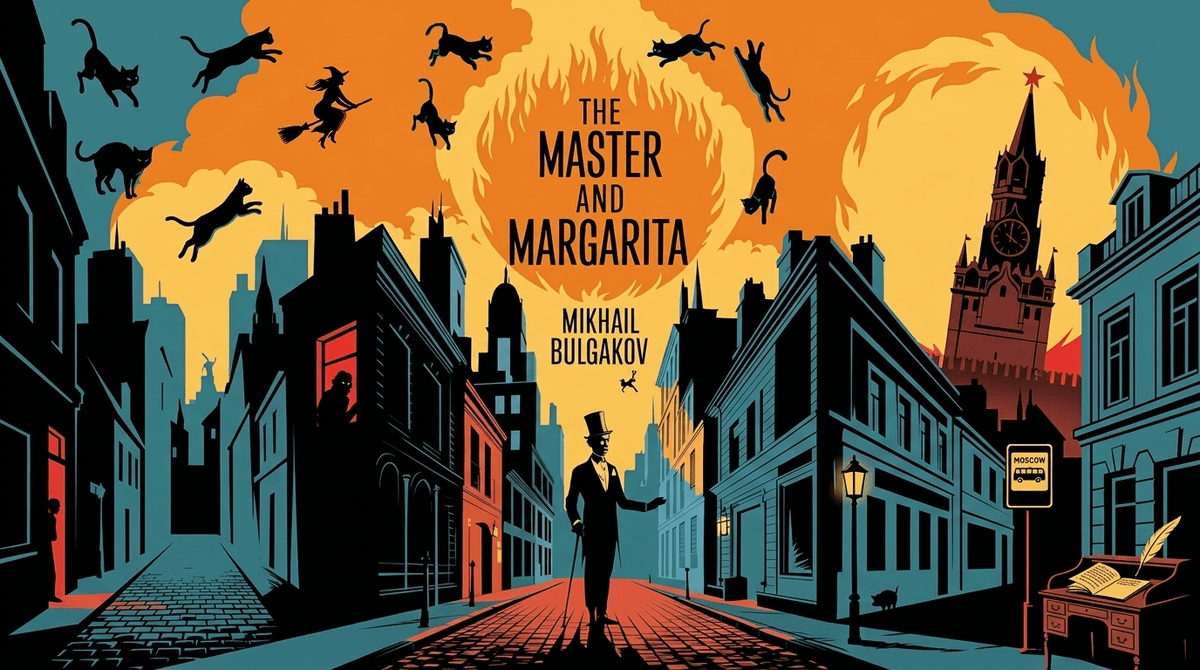
If your teen has been assigned The Master and Margarita or just picked it up because they saw a TikTok about a giant black cat with a penchant for vodka and handguns, they’ve stumbled onto the undisputed "coolest" classic in the literary canon. It is a wild, hallucinogenic ride that manages to be a slapstick comedy, a tragic romance, and a blistering political satire all at once. It also features a significant amount of nudity and a very memorable decapitation in the first few chapters.
The Master and Margarita is a masterpiece of magical realism that is best suited for high schoolers (ages 15+) due to its complex themes, casual violence, and extended sequences of "naturalist" nudity. It’s the perfect choice for a teen who finds The Great Gatsby too dry or 1984 too depressing; it offers the same level of intellectual depth but wraps it in a fever dream of devilish pranks and ancient history.
The Master and Margarita is a brilliant, bizarre Russian classic that follows the Devil’s visit to 1930s Moscow. It’s highly recommended for older teens who enjoy dark humor and "weird" fiction, though parents should be prepared for graphic descriptions of a decapitation and a long sequence where the female lead flies naked through the city. For more high-level reads, check out our best books for kids list.
To understand why this book is a rite of passage for smart kids, you have to understand its structure. Mikhail Bulgakov wrote this in secret while living under Stalin’s regime, knowing it could never be published in his lifetime. That "nothing to lose" energy is on every page. The book jumps between three distinct worlds:
- The Moscow Mayhem: The Devil (going by the name Woland) rolls into Moscow with a troupe of demons, including Behemoth—a giant black cat who talks, drinks vodka, and plays chess. They spend their time pranking greedy Soviet bureaucrats, making people’s clothes disappear in public, and generally exposing the hypocrisy of the state.
- The Master and Margarita: A tragic love story about a broken writer (The Master) who has been institutionalized for writing a book about Jesus, and his devoted mistress (Margarita) who literally makes a deal with the Devil to save him.
- The Jerusalem Chapters: A "realistic" retelling of the trial of Yeshua Ha-Nozri (Jesus) from the perspective of a migraine-suffering Pontius Pilate. It’s stripped of the supernatural and feels like a gritty historical drama.
If you’re vetting this for a 15 or 16-year-old, there are three main things that usually give parents pause. Here is the straight take on them:
The Nudity
Margarita eventually becomes a witch to save the Master. In Bulgakov’s world, witches don’t wear clothes. There is a long, famous sequence where she rubs a magical cream on her body, becomes youthful and invisible, and flies over Moscow on a broomstick. Later, she hosts "Satan’s Ball" wearing only a heavy necklace. It isn’t written as "smut"—it’s written as a symbol of her shedding the suffocating, drab constraints of Soviet society. It’s empowering and artistic, but it is undeniably there.
The Violence
The book opens with a man getting his head sliced off by a streetcar. It’s described with a certain detached, dark-humor clinicality. There are also shootouts involving the demon cat and various instances of people being physically transported or "disappeared." It’s "R-rated" violence, but it’s more surreal than it is sadistic.
The Substance Use
Since this is 1930s Moscow, there is a lot of vodka. Behemoth the cat is frequently seen with a glass in one hand and a pistol in the other. It’s portrayed as part of the chaotic, carnivalesque atmosphere of the Devil’s retinue.
Most "classics" feel like they were written by people who forgot what it was like to be young and annoyed by authority. The Master and Margarita feels like it was written by a rebel.
- The Humor is Dark and Modern: The way the demons troll the "literary elite" feels remarkably like modern internet culture. Behemoth is basically the original "Chaos Gremlin."
- It Validates Their Skepticism: Teens are naturally attuned to hypocrisy. Seeing the Devil expose a bunch of lying, greedy "officials" is deeply satisfying.
- It’s Genuinely Imaginative: From a vampire-demon named Hella to a man whose head is briefly replaced with a suitcase, the imagery is miles ahead of standard high school reading lists.
If your teen finishes this and wants more in this vein, they should look at Good Omens by Terry Pratchett and Neil Gaiman, which carries a very similar "Devil-as-a-protagonist" energy.
If your kid is currently reading it, don't ask them "what happened in the plot" (because they might not even know). Ask these instead:
- "Who is the most 'moral' character?" Interestingly, the Devil in this book isn't the source of evil—he just exposes the evil that’s already in people.
- "Why do you think Margarita had to become a witch to save the Master?" It’s a great way to talk about the sacrifices people make in oppressive systems.
- "What’s the deal with the cat?" Seriously. Every reader has a favorite Behemoth moment.
The biggest hurdle for most readers isn't the content—it's the names. Russian names involve patronymics (Ivan Nikolayevich Ponyryov), and characters are often called by three different names depending on who is talking to them. If your teen is struggling, tell them to print out a character "cheat sheet." It makes the first 50 pages much smoother.
Q: Is The Master and Margarita okay for a 14-year-old? It depends on the 14-year-old, but generally, it’s a better fit for 15 or 16 and up. The political satire requires some knowledge of Soviet history to really "land," and the nudity/violence can be a bit much for younger middle schoolers.
Q: Is there a lot of "adult" content in the book? Yes. Beyond the nudity of the witch sequences and the ball, there are themes of suicide, mental illness, and political execution. However, it is handled with a level of literary sophistication that makes it appropriate for high school students.
Q: Is it a religious book? It uses religious figures (Jesus and Pilate), but it isn't "religious" in a traditional sense. It’s more of a philosophical exploration of cowardice, mercy, and the nature of truth. Even secular families usually find it fascinating rather than offensive.
Q: Which translation is the best for teens? The Burgin and Tiernan O'Connor translation is generally considered the most "readable" and punchy for a modern audience. Avoid the older, censored versions from the 60s if you want the full experience.
The Master and Margarita is the ultimate "brainy teen" book. It’s weird, it’s challenging, and it makes them feel like they’re reading something they shouldn’t be—which is exactly why they’ll actually finish it.
- Check out our digital guide for high school for more age-appropriate media picks.
- If they loved the "magical realism" aspect, suggest The Great Gatsby for a different look at the "Jazz Age" or dive into our best books for kids list.
- Get help picking a next book series
