

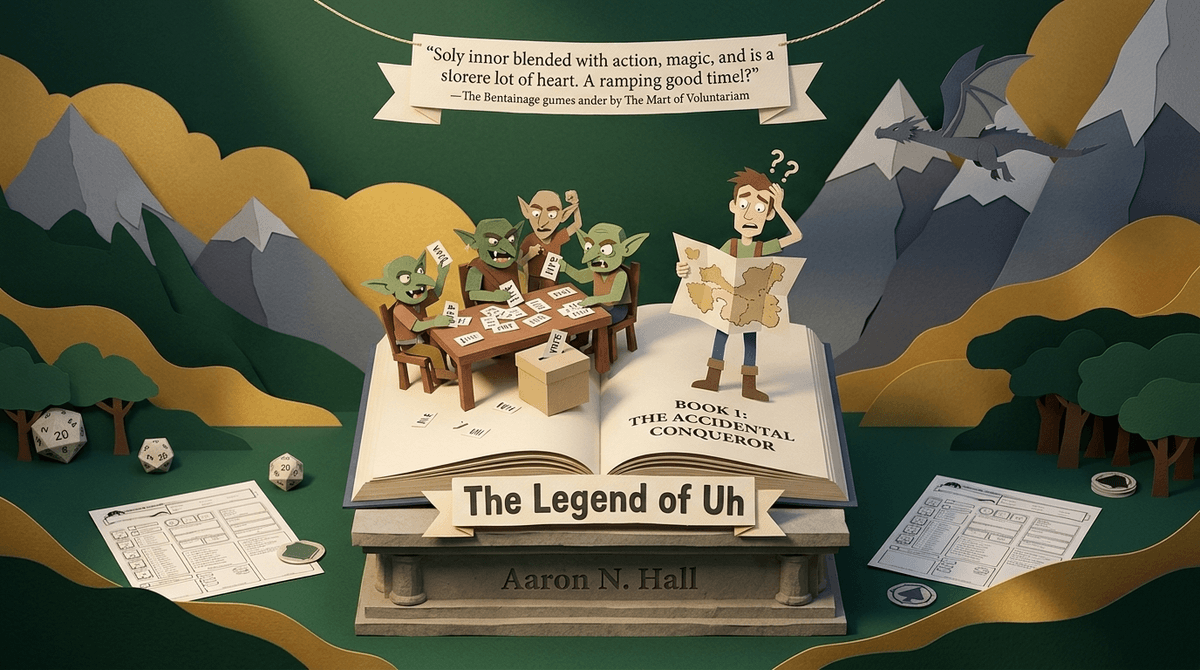
The Legend of Uh is the book series for the kid who thinks traditional fantasy is a little too earnest and a lot too long. It’s a meta-commentary on the entire genre that actually manages to tell a compelling story while making fun of it, making it the perfect bridge for middle schoolers who have graduated from "easy" readers but aren't quite ready—or willing—to slog through a 700-page epic about magic rings.
TL;DR
The Legend of Uh by Aaron N. Hall is a sharp, fast-paced fantasy parody that lands perfectly for kids aged 9–13 who love Dungeons & Dragons or Percy Jackson. It trades "Chosen One" clichés for democratic goblins and self-aware snark, offering a high-engagement read for both bookworms and reluctant readers. For more high-energy picks, check out our best books for kids list.
At its core, the series is a deconstruction of every fantasy trope you’ve ever seen. The protagonist, Uh (yes, that's his name), isn't a hero by choice or even by prophecy—he’s more of a hero by default and mild confusion. Aaron N. Hall writes with the rhythm of a seasoned Dungeon Master who has seen too many players try to "break" the game.
Instead of an ancient, brooding evil, the obstacles are often bureaucratic, social, or just plain weird. It’s a world where goblins have complex voting systems and the "epic quests" often feel like a series of failed skill checks. It’s funny, it’s irreverent, and it respects the reader’s intelligence by assuming they’re already "in" on the joke.
Middle school is the era of the "Internal Cringe Detector." Kids this age are starting to find traditional hero stories a bit saccharine. They want something that acknowledges the absurdity of the world, and The Legend of Uh delivers that in spades.
The "D&D" Logic
If your kid spends their weekends rolling d20s or watching actual-play streams, they will feel seen by this book. The humor relies on an understanding of RPG (Role-Playing Game) mechanics—things like "non-player characters" (NPCs) having their own lives, or the sheer chaos of a plan gone wrong. It’s a literary version of a chaotic-good campaign.
The Meta-Humor
The series doesn't just tell a story; it comments on how stories are told. When Uh questions why a villain is monologuing or why the map is so conveniently laid out, it mirrors the way Gen Alpha and Gen Z consume media—critically and with a side of irony. It’s the same energy found in shows like Hilda or The Last Kids on Earth, where the stakes are real but the vibe remains grounded and snarky.
The Social Satire (Light Version)
The "Democratic Goblins" aren't just a gag; they’re a way Hall sneaks in some actual thinking about how societies work. It’s not a political science textbook, but it does prompt kids to think about why fantasy worlds are always monarchies and what happens when the "monsters" decide they’d rather have a committee.
Parents often ask if "parody" means "crude." In this case, no. The humor is sophisticated but clean.
- Violence: It’s fantasy violence, but it leans heavily into the slapstick. Think "falling off a cliff because of a bad boots-of-speed purchase" rather than graphic combat. It’s less intense than Percy Jackson but more chaotic.
- Language: Very mild. The "Uh" of the title is about as close as it gets to a verbal slip-up. The snark is the sharpest tool in the shed here, not the vocabulary.
- Themes: Underneath the jokes, there’s a solid throughline about identity. Uh has to figure out who he is when he doesn't fit the "hero" mold. It’s a great parallel for the middle school experience of trying to find your niche.
If your kid is already halfway through the series, don't just let it be a passive read. This series is a massive "on-ramp" to other creative outlets.
Ask them about the "Game Logic": Ask which part of the book felt most like a video game or a tabletop session. Kids who love this series often have a high "system literacy"—they understand how rules and world-building work.
Bridge to World-Building: If they love the democratic goblins, they might be ready for more complex world-building. This is a great time to introduce them to Dungeons & Dragons if they haven't started, or even Stardew Valley for a different kind of system-based storytelling.
Try the Audiobooks: Aaron N. Hall’s prose is very voice-driven. If you have a reluctant reader, the audiobooks are a masterclass in comedic timing and can make a long car ride much more bearable for the adults, too.
Parody is a specific itch to scratch. If this series is a hit, here are the "next steps" that hit the same frequency:
- For more snarky fantasy: The Last Kids on Earth. It’s post-apocalyptic rather than high fantasy, but the "kid-led chaos" vibe is identical.
- For the "in on the joke" feel: Hilda (the graphic novels or the show). It treats the magical world with a matter-of-factness that feels very similar.
- For the RPG fans: Dungeons & Dragons. If they're reading about the mechanics, they're ready to play them.
- For the "Chosen One" subversion: Percy Jackson. It’s the gold standard for taking ancient myths and making them feel like they’re happening to a kid with ADHD in New York.
Q: What age is The Legend of Uh appropriate for? The sweet spot is 9 to 13. Younger kids (7-8) might enjoy the slapstick, but they’ll miss about 80% of the meta-humor that makes the book special. Older teens might find it a bit light, but it’s a great "palate cleanser" read.
Q: Is there any "inappropriate" humor in the parody? It’s very safe. The "parody" here is about the tropes of storytelling, not "adult" humor. It stays firmly in the middle-grade lane—think Shrek energy, where the jokes work for kids but keep parents from falling asleep.
Q: My kid doesn't play D&D—will they still get it? Absolutely. While D&D fans get an extra layer of enjoyment, anyone who has ever seen a Disney movie or read a fairy tale will understand the tropes being poked. It’s a "fantasy literacy" book more than a "gaming" book.
Q: Is The Legend of Uh better than Percy Jackson? They’re different flavors. Percy Jackson is an action-adventure with jokes; The Legend of Uh is a comedy with adventures. If your kid wants to feel like a hero, go Percy. If they want to laugh at how weird heroes are, go Uh.
The Legend of Uh is a win for intentional parents because it encourages kids to be critical consumers of the stories they’re told. It’s funny, it’s fast, and it doesn't talk down to them. In a landscape of very "serious" middle-grade fantasy, it’s a breath of fresh, slightly sarcastic air.
- Explore our digital guide for middle school for more age-appropriate media.
- Check out the best books for kids for our full list of WISE-scored titles.
- Find more fantasy parodies
