

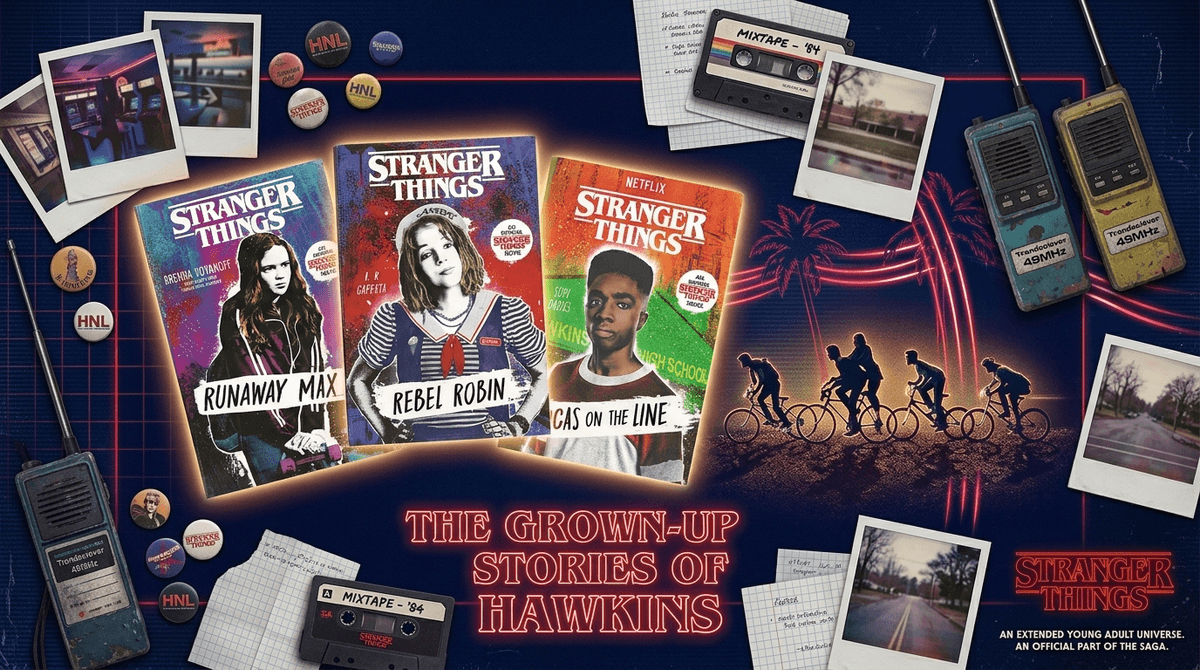
The official Stranger Things prequel novels—Runaway Max, Rebel Robin, and Lucas on the Line—are significantly more "YA" than "Middle Grade," ditching the monster-of-the-week thrills for some very real, very heavy character studies. If your kid is cruising through the show and wants more, these books deliver, but they trade the Demogorgons for internal demons like domestic abuse, systemic racism, and the crushing weight of being an outsider in the 1980s.
TL;DR: The Stranger Things boxed set is a great deep dive for fans, but parents should know these books lean into heavy themes like physical abuse in Runaway Max and systemic racism in Lucas on the Line. They are best for readers aged 12 and up who can handle the "real world" trauma that the Stranger Things TV show often keeps in the background.
When a show gets as big as Stranger Things, the tie-in books are usually an afterthought—lazy novelizations or "choose your own adventure" fluff. This boxed set is different. These are standalone novels written by established YA authors who clearly got the memo to "make it hurt."
In the show, we see the Upside Down. In the books, we see the inside of the characters' heads. For a middle schooler, that transition can actually be more jarring than a jump-scare. The monsters in these books don't have teeth; they have social expectations and broken homes.
Runaway Max by Brenna Yovanoff: The Anatomy of an Abusive Home
If you thought Billy was just a "misunderstood jerk" in the show, this book will set you straight. Runaway Max is a prequel that follows Max’s life in California before she moved to Hawkins.
The Heavy Stuff: This is essentially a book about domestic violence. It details the physical and psychological abuse Max and her mother endure at the hands of Neil (Billy’s dad) and the way Billy mirrors that violence toward Max. It’s gritty, claustrophobic, and doesn’t pull punches. Max’s "cool skater girl" persona is revealed as a survival mechanism.
Why it’s worth it: For a kid who already loves Max, this adds massive layers to her character. It turns her from a "token girl" in the party to a resilient survivor. It’s a masterclass in showing how trauma shapes personality, but it’s a tough read for kids who aren't ready for realistic depictions of a toxic household.
Rebel Robin by A.R. Capetta: The "Otherness" of the 80s
Set during Robin’s sophomore year, this book tackles the internal monologue of a girl realizing she’s gay in a town that doesn’t even have a word for it yet.
The Heavy Stuff: While not "dark" in the violent sense, it’s heavy on existential dread. Robin feels like an alien in her own skin. The book explores the "Operation Europe" plan she mentions in Season 3 and her desperate need to escape a culture that feels designed to exclude her.
Why it’s worth it: It’s a fantastic look at identity and the importance of finding your people. If your kid is an "outsider" or just loves Robin’s fast-talking wit, this book explains exactly where that armor came from. It’s the lightest of the three, but it’s deeply emotional.
Lucas on the Line by Suyu J. Zeyi: The Reality of being Black in Hawkins
This is the most "important" book in the set and arguably the best written. It takes place during the events of Season 4, filling in the gaps of Lucas’s decision to join the basketball team.
The Heavy Stuff: The show touches on the racism Lucas faces (mostly through Billy), but this book dives into the systemic stuff. It explores the microaggressions from his teammates, the pressure to be "twice as good," and the realization that the town he’s saving doesn’t necessarily want to save him back. It deals with the 1980s racial landscape in a way that feels very modern and very urgent.
Why it’s worth it: Lucas is often the most grounded member of the party, and this book gives him the spotlight he deserves. It’s a great conversation starter about how "saving the world" looks different depending on who you are.
The biggest friction point isn't the "scary" stuff—it's the maturity of the themes. These books are written for the "Upper Middle Grade" and "Young Adult" audience. If your kid is 10 and loves the show for the monsters and the D&D, these books might feel "boring" or "too sad."
Pro-tip: If your kid is a reluctant reader, start with Runaway Max. It has the most direct ties to the show's lore and moves at a faster clip. If they’re more into social justice or character-driven stories, Lucas on the Line is the clear winner.
- On Billy and Max: "The book shows a lot more of why Billy acted the way he did. Does understanding someone’s trauma make their actions okay, or just more understandable?"
- On Robin’s 'Alien' Feeling: "Robin feels like she’s from another planet because she doesn't fit in. Have you ever felt like you had to put on a performance to fit in at school?"
- On Lucas’s Choice: "Lucas joins the basketball team to feel 'normal' and popular. Do you think he was betraying his friends, or just trying to survive in a town that treats him differently?"
Q: Do you need to have seen the show to understand the books?
You definitely need to be through Season 3 for Runaway Max and Rebel Robin, and you should be watching Season 4 alongside Lucas on the Line. Without the show context, these books lose about 50% of their impact.
Q: Is there any graphic content?
There’s no "Game of Thrones" level graphic content, but the descriptions of physical abuse in Runaway Max are intense. There is some mild language (consistent with the show) and some teenage romance/crushes, but nothing explicit.
Q: Which book is the darkest?
Runaway Max is the darkest because of the domestic violence. It deals with a child being afraid in their own home, which hits harder than a monster in the woods for many readers.
Q: Are these books "canon"?
Yes, these are officially licensed by Netflix and are considered part of the "expanded universe." They don't contradict the show; they just add the "why" behind the "what."
If your kid is a Stranger Things superfan, this boxed set is a high-value purchase. They are genuinely good books, not just cheap merchandise. Just be ready for the fact that they deal with the "Upside Down" of the human experience—abuse, prejudice, and isolation—more than they deal with interdimensional portals.
Get help picking a next book series
Next Steps
- For more great reads for this age group, check out our best books for kids list.
- Navigating the jump from elementary to middle school media? See our digital guide for middle school.
- If they've finished the books and the show, try these cozy games for kids to decompress.