

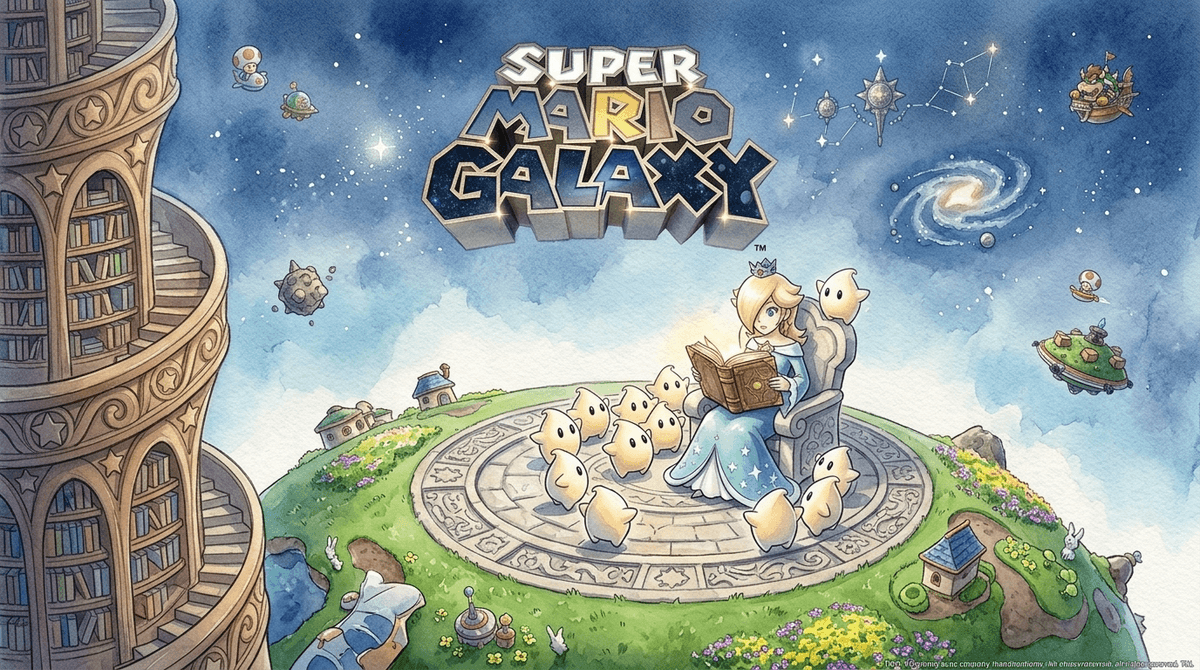
Rosalina’s Storybook is the emotional gut-punch hiding inside the bright, gravity-defying world of Super Mario Galaxy. While the rest of the game is about triple-jumping off planetoids and collecting star bits, this optional side-story is a beautifully illustrated, nine-chapter meditation on death, loneliness, and the families we build when our original ones are gone. It’s not "too much" for kids, but it is a massive tonal shift that catches many parents off guard when their seven-year-old suddenly wants to talk about where mothers go when they die.
TL;DR: Rosalina’s Storybook is an unlockable narrative in Super Mario Galaxy (and the Super Mario 3D All-Stars collection) that uses a picture-book format to explain the origin of the character Rosalina. It’s a masterclass in introducing heavy themes like grief and permanent loss to children through the safety of a "found family" narrative. If your kid is engaging with it, they aren't just playing a platformer; they’re engaging with a sophisticated piece of digital literature that treats them like they can handle the truth.
In the Comet Observatory (the game's hub world), there’s a Library. As kids progress through Super Mario Galaxy, Rosalina reads chapters of her book to a group of Lumas (the little star creatures). The art is flat, painterly, and nostalgic—a far cry from the 3D kinetic energy of the main game.
The story follows a young girl who finds a spaceship and a lonely Luma waiting for its mother. She joins the Luma on a quest through the cosmos to find her, only to eventually realize two things: the Luma’s mother isn't coming back, and neither is her own.
Most Mario games have the emotional depth of a puddle—and that’s fine; we’re here for the mechanics. But Rosalina’s story is different because it doesn't use "video game logic" to solve the problem of death. There is no 1-Up mushroom for Rosalina’s mom.
The Realization of Permanence
In Chapter 4, "The Dream," Rosalina looks at her home planet through a telescope and sees the hill where she used to go sledding with her father and brother. She realizes that her mother "is sleeping under the tree on the hill." This is a direct, albeit gentle, reference to a grave. For a kid, seeing a powerful, god-like character like Rosalina deal with the same "forever-ness" of loss that they might be curious about is incredibly validating.
The Pivot to Found Family
The story doesn't end in a hole. It ends with Rosalina deciding to become the "Mother" to the Lumas. It’s a pivot from being a grieving child to being a caretaker. This is "Found Family" 101. It teaches kids that while you can't replace what you lost, you can build something new that is just as meaningful.
You’d think kids would skip the reading to get back to the jumping, but Screenwise data and community feedback suggest the Library is often a kid’s favorite part of the game. Here’s why:
- The Secret Lore Factor: Kids love feeling like they know the "true story" behind a character. Knowing why Rosalina is sad/stoic makes them feel like they’re in on a secret.
- The Music: The "Luma" theme that plays during these segments is a waltz that is intentionally designed to trigger nostalgia. It’s "core memory" music.
- Safe Spookiness: The vastness of space and the idea of being lost is "scary-lite." It allows kids to explore the feeling of being small in a big universe from the safety of their couch.
If your kid spent more time in the Library than in the actual levels, they’re likely looking for games and stories that have an "emotional atmosphere." They want more than just a high score; they want a vibe.
For the "Atmospheric Explorer"
If they liked the lonely, cosmic feeling of the storybook, try A Short Hike. It’s a tiny, perfect game about a bird climbing a mountain to get cell service to talk to her mom. It deals with anxiety and family in a way that feels just as gentle and "real" as Rosalina’s book.
For the "Big Questions"
If they’re ready for the "heavy hitters" of grief in gaming, Spiritfarer is the gold standard. You play as a ferrymaster to the deceased. It’s beautiful, it’s about saying goodbye, and it’s a management sim that feels like a warm hug. It’s a step up in complexity from Mario, but for a kid who was moved by Rosalina, it’s the natural next step.
The Book Connection
In the world of physical books, The Wild Robot by Peter Brown hits almost identical notes. It’s about a robot who becomes an accidental mother to a gosling. It deals with nature, death, and the "found family" theme with the same sophisticated simplicity as the Mario Galaxy storybook.
You don't need to sit them down for a "Talk About Death." Just wait for them to finish a chapter and ask one specific thing.
The Pro-Tip: Ask, "Why do you think Rosalina decided to stay in space instead of going back home?"
This gets them thinking about the difference between "moving on" and "moving forward." Rosalina can't go back to the way things were because her mom isn't there, so she creates a new home. It’s a massive concept wrapped in a Nintendo skin.
Q: Is Rosalina’s Storybook too sad for a 6 or 7-year-old? No, but it might make them contemplative. It doesn't show anything graphic; it uses metaphors like "sleeping under the tree." It’s a great litmus test for their emotional maturity. If they’re bored, they’ll skip it. If they’re ready, they’ll be mesmerized.
Q: Do you have to read the storybook to finish Super Mario Galaxy? Technically, no. It’s optional content. But skipping it means missing the entire narrative heart of the game. If your kid is a "completionist," they will find it.
Q: Is there a physical version of the book? Nintendo has never released an official standalone physical book (missed opportunity, honestly), but you can find "read-aloud" versions on YouTube if you want to see the art and text without playing the game.
Rosalina’s Storybook is the reason Super Mario Galaxy is considered a work of art and not just a great toy. It’s a rare moment where a massive franchise trusts kids enough to tell them a sad story. Don't worry about the "heaviness"—the game balances it out with enough joy to keep it from being a downer. Just be ready for a slightly deeper conversation than "How many stars did you get?"
- Check out our best games for kids list for more titles with great storytelling.
- If your kid is into the "Found Family" vibe, look at our digital guide for elementary school for age-appropriate media that hits those themes.
- Find more games with deep lore
