

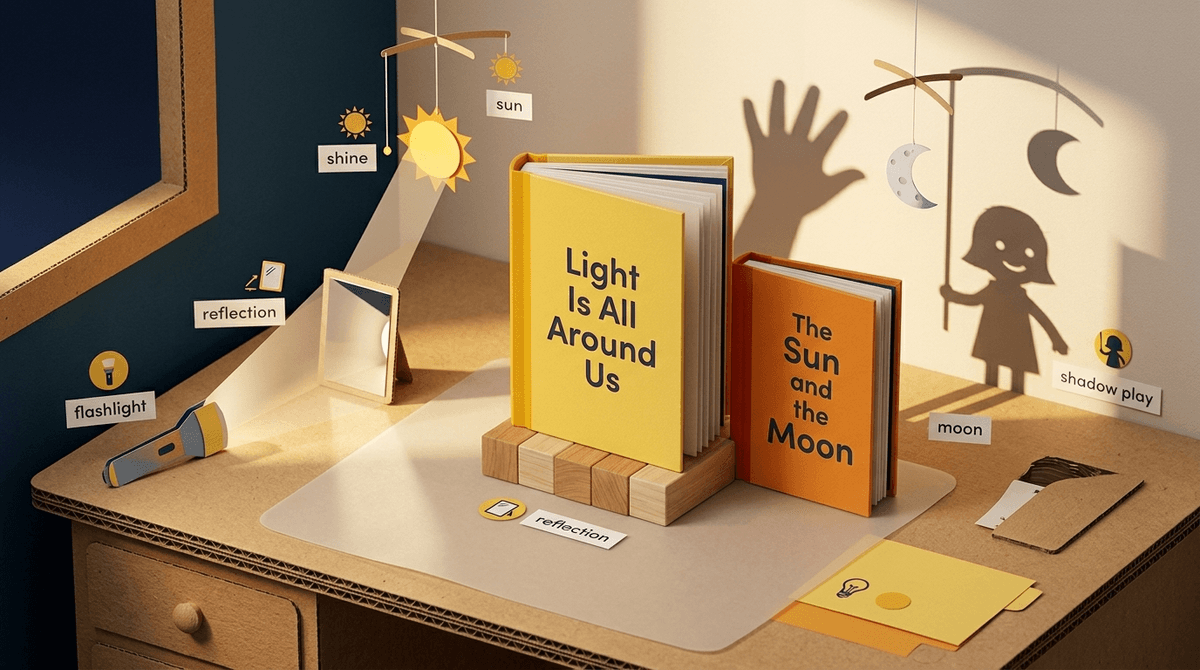
Light Is All Around Us is the rare science book for the K-2 crowd that doesn’t feel like a chore to read aloud; it takes abstract physics—photons, reflection, and the movement of the sun—and makes them as tangible as a game of flashlight tag. It’s part of the legendary Let's-Read-and-Find-Out Science series, and it earns its shelf space by respecting a 6-year-old’s intelligence without drowning them in jargon.
Light Is All Around Us is a standout STEM staple for ages 4-8 that explains how light travels and how shadows are formed through clear visuals and simple, at-home experiments. It’s the perfect anchor for turning a sunny afternoon into a legit physics lesson, especially when paired with curiosity-driven media like the Brains On! podcast. For more science-heavy hits, check out our best books for kids list.
If you’ve spent any time in the children’s section of a library, you’ve seen these books. They’ve been around since the 60s, but they’ve been updated enough that they don't feel like a time capsule. Light Is All Around Us is a "Stage 2" book, which in this series' language means it’s for kids who are starting to handle more complex ideas but still need a heavy assist from the illustrations.
The vibe here isn't "I am teaching you science." It’s "Look at this cool thing that’s happening right in front of you." It starts with the sun, moves to the moon, hits on reflection, and finishes with how we see in the dark. It’s a linear, logical progression that builds a foundation for actual scientific literacy before they ever hit a middle school lab.
What makes this book a winner is that it doesn't ask you to go to the store. The "experiments" are things you’re already doing, just framed with a bit more intentionality.
Shadow Play and Sun Tracking
The book excels at explaining the relationship between the sun’s position and the length of a shadow. It’s a concept that’s hard to explain with words but easy to show with the book’s diagrams. It turns a walk to the park into a "where is the sun?" game. If your kid gets obsessed with the celestial side of this, The Sun and the Moon is the natural next step.
Mirrors and Reflection
It tackles the "how do we see?" question by explaining that light bounces. It’s a simple concept that usually blows a 5-year-old’s mind. The book encourages using a mirror and a flashlight to see where the light goes—low tech, high engagement.
Night Vision (Or Lack Thereof)
The final section on how we see at night—and why we can’t see in total darkness—is a great bridge for kids who might be a little nervous about the dark. It turns "scary" into "scientific."
If this book lands well, don't stop there. The "obsessed with how things work" phase is a great time to introduce media that reinforces these concepts without feeling like "school at home."
The "I Want to See It" Category
- StoryBots: Answer Time: Specifically the episodes on how eyes work or how the sun shines. It’s fast-paced, funny, and shares the same "ask a question, get a real answer" DNA as the book.
- Emily's Wonder Lab: If the experiments in the book felt too tame, Emily Caliandrelli brings the "big science" energy that 6-year-olds crave.
The "I Want to Do It" Category
- Little Alchemy 2: This is a great "waiting in line" game. It’s a puzzle where you combine elements (like Air + Fire) to create new things. It reinforces the idea that the world is made of building blocks.
- Toca Lab: Elements: A digital chemistry set that lets kids experiment with "elements" in a way that’s purely about discovery, not following a recipe.
The "I Want to Hear It" Category
- Brains On!: This is the gold standard for science podcasts. They have several episodes on light, color, and the sun that pair perfectly with a reread of the book.
- Wow in the World: For a slightly more "zany" approach to scientific discovery, Guy Raz and Mindy Thomas hit that sweet spot for the elementary school set.
Don't just read the book and put it back on the shelf. The whole point of a book like this is to change how the kid sees their actual environment.
- The Shadow Trace: Take some sidewalk chalk outside at 10 AM, 1 PM, and 4 PM. Trace their shadow in the same spot each time. It’s the book’s core lesson brought to life.
- Flashlight Tag (Science Edition): Use a flashlight in a dark room to "catch" reflections off different surfaces (mirrors, spoons, windows). Ask them why the light bounces off the spoon but not the rug.
- The "Why" Audit: When they ask "Why is the sky blue?" or "Where does the sun go?", don't feel like you have to have the PhD answer ready. Use the book’s logic: "Let’s look at how the light is moving."
The "Stage 2" label on the cover can be misleading. It’s not about the reading level—it’s about the conceptual depth. A 4-year-old will love the pictures and the basic idea of shadows, but an 8-year-old will actually understand the mechanics of light travel. It’s a book that grows with them. If you have a reluctant reader, the clear, labeled diagrams are a great way to keep them engaged without overwhelming them with blocks of text.

Q: What age is Light Is All Around Us appropriate for? The sweet spot is 4 to 8 years old. Younger kids (4-5) will enjoy the shadow activities and the "seek and find" nature of the illustrations, while older kids (7-8) can actually read it themselves and grasp the physics of reflection and light waves.
Q: Is this book part of a specific curriculum? While it aligns with many Next Generation Science Standards (NGSS) for early elementary school, it’s designed as a trade book for home use. It’s a "living book" that teaches science through narrative and observation rather than rote memorization.
Q: Do I need to buy any special equipment to do the activities in the book? No. Everything mentioned—mirrors, flashlights, shadows, and water—is stuff you already have. It’s very much a "kitchen table science" kind of experience.
Q: How does this compare to other STEM books like the Magic School Bus? The Magic School Bus is great for high-concept, imaginative journeys, but Light Is All Around Us is more grounded. It focuses on things the child can actually see and touch in their own backyard, making the science feel more immediate and less like a "cartoon" world.
Light Is All Around Us is a "buy" for any family that wants to foster a scientific mindset without the pressure of "lessons." It’s clear, it’s durable, and it actually explains the why behind the world.
- Dive into our digital guide for elementary school for more age-appropriate media picks.
- Explore the full best books for kids list to find your next read-aloud.
- Check out our best podcasts for kids to keep the science conversation going in the car.