

Look, we all like to think we're too smart to fall for scams. We delete those "Nigerian prince" emails without a second thought, roll our eyes at obvious phishing attempts, and assume our kids have inherited our BS detectors. But here's the thing: online scams have evolved, and they're specifically targeting the spaces where our kids spend their time.
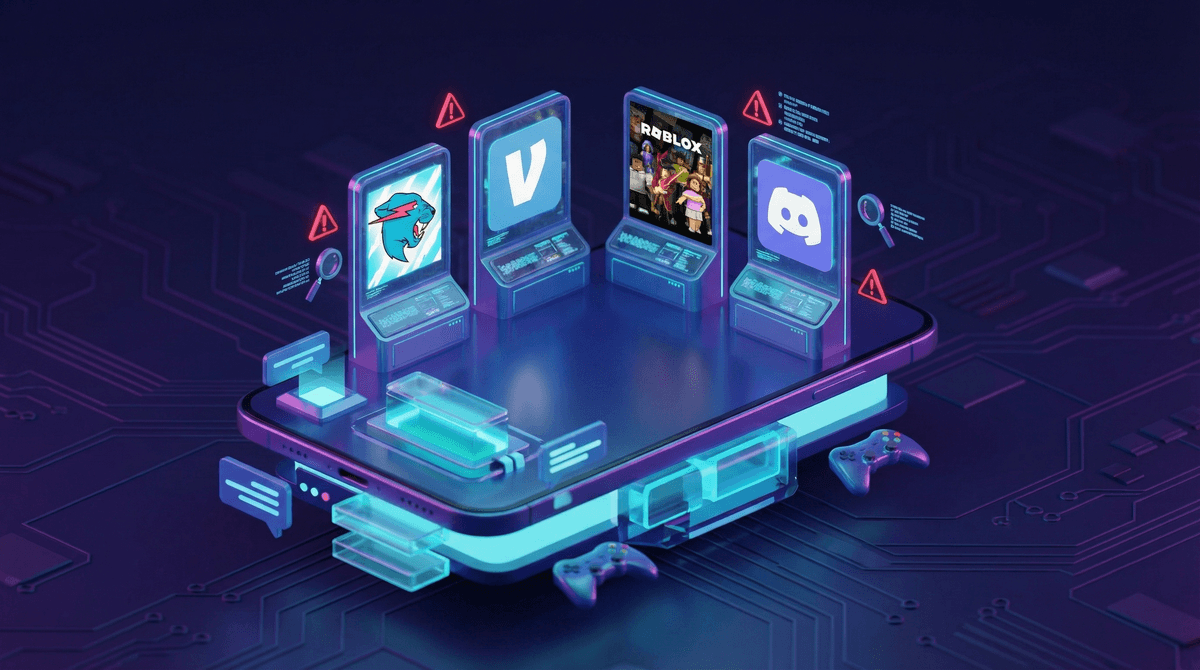
We're not talking about sketchy emails from fake banks anymore. Today's scams show up in Roblox as "free Robux generators," on YouTube as fake MrBeast giveaways, in Discord servers promising exclusive game items, and through Instagram DMs that look exactly like messages from their friends. They're designed to exploit the exact things that make kids, well, kids: trust, excitement, FOMO, and that beautiful naivety that hasn't yet been crushed by adult cynicism.
The worst part? These scams aren't just stealing lunch money anymore. They're after account credentials, personal information, and yes, real money—often through gift cards, which are basically untraceable cash for scammers.
Kids are actually the perfect target for modern scammers, and it's not because they're dumb. It's because:
They don't have the pattern recognition yet. You've probably seen a thousand variations of "Click here to claim your prize!" over the years. Your kid? This might be their first rodeo.
The scams show up in their trusted spaces. When something appears inside Fortnite, on their favorite YouTuber's comment section, or in a Snapchat from what looks like their friend's account, their guard is down. These aren't strangers in dark alleys—these are scams disguised as part of their normal digital life.
FOMO is real. "Only 5 spots left!" "Expires in 10 minutes!" "Your account will be deleted if you don't verify NOW!" Kids don't have the executive function to pause and think critically when they're panicking about missing out or losing something important.
They want to be helpful. Some scams work by making kids think they're helping a friend who's "locked out of their account" or needs them to "test a link." Kids' natural desire to help their friends makes them vulnerable.
Free V-Bucks/Robux/Premium Currency Scams
This is the big one. Your kid sees an ad, a YouTube video, or a website promising free currency for their favorite game. They just need to "verify" by entering their account credentials, or complete a survey, or download an app. Spoiler: there is no free lunch, and there are no free V-Bucks.
These scams either steal their account credentials (which then get used to steal the account or scam their friends), install malware, or rope kids into endless survey loops that make money for the scammers while delivering nothing.
Fake Giveaways
Scammers create accounts that look exactly like popular YouTubers, streamers, or influencers (we're talking pixel-perfect copies) and announce "giveaways" in comments or DMs. To enter, kids just need to click a link, enter their info, or send a "small processing fee" via gift card. The real creator has no idea this is happening.
Phishing Through Gaming Platforms
Your kid gets a message that looks like it's from Roblox, Epic Games, or Discord saying there's a "security issue" or they've "won a prize" and need to verify their account by clicking a link. That link goes to a fake login page that looks identical to the real thing, and boom—credentials stolen.
The "I Got Hacked" Friend Scam
A friend's account gets compromised, and the scammer uses it to message everyone on the friend list: "Hey, I accidentally reported your account, you need to talk to this Discord mod to fix it" or "Check out this cool game I made!" The links lead to credential theft or malware.
Too-Good-To-Be-True Marketplace Deals
On platforms like Roblox, Discord, or even eBay, scammers offer rare items, accounts, or game currency at suspiciously low prices. They ask for payment through gift cards, Venmo, or other non-refundable methods, then vanish. Or they ask you to "go first" in a trade and never hold up their end.
Here's what you need to drill into their heads (and honestly, it's good for us adults too):
- If it seems too good to be true, it is. No one is giving away free Robux. No one. Not even if the website looks legit.
- Legitimate companies never ask for your password. Not in emails, not in DMs, not anywhere. If someone asks for your password, it's a scam. Period.
- Check the URL carefully. Scammers use URLs like "r0blox.com" (with a zero) or "discrod.com" that look right at first glance but aren't.
- Urgency is a manipulation tactic. "Act now or lose your account!" is designed to make you panic and skip thinking critically.
- Gift cards = red flag. If anyone asks for payment in gift cards—whether it's for a "prize processing fee" or to "verify" something—it's 100% a scam.
- Verify through official channels. If they get a message claiming to be from a company, don't click the link. Go directly to the official website or app and check there.
The goal isn't to make kids paranoid about every click—it's to build their critical thinking skills. Here's how to approach it:
Make it a conversation, not a lecture. Ask them: "Have you ever seen those 'free Robux' things? What do you think about them?" Let them tell you what they've encountered.
Share your own experiences. "I got a text today that said my package couldn't be delivered and I needed to click a link. It looked so real! But then I realized I'm not expecting any packages, so I deleted it." Normalizing skepticism is key.
Role-play scenarios. "What would you do if you got a message from my account asking you to click a link? What if it said it was an emergency?" Help them think through their response before they're in the moment.
Emphasize: come to me first. Make it clear that if they're ever unsure, excited about something that seems amazing, or worried they've made a mistake, they should come to you before clicking, sharing info, or sending money. And critically—no punishment for asking. If they're afraid of getting in trouble, they won't tell you when something goes wrong.
Ages 6-9: At this age, kids should have very limited independent online access, but they still need to learn basics. Teach them: never share passwords with anyone (except parents), if something asks for personal information, get a parent, and if something seems "too cool," check with a grown-up first.
Ages 10-13: These kids are navigating more independence online but still lack sophisticated critical thinking. Focus on the red flags above, practice identifying fake vs. real messages together, and set up parental controls on their gaming platforms. Consider using their real experiences—"Did you see that comment on your YouTube video about free V-Bucks? Let's look at it together."
Ages 14+: Teens need to understand not just how to protect themselves, but how scams work and why. They're sophisticated enough to understand the economics: "Scammers aren't doing this for fun—it's a business that makes millions by exploiting people's trust and excitement." Talk about how their accounts could be used to scam their friends if compromised. Discuss the permanence of financial scams and identity theft.
First: don't freak out. I know, easier said than done, especially if money's involved. But if your kid thinks they're going to be in massive trouble, they won't tell you next time until it's way worse.
Immediate steps:
- Change passwords immediately on any accounts where credentials were shared. Use unique, strong passwords for each account.
- Enable two-factor authentication everywhere possible.
- Check for unauthorized purchases on any linked payment methods.
- Report the scam to the platform where it occurred (Roblox, Discord, etc.) and to the FTC at reportfraud.ftc.gov.
- Monitor accounts closely for the next few weeks for any suspicious activity.
- If money was lost, contact your bank or credit card company immediately. Depending on the method, you might be able to recover funds.
Then, and this is important: use it as a learning opportunity, not a shame session. "These scams are designed by professionals to trick people. Even adults fall for them. Let's figure out what happened and what to watch for next time."
Online scams aren't going anywhere—they're getting more sophisticated, more targeted, and better at exploiting the psychology of kids and teens. But here's the good news: critical thinking is learnable, and kids who understand how scams work are dramatically less likely to fall for them.
The goal isn't to make your kids afraid of the internet. It's to make them skeptical in a healthy way, to give them the tools to pause and evaluate before clicking, and to ensure they know they can always come to you when something feels off.
Because at the end of the day, the best defense against scams isn't perfect parental controls or blocking every website—it's a kid who thinks "wait, this seems weird" and knows they can ask for help without judgment.
- Have a casual conversation this week about whether they've seen any "free" offers online and what they thought about them
- Review the red flags list together and ask if they've encountered any of these situations
- Set up (or review) two-factor authentication on their most-used accounts
- Learn more about keeping gaming accounts secure

- Make sure they know your "no judgment" policy for coming to you when something seems suspicious or if they think they've made a mistake