

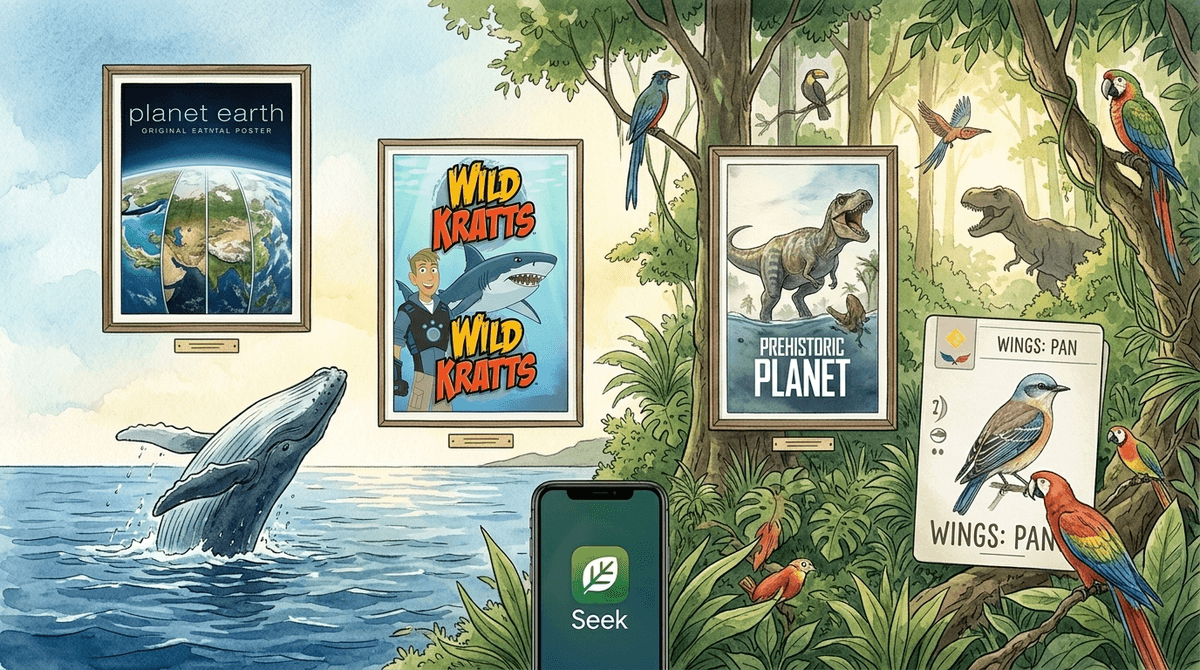
TL;DR: If your kid is currently obsessed with the mating rituals of the bowerbird or can explain exactly why a Blue Whale's heart is the size of a bumper car, you’re in a "high-quality screen time" sweet spot. Nature documentaries are the ultimate parenting win—they’re educational, visually stunning, and generally lack the frantic pacing of "brain rot" content.
Quick Links for the Nature-Obsessed Kid:
- The Gold Standard: Planet Earth
- Best for Littles: Wild Kratts or Octonauts
- The "Dino" Fix: Prehistoric Planet
- Best Interactive Tool: Seek by iNaturalist
- Best Family Board Game: Wingspan
We’ve all been there: you’re trying to get dinner on the table, and your seven-year-old is following you around giving a play-by-play of how a Cordyceps fungus hijacks an ant’s brain. It’s weird, it’s slightly gross, and it’s honestly kind of impressive.
This is "The David Attenborough Effect." It’s that moment when a kid moves past just liking "cute doggies" and starts caring about ecosystems, biodiversity, and the brutal reality of the food chain.
As a parent, this is the dream scenario for digital wellness. You aren't fighting them to turn off Skibidi Toilet or some mindless unboxing video. They are actually learning. But nature content isn't a total "set it and forget it" category. Between the "circle of life" (read: bloody predation) and the very real "climate anxiety" that modern docs lean into, there’s a bit of a roadmap you need to follow.
Find "gentle" nature shows for sensitive kids
The "Starter Pack" (Ages 3-6)
At this age, we want the facts without the trauma. You want shows that personify animals just enough to be engaging but stay grounded in actual science.
- The Kratt brothers are legends. They combine animation with live-action segments. It’s great because it focuses on "creature powers" (biological adaptations), making science feel like a superhero story.
- Don't let the cute animation fool you; the marine biology in this show is surprisingly accurate. Your kid will learn about hydrothermal vents and symbiotic relationships while thinking they’re just watching a polar bear drive a submarine.
- This is a fantastic, safe place for them to click around. It’s one of the few websites for kids that doesn't feel like it was designed in 1998.
The "Deep Dive" (Ages 7-12)
This is where the cinematography gets jaw-dropping and the narration gets British.
- The GOAT. If your kid hasn't seen the "iguana vs. snakes" sequence from Planet Earth II, stop reading this and go watch it. It’s better than any Marvel action scene.
- Narrated by Attenborough, this one is stunning but carries a heavier environmental message. It’s less "look at this cool bird" and more "look at this cool bird whose home is melting."
- If you have a dino-kid, this is the gold standard. It uses CGI to treat dinosaurs like actual animals in a nature doc rather than monsters in a movie. It’s scientifically up-to-date (yes, there are feathers).
Beyond the Screen: Games & Apps
If they love the shows, use that momentum to move them into interactive media that isn't just mindless clicking.
- This is arguably the best "engine building" board game of the last decade. You’re literally just trying to attract birds to your wildlife preserve. It’s beautiful, competitive, and teaches actual bird facts. There is also a Wingspan digital game version for tablets.
- A "cozy game" where you play as a girl visiting her grandparents on a Mediterranean island, cleaning up trash and taking photos of local wildlife. It’s pure, wholesome, and high-quality.
- This is the "Pokemon Go" of real life. You point your phone camera at a bug, a leaf, or a bird, and it identifies it using AI. It’s the best tool for turning a boring walk into an expedition.
1. The Predation Problem
Nature is metal. In Planet Earth, things get eaten. If you have a particularly sensitive kid, "Circle of Life" moments can lead to tears or nightmares. Pro-tip: Most modern docs have "Making Of" segments at the end. Watching the camera crew interact with the environment can help kids deconstruct the "movie magic" and realize it's a scientific observation, not a horror movie.
2. Climate Anxiety is Real
We’re seeing a trend where nature documentaries are becoming increasingly political and urgent regarding climate change. While it’s important, some kids can feel overwhelmed by the "everything is dying and it’s our fault" narrative. Check out our guide on talking to kids about climate change in media
3. The YouTube Trap
If your kid searches "cool animals" on YouTube, they might end up on channels that feature staged animal fights or "fake" rescues. It’s a dark corner of the internet. Stick to verified channels like Deep Look or PBS Eons for high-quality, ethical content.
According to Screenwise community data, about 38% of parents of elementary-aged kids report that nature documentaries are their "go-to" for guilt-free screen time. Interestingly, kids who regularly watch nature content are 2x more likely to engage with educational apps or outdoor hobbies compared to kids who primarily consume "influencer" content.
It’s a gateway drug to curiosity. If they’re asking about how a shark breathes, they’re practicing the kind of "how and why" thinking that makes science and math easier later on.
Instead of just letting the credits roll, try these conversation starters to move the experience from "passive watching" to "active learning":
- "That leopard was a calculated hunter, but did you see how the baboons worked together to warn each other? Why do you think being in a group helps?"
- "The cinematography in Our Planet is insane. How do you think they got a camera inside that beehive?"
- "If we went to the park tomorrow, what 'creature powers' do you think the squirrels have?"
A nature obsession is one of the "easiest" phases to parent because the content is generally high-quality and the values (stewardship, curiosity, respect for life) align with what most of us are trying to teach anyway.
The goal isn't just to keep them quiet for 50 minutes while David Attenborough whispers about fungi; it’s to use that screen time as a springboard. When they see something amazing on Disney+, grab Seek by iNaturalist and go see what's living under the rocks in your own backyard.
Next Steps:
- Audit your streaming: Check if you have access to the BBC Earth collection on Max or the Nat Geo hub on Disney+.
- Download Seek: It’s free and a total game-changer for hikes.
- Plan a "Nature Doc Night": Pick a specific ecosystem (like the Deep Sea) and pair it with a related activity.
Learn more about balancing educational screen time vs. entertainment