

TL;DR
Looking for books that use sports to explore bigger ideas? Levels of the Game by John McPhee is a masterclass in narrative nonfiction—a stroke-by-stroke account of a 1968 tennis match that becomes a meditation on race, class, and character. Perfect for teens (12+) who are ready for thoughtful sports writing that transcends the court. We've also rounded up other incredible tennis books that spark real conversations about competition, perseverance, and what it means to push yourself to the limit.
Quick picks:
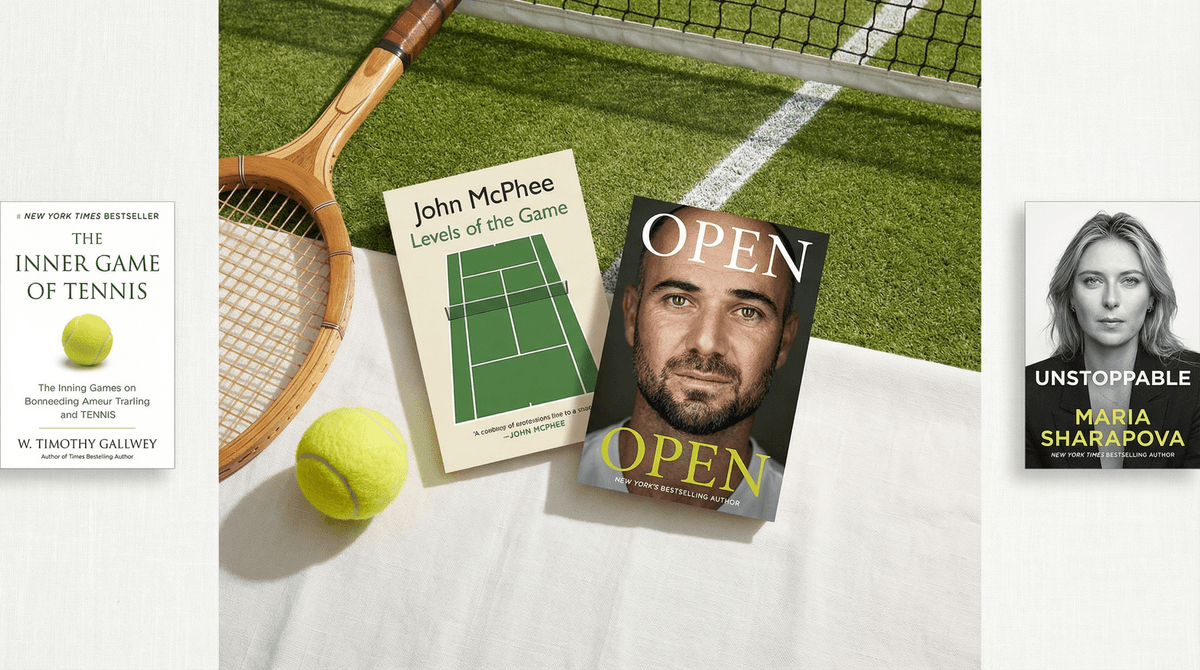
- Levels of the Game - The gold standard (Ages 12+)
- Open by Andre Agassi - Raw memoir about pressure and identity (Ages 14+)
- The Inner Game of Tennis - Mental game philosophy that applies to everything (Ages 13+)
- Unstoppable by Maria Sharapova - Grit and determination (Ages 12+)
Tennis literature occupies this fascinating space between sports writing and psychology. Unlike team sports, tennis is brutally individual—it's just you, your opponent, and the mental game happening between your ears. The best tennis books capture that internal battle while using the sport as a lens to examine bigger questions about ambition, failure, identity, and what happens when talent meets opportunity (or doesn't).
For parents, these books offer something rare: sports content that actually deepens critical thinking. They're not just "inspirational"—they're complex, sometimes uncomfortable, and always thought-provoking.
Ages 12+ | 160 pages | Published 1969
This is the book that changed sports journalism. McPhee takes the 1968 U.S. Open semifinal between Arthur Ashe and Clark Graebner—two 25-year-olds at the top of their game—and turns it into something extraordinary. He alternates between point-by-point play-by-play and deeply researched profiles of the players, using their contrasting backgrounds (Ashe, a Black activist from Richmond; Graebner, a white middle-class dentist's son from Cleveland) to illuminate race, class, and the early Open Era of tennis.
Robert Lipsyte of the New York Times called it "the high point of American sports journalism," and that's not hyperbole. McPhee's technique—weaving stroke-by-stroke action with interviews of players, families, and coaches—creates this incredible dual narrative where you're both watching a thriller unfold and reading a literary essay on character.
Why it works for teens: The 160-page length is manageable, the writing is vivid without being flowery, and there's zero graphic content. But the real value is in the conversations it opens up. The book dives into civil rights, the personal cost of excellence, and how two people can approach the same goal from completely different philosophical starting points. It's showing up in writing and journalism curricula for good reason.
Parent note: Because the book deals with race and politics in the late 1960s, you might want to preview those sections with younger readers (the 12-13 range) to provide context. For high schoolers, it's an incredible companion to history units on the civil rights era.
Available in paperback for around $15-17, and it's also on audio. ISBN 978-0-374-51526-3, published by Farrar, Straus and Giroux.
Ages 14+ | 388 pages
If Levels of the Game is a meditation, Open is a scream. Agassi's memoir is brutally honest about the cost of being groomed for greatness from childhood. The opening line—"I hate tennis, hate it with all my heart"—sets the tone for a book that's as much about identity and autonomy as it is about Grand Slams.
This is not a feel-good sports story. It's about a kid who had no choice, the psychological toll of performance, the emptiness of achievement when it's not on your own terms, and eventually, the hard work of becoming yourself. The writing (with help from J.R. Moehringer) is exceptional.
Why teens should read it: It's a powerful counter-narrative to "follow your passion" platitudes. Agassi shows what happens when someone else's passion becomes your prison, and how hard it is to reclaim your life. For teens feeling pressure (academic, athletic, parental), this book is validating and honest in ways that typical sports memoirs aren't.
Content heads-up: There's discussion of drug use (methamphetamine), failed relationships, and some language. The 14+ recommendation is firm—this isn't for middle schoolers.
Ages 13+ | 134 pages | Published 1974
This slim book has influenced everyone from coaches to business executives because it's not really about tennis—it's about the mental game of performance. Gallwey introduces the concept of "Self 1" (the critical, overthinking voice) and "Self 2" (the instinctive, capable doer), and explores how to get out of your own way.
It's essentially sports psychology before that was a mainstream field, and the principles apply to test-taking, music performance, public speaking—anything where anxiety interferes with ability.
Why it's great for teens: The book is short, accessible, and immediately applicable. A teen who plays any sport (or does theater, or takes hard tests) will recognize the mental traps Gallwey describes. It's also a nice introduction to mindfulness concepts without any of the woo-woo baggage.
Best for: Thoughtful kids who tend to overthink, perfectionists, or anyone dealing with performance anxiety. Also excellent for young athletes navigating competitive pressure .
.
Ages 12+ | 288 pages
Sharapova's memoir covers her childhood in Russia, moving to the U.S. at age 7 with her father (leaving her mother behind for two years), training at the IMG Academy, and her rise to become one of the highest-paid female athletes in the world. It's a story about sacrifice, grit, and the immigrant experience through the lens of elite tennis.
The writing is straightforward and the tone is determined rather than reflective—very much Sharapova's on-court personality. She doesn't shy away from discussing the loneliness of the tennis circuit, the physical toll of injuries, or the business side of being a brand.
Why it resonates: For kids (especially girls) interested in what it actually takes to compete at the highest level, this is a realistic portrait. Sharapova talks about the boring parts—the training, the travel, the constant physical therapy—alongside the glamorous wins. It's also a good book for discussing what happens when talent meets opportunity, and the role of privilege and access in success.
Ages 16+ | Essay collection
Wallace was a serious junior tennis player before becoming a literary giant, and his essays on tennis are some of the best sports writing ever produced. The centerpiece is his profile of Roger Federer, "Federer as Religious Experience," which is exactly as transcendent as the title suggests. These essays are dense, footnote-heavy, and absolutely brilliant—but definitely for older, strong readers.
Ages 13+ | Novel
A tennis-themed novel about a college player who gets involved in match-fixing. It's a thriller that explores ethics, pressure, and the gray areas of competition. Lighter than the memoirs but still substantive.
Ages 12+ | Strategy guide
Gilbert's guide to competitive strategy is both practical and philosophical. It's about how to win when you're not the most talented player on the court—using mental toughness, pattern recognition, and smart tactics. Great for competitive kids in any sport (or any competitive endeavor, really).
Ages 12-13: Start with Levels of the Game, Winning Ugly, or Unstoppable. These are accessible, relatively short, and free of mature content while still being intellectually substantial.
Ages 14-15: Add The Inner Game of Tennis and Open. The Agassi memoir deals with adult themes but in a way that's honest rather than gratuitous.
Ages 16+: David Foster Wallace's essays are for strong readers who can handle complex prose and existential questions. Worth it if they're up for the challenge.
These books are about so much more than tennis. They're about:
- The cost of excellence and whether it's worth it
- Race, class, and access in American sports
- Mental health and performance anxiety
- Identity formation when you're defined by a single skill
- The difference between passion and pressure
If your teen plays competitive sports, these books can open up conversations about their own experiences. If they don't play sports at all, these books still offer profound insights into ambition, failure, and what it means to pursue something difficult.
The best part? Unlike a lot of sports media, these books don't glorify suffering. They're honest about the trade-offs, the loneliness, the physical toll, and the question of whether it's all worth it. That honesty is rare and valuable.
Levels of the Game remains the gold standard—a 160-page masterpiece that uses one tennis match to explore everything that matters. Start there, especially if you're looking for something that works in an educational context (it's showing up in writing classes for good reason).
For teens who want raw honesty about elite athletics, Open delivers. For mental game philosophy that applies beyond sports, The Inner Game of Tennis is essential. And for girls looking for a story about determination and grit, Unstoppable is inspiring without being saccharine.
These aren't "sports books" in the typical sense—they're literature that happens to be about tennis. And that's exactly what makes them worth reading.
Want more recommendations? Check out our guide to books that teach critical thinking through sports or explore memoirs for teens that go beyond inspiration.