

Let's start with the uncomfortable truth: there is no magic number.
I know, I know. You came here hoping I'd tell you "2 hours per day for ages 8-12" and you could screenshot it and move on with your life. But the research is pretty clear that the quality of screen time matters way more than the quantity. And honestly? That's both harder and easier to work with.
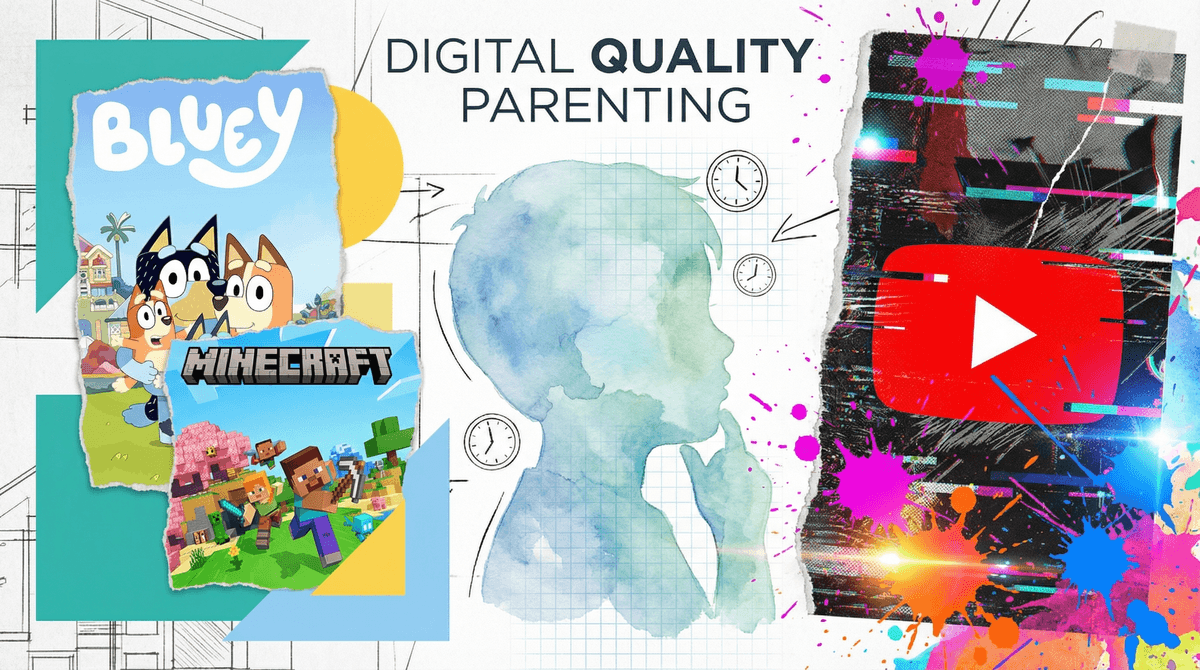
The American Academy of Pediatrics updated their guidelines a few years ago specifically because they realized the old "2 hours max" rule was too simplistic for our actual lives. A kid spending 2 hours building a complex city in Minecraft with friends is having a fundamentally different experience than a kid spending 2 hours watching random YouTube shorts.
But I get it—you still need some actual numbers to work with. So let's break this down by what the research actually says, and then talk about what matters more than the clock.
Here's what we know from the data:
For kids under 2: The AAP still recommends avoiding screens except for video chatting. Their brains are in such rapid development that they genuinely learn better from real-world interaction. (Yes, even if the app claims to teach them the alphabet.)
For ages 2-5: About 1 hour per day of high-quality programming, ideally co-watched with a parent. Think Bluey where you're both actually engaged, not background TV while you make dinner.
For ages 6+: This is where it gets interesting. The AAP basically says "it depends" and recommends you create a family media plan. Super helpful, right? But they're onto something—because the research shows that when screens are used matters as much as how much.
Studies consistently show that screens before bed mess with sleep (the blue light thing is real), that screens during meals reduce family connection, and that replacing physical activity with screens has obvious health impacts. But screens used for creative projects, learning, or genuine social connection? Those show neutral or even positive outcomes.
Here's what actually matters more than total minutes:
What they're doing: Passively consuming content (especially the algorithmic rabbit hole stuff) is very different from creating, learning, or connecting. A kid spending 3 hours on a Saturday making a stop-motion animation is having a completely different experience than 3 hours of TikTok.
What they're NOT doing: Is screen time replacing sleep? Outdoor play? Face-to-face friendships? Homework? If screens are crowding out the essentials, that's your red flag—regardless of whether it's 1 hour or 4.
How they feel afterward: This is the question that cuts through everything. Do they seem energized, creative, connected? Or zonked out, irritable, and asking for more? Kids' own responses to their screen time tell you a lot.
The content quality: Twenty minutes of Brains On! is not the same as 20 minutes of unboxing videos. Not all screen time is created equal, and you know this intuitively.
Elementary (ages 5-10): Most research suggests 1-2 hours of recreational screen time on school days is reasonable, with more flexibility on weekends. But focus on:
- No screens during meals or the hour before bed
- Prioritizing creative or educational content over pure entertainment
- Encouraging active gaming over passive watching when possible
- Setting up parental controls that actually match their age
Middle School (ages 11-13): This is when it gets complicated because they need screens for school AND social connection is happening there. Rather than a strict time limit, consider:
- Distinguishing between homework screens and fun screens
- Recognizing that texting friends is legitimate social time (but maybe not at midnight)
- Teaching them to notice their own screen habits and how they feel
- Having tech-free zones (bedrooms at night, family dinners) rather than counting every minute
High School (ages 14+): At this point, you're preparing them to manage their own screen time as adults. The research shows that autonomy with guardrails works better than strict limits. Focus on:
- Helping them track their own usage and reflect on it
- Discussing the dopamine trap of social media algorithms
- Modeling healthy screen habits yourself (yes, they notice)
- Maintaining some family boundaries (like phone-free dinners) as anchors
The most robust research comes from studies looking at kids' overall wellbeing, not just screen time in isolation. And here's what matters:
Sleep is non-negotiable: Kids who get enough sleep do better on literally every measure—academic, social, emotional, physical. If screens are cutting into sleep (either by keeping them up late or by the blue light affecting sleep quality), that's your clearest place to set boundaries.
Physical activity is the other non-negotiable: Kids need to move. If your kid is getting their recommended physical activity AND adequate sleep AND doing okay socially and academically, their screen time is probably fine—even if it's more than the "official" recommendations.
Social connection matters, even digital: The research on whether social media helps or hurts kids is genuinely mixed, but one clear finding is that using screens to maintain real friendships (texting with school friends, playing Roblox with cousins) is very different from passive scrolling or parasocial relationships with influencers.
Context is everything: A kid using screens a lot because they're anxious and avoiding real life is different from a kid using screens a lot because they're learning to code or making digital art or staying connected with long-distance family.
If you want an actual number to start with: 1-2 hours of recreational screen time on school days for elementary kids, with more flexibility on weekends and as they get older. But immediately start paying attention to the quality of that time and what else is happening in their lives.
The research is clear that these things matter more than the total minutes:
- Are they sleeping enough?
- Are they physically active?
- Are they connecting with real humans face-to-face?
- Are they doing okay in school?
- Do they have interests and hobbies offline?
If yes to all of those, their screen time is probably fine. If no to several of those, that's where to focus—not on shaving 15 minutes off their daily total.
Start tracking for a week: Not to judge, just to know. You might be surprised—both by how much and how little screen time is actually happening. Most phones and devices have built-in screen time trackers.
Talk about quality, not just quantity: Ask your kids what they're doing on screens and how it makes them feel. Help them develop their own awareness of when screens feel good versus when they're just filling time.
Set boundaries around the essentials: Rather than fighting over every minute, protect sleep, meals, and face-to-face time. Those are your anchors.
Remember that perfect is impossible: Some days will have more screen time. Some weeks will be off. You're aiming for a sustainable pattern, not perfection. And honestly? The fact that you're reading this means you're already being more intentional than most.