

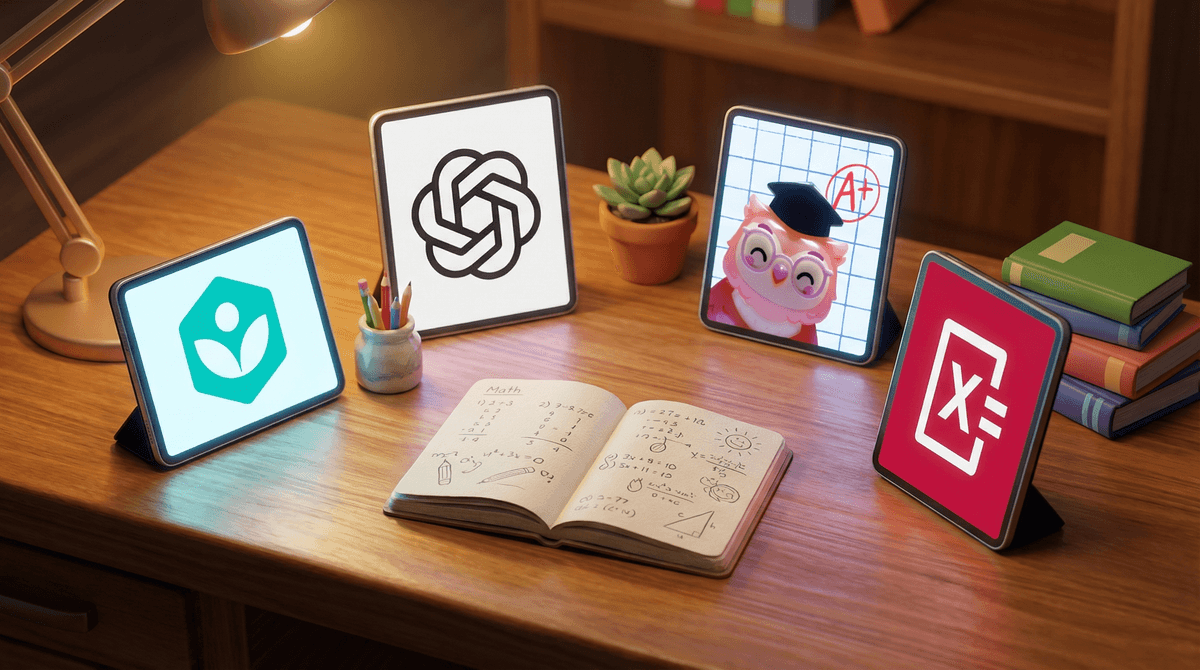
Homework help apps have exploded in the last few years, especially since AI got scary-good at solving problems. We're talking about apps like Photomath, Khan Academy, Chegg, Brainly, and now a whole wave of AI tutors like ChatGPT, Claude, and specialized tools like Numerade and Socratic.
The promise? Your kid gets unstuck on homework without you having to remember how to factor polynomials at 9pm on a Tuesday. The concern? Are they actually learning, or just copying answers?
Here's the thing: not all homework help apps are created equal. Some are genuinely trying to teach. Others are basically "give me the answer" machines with a thin educational veneer.
Tier 1: The Real Teachers
Khan Academy - This is the gold standard. Free, comprehensive, and designed to actually teach concepts through video lessons, practice problems, and progress tracking. It doesn't just give answers—it walks kids through the process. The AI tutor feature (Khanmigo) is surprisingly good at Socratic questioning rather than just handing over solutions.
Ages: Really 5+ through college. Seriously.
The catch: Your kid actually has to want to learn. If they're just hunting for answers, they'll bounce off this fast.
Photomath - This one surprised me. Yes, you can just scan a problem and get an answer. But the step-by-step explanations are genuinely helpful, and the app tries to teach the methodology. It's like having a patient tutor who shows their work.
Ages: Best for middle school through high school (roughly 11-18)
The catch: You need to actually READ the explanations. If your kid is just screenshotting the answer and moving on, this becomes a cheating tool real fast.
Tier 2: Helpful But Requires Supervision
Socratic (by Google) - Uses AI to identify what a question is asking and pulls up relevant educational resources. It's more of a smart search engine than a tutor, but that can be genuinely useful for understanding concepts.
Ages: Middle school and up (12+)
The catch: Results vary wildly in quality. Sometimes you get a perfect Khan Academy video, sometimes you get a sketchy forum post from 2013.
Brainly - Community-driven Q&A where students help each other. When it works, it's kind of beautiful—kids explaining concepts to other kids in language that actually makes sense.
Ages: Middle school and up (12+)
The catch: Answer quality is all over the place. Wrong answers get posted. There's also a paid tier that prioritizes your questions, which feels... icky?
Tier 3: Proceed With Caution
Chegg - Look, I'm just going to say it: Chegg is primarily used for cheating. Yes, they have tutoring services and textbook solutions that could be educational. But the core use case is "I need this homework done now" not "I want to understand this concept."
Ages: High school and college (14+)
The reality: If your high schooler is using Chegg, you should probably have a conversation about academic integrity. Also, it's expensive ($20+/month), and many teachers now know to check for Chegg-specific solutions.
ChatGPT/Claude/AI Chatbots - These are wild cards. They can be incredible learning tools if used right—explaining concepts, generating practice problems, helping brainstorm essay ideas. They can also write entire essays in seconds.
Ages: Really depends on the kid and how you're using it (13+ per terms of service)
The reality: AI homework help is the new calculator debate , but on steroids. Some teachers are embracing it, others are banning it, most are confused. You need to know your school's policy and have explicit conversations about appropriate use.
Kids aren't dumb. They know when homework feels like busywork, and they know these apps can save them hours of frustration. The appeal is obvious:
- Instant answers when they're stuck at 10pm
- No judgment from an app (unlike asking the teacher or parent)
- Efficiency - why spend 30 minutes on a problem when you can get the answer in 30 seconds?
But here's what they're not thinking about: homework exists to build understanding and practice skills. When you bypass the struggle, you bypass the learning. And then the test comes, and suddenly the app can't help you.
The homework help app itself isn't the problem—it's how it's being used. Here's what actually matters:
The Questions to Ask
-
"Show me how this app helped you understand the problem" - Not "show me the answer." If your kid can explain the process, the app is working. If they just copied the answer, it's not.
-
"What's your teacher's policy on homework help?" - Many teachers are fine with tutoring resources but draw the line at answer-generators. Know the rules.
-
"Are you using this because you're stuck or because you don't want to try?" - There's a huge difference between needing help on #7 after doing #1-6, versus opening the app for every single problem.
The Red Flags
- Your kid's homework is suddenly perfect but they bomb every test
- They can't explain how they got their answers
- They're using paid services you didn't know about (check those credit card statements)
- They're taking photos of every worksheet the second they get home
The Healthy Use Cases
- Checking work after completing problems independently
- Getting unstuck on one or two problems after genuinely trying
- Watching explanation videos to understand a concept better
- Generating extra practice problems for topics they're struggling with
Khan Academy is the app you should be steering your kids toward. It's free, it's comprehensive, and it's actually designed to teach. Photomath is solid for math-specific help if used correctly.
Everything else? Proceed with caution and have explicit conversations about academic integrity.
The real issue isn't the apps—it's that homework culture has gotten kind of insane, and kids are drowning in busywork while also being told their GPA will determine their entire future. These apps are a symptom of that pressure.
The best "homework help app" is still a parent, tutor, or teacher who can sit down and help a kid understand why they're stuck. But I get it—you can't factor polynomials anymore, you're exhausted, and Khan Academy is free. No judgment.
-
Check what your kid is already using - Look at their phone. You might be surprised.
-
Set clear expectations - "You can use Photomath to check your work or understand one problem, but not to complete entire assignments."
-
Know your school's policy - Some schools have explicit rules about AI and homework help. Find out before there's a problem.
-
Consider the alternatives to homework battles
- Sometimes the issue isn't the app, it's that your kid is genuinely overwhelmed.
And if you're wondering whether your kid is using these apps appropriately or just finding creative ways to avoid learning, let's talk about academic integrity in the AI age.