

Let's be real: teaching kids about the Holocaust is one of the hardest conversations you'll ever have as a parent. How do you explain systematic genocide to a 9-year-old? When is the right time? And how do you do it without either traumatizing them or sugar-coating one of history's darkest chapters?
Holocaust books for kids are specifically written to introduce this difficult history in developmentally appropriate ways. They range from picture books that introduce concepts of prejudice and courage for younger kids, to middle-grade novels that explore the lived experiences of children during the Holocaust, to young adult books that don't pull punches about the full horror of what happened.
The key word here is appropriate. Not "easier" or "nicer" — but matched to what a child at a specific age can actually process and understand.
You might be wondering when to even start this conversation. Here's the thing: kids are encountering Holocaust references younger than you think. It comes up in Anne Frank references on TikTok , in Fortnite chats where kids throw around words like "Nazi" without understanding them, and in school curriculum as early as 4th or 5th grade in many districts.
If you don't introduce this history thoughtfully, someone else will — probably in a way you wouldn't choose.
Plus, teaching about the Holocaust isn't just about history. It's about teaching kids to recognize prejudice, understand the dangers of dehumanization, and see the importance of standing up when something is wrong. These are lessons that matter in 2026 just as much as they did in 1945.
Ages 6-8: Starting with Empathy and Courage
At this age, you're not teaching about the Holocaust directly. You're laying groundwork about what it means when people are treated unfairly because of who they are, and what courage looks like.
The Butterfly by Patricia Polacco is a beautiful starting point. It tells the story of a French girl whose family hides a Jewish family during the war. It introduces the concept of people being in danger and others helping them, without graphic details about camps or death.
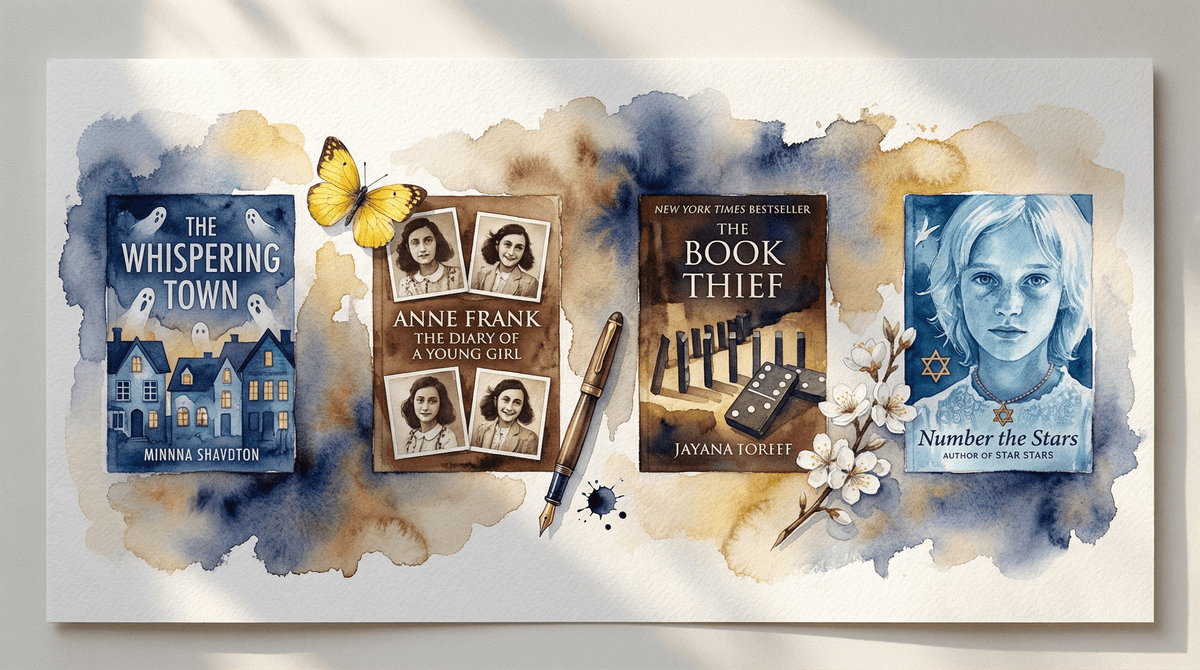
The Whispering Town by Jennifer Elvgren shows a Danish town secretly helping Jewish neighbors escape to Sweden. Again, the focus is on courage and community, not on the horrors.
These books answer the question: "Some people needed help, and brave people helped them." That's enough for a 7-year-old.
Ages 9-12: Introducing the Reality
This is when most kids are ready for books that explicitly discuss the Holocaust, though still through the lens of individual stories rather than systematic horror.
Number the Stars by Lois Lowry is the gold standard here. It follows a Danish girl helping her Jewish best friend escape. It's honest about the danger without being graphic about violence. Most 5th-grade classrooms read this, and for good reason.
The Boy in the Striped Pajamas by John Boyne is more controversial. It's told from the perspective of a German boy whose father runs a concentration camp. The ending is devastating. Some parents love it; others feel it centers the wrong perspective. Read more about the debate around this book.
Refugee by Alan Gratz weaves together three refugee stories across different time periods, including a Jewish boy fleeing Nazi Germany. It connects historical persecution to modern refugee experiences in a way that feels relevant to kids today.
For graphic novel readers, Maus by Art Spiegelman is powerful, though it's better suited for mature 12-year-olds. Yes, it uses mice and cats as characters, but it doesn't soften the reality of what happened.
Ages 13+: The Full Truth
Teenagers can handle — and should read — books that don't sanitize the horror.
Night by Elie Wiesel is a memoir of survival in Auschwitz and Buchenwald. It's short, devastating, and required reading in many high schools. This is the book that makes the Holocaust real in a way that history textbooks can't.
The Diary of a Young Girl by Anne Frank is obviously the most famous Holocaust book for young readers. What many parents don't realize is that there's an unedited version that includes Anne's more mature thoughts about puberty and sexuality. Both versions are appropriate for teens, but know which one you're getting.
The Book Thief by Markus Zusak, narrated by Death itself, follows a German girl who steals books and hides a Jewish man in her basement. It's beautifully written and explores complicity, resistance, and the power of words.
You don't have to be an expert. You just have to be willing to read alongside your kid and talk about hard things. It's okay to say "This is difficult for me too" or "I don't know how to explain why people did this."
Watch for nightmares and anxiety. Some kids process heavy topics easily; others spiral. If your kid is already anxious, you might want to wait a year or two, or choose books that focus more on rescue and resistance than on camps and death.
Context matters. Don't just hand them a book. Read it with them, or at least read it yourself first. Be available for questions. Kids will want to know: Could this happen again? Could this happen here? Are there still Nazis? These are questions worth exploring together.
Connect it to today. The Holocaust isn't just history — it's a warning. Talk about what antisemitism looks like now, what other genocides have happened since, and what it means to be an upstander instead of a bystander.
There's no perfect age to introduce Holocaust education, and no perfect book that works for every kid. But somewhere between "too young to understand" and "old enough that they've already heard about it from TikTok" is the right moment for your family.
Start with books that match where your kid is developmentally. Focus on stories of individual people, not statistics. And remember: the goal isn't to traumatize them with horror, but to teach them that ordinary people made choices — some chose cruelty, some chose courage — and that those choices mattered.
These books aren't easy reads. They're not supposed to be. But they're some of the most important books your kids will ever encounter.
Not sure which book to start with? Get Holocaust book recommendations based on your child's age and reading level based on your child's age and reading level.
Want to explore other difficult history topics? Check out our guides on talking to kids about slavery, books about civil rights for kids, and how to discuss current events with children.