

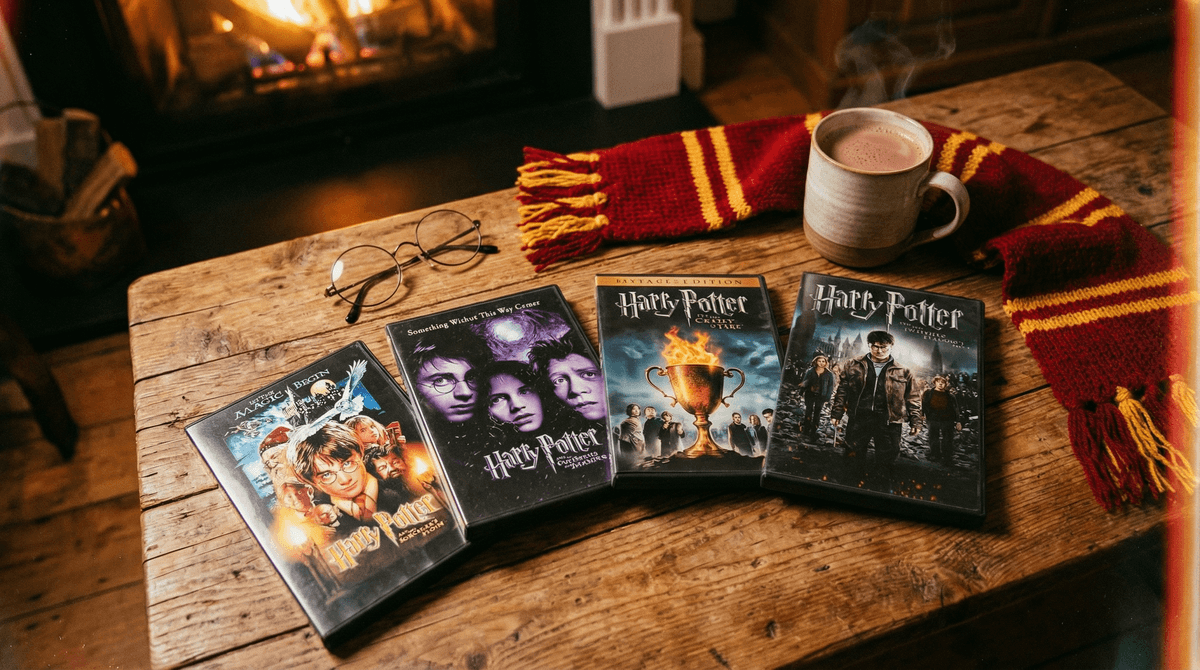
Look, by now you probably know what Harry Potter is—the boy wizard, the lightning scar, the whole magical universe. But if you're standing in front of your TV wondering whether your 7-year-old is ready for Hogwarts or trying to figure out if you should start with the movies or books, you're in the right place.
The Harry Potter movie series consists of eight films released between 2001 and 2011, following an orphaned boy who discovers he's a wizard and attends a magical boarding school. What starts as whimsical children's fantasy progressively becomes darker, more violent, and emotionally complex as Harry (and the audience) ages.
Screenwise Parents
See allHere's the thing parents need to know upfront: these movies grow up with the characters. The first film is genuinely appropriate for younger kids. The last few? Absolutely not.
Good news: unlike some franchises (cough Star Wars cough), Harry Potter has one straightforward viewing order—release order, which is also chronological order:
- Harry Potter and the Sorcerer's Stone (2001) - Ages 7+
- Harry Potter and the Chamber of Secrets (2002) - Ages 8+
- Harry Potter and the Prisoner of Azkaban (2004) - Ages 9+
- Harry Potter and the Goblet of Fire (2005) - Ages 10+
- Harry Potter and the Order of the Phoenix (2007) - Ages 11+
- Harry Potter and the Half-Blood Prince (2009) - Ages 11+
- Harry Potter and the Deathly Hallows Part 1 (2010) - Ages 12+
- Harry Potter and the Deathly Hallows Part 2 (2011) - Ages 12+
Do NOT start with the third movie because it's "the best one." Do NOT let your kid watch them out of order at a friend's house and then try to backfill. The story builds on itself, and spoilers matter here.
Here's where it gets tricky. The MPAA slapped PG or PG-13 on all of these, which is about as helpful as telling you a video game is "rated E for Everyone." Let's break down what you're actually dealing with:
Movies 1-2: Sorcerer's Stone & Chamber of Secrets (Ages 7-8+)
These are legitimately kid-friendly. Yes, there are scary moments—giant spiders, a basilisk, some peril—but it's fantasy scary, not traumatizing. Think classic adventure movies. If your kid handled The Lion King or Moana, they can handle these.
Watch for: Kids who are particularly sensitive to jump scares or large creatures might need a heads-up about the spider scene in Chamber of Secrets.
Movie 3: Prisoner of Azkaban (Ages 9+)
This is where the tone shifts. The Dementors (soul-sucking creatures) are genuinely creepy and represent depression in a way that can be unsettling. The movie gets darker, both literally (cinematography) and thematically. Still manageable for most kids, but this is your checkpoint.
Movie 4: Goblet of Fire (Ages 10+)
Major escalation alert. Someone dies on screen. It's not gratuitous, but it's real death, and it matters to the plot. There's also more intense action sequences and the return of Voldemort in a genuinely disturbing scene. This is where you need to know your kid—are they ready for mortality as a real concept in their entertainment?
Movies 5-8: Order of the Phoenix through Deathly Hallows (Ages 11-12+)
These are war movies disguised as fantasy. There are multiple deaths of beloved characters, torture scenes (brief but present), intense psychological manipulation, and the overall vibe is "everything is terrible and people you love will die."
The final battle in Deathly Hallows Part 2 is legitimately intense. Bodies everywhere, characters you've known for years getting killed, and emotional gut-punches throughout.
Real talk: Just because your 9-year-old has read all the books doesn't automatically mean they're ready for the later movies. Books let kids process at their own pace and imagine things their own way. Movies force the imagery on them. These are different experiences.
The J.K. Rowling situation: Yeah, we need to address this. Rowling's public statements about transgender people have been controversial and hurtful to many families. Whether you engage with Harry Potter content now is a personal family decision. Some families have moved on to other fantasy series. Some separate the art from the artist. Some use it as an opportunity to talk about how people we admire can disappoint us. There's no one right answer here, but it's worth thinking through before you dive into a 20-hour movie marathon.
Representation matters: The books and movies have been criticized for lack of diversity and for how certain characters (particularly the house elves and goblins) can be read as problematic stereotypes. The main cast is overwhelmingly white, and LGBTQ+ representation is essentially nonexistent in the films.
The magic system isn't the issue: Some families avoid Harry Potter due to religious concerns about witchcraft. That's a personal family decision. But for what it's worth, the "magic" here functions more like a superpower in Marvel movies—it's a plot device, not a religious practice. If your family is comfortable with Star Wars Force powers, Harry Potter magic operates similarly.
Books vs. Movies: The books are generally less intense than the movies for younger kids because reading lets them control the pace and their imagination fills in details at their comfort level. Movies make all the scary stuff explicit. That said, the books are also LONG, and some kids just aren't there yet as readers. Both paths are fine.
Despite all the discourse, Harry Potter remains wildly popular with kids because:
- The fantasy of being special: Every kid wants to discover they're secretly magical
- The boarding school setting: Independence plus friends minus parents equals kid heaven
- Clear good vs. evil: Especially in the early films, the moral lines are satisfying
- Rich world-building: Quidditch, Diagon Alley, magical creatures—it's an immersive universe
- Friendship at the core: Harry, Ron, and Hermione's relationship is genuinely well-done
The series also has legitimate themes worth discussing: standing up to authority when it's wrong, the importance of choices over circumstances, confronting prejudice, and dealing with loss.
Start young, pace it out: If you're beginning with a 7-year-old, watch the first movie. Then wait. Maybe six months. Then watch the second. You don't need to binge all eight films in a month. Let them grow into the series.
Co-viewing is non-negotiable for the later films: You need to be there to pause, discuss, and process. When Dobby dies, your kid might need to talk about it. When Sirius falls through the veil, they might have questions about death. Be present.
Conversation starters:
- "Why do you think Harry chose to be in Gryffindor instead of Slytherin?"
- "What would you do if you found out your friend's family believed in blood purity?"
- "How do you think Neville felt when everyone thought he wasn't good at magic?"
The streaming situation: As of 2026, the Harry Potter films rotate between streaming services. Check Peacock first (NBCUniversal owns the rights), but they also pop up on HBO Max periodically. Or just buy/rent them—this is one where ownership might make sense if you're planning a multi-year family journey.
If you're looking for magical adventures without the baggage or you want something tonally different:
- Percy Jackson series: Greek mythology, diverse cast, similarly aged protagonists (though the movies are... not great; stick with the books or the newer Disney+ show)
- The Chronicles of Narnia: Classic fantasy, Christian allegory if that's your thing, generally lighter tone
- Howl's Moving Castle: Studio Ghibli magic, beautiful animation, different vibe entirely
- Avatar: The Last Airbender: Not movies, but an animated series that does the "kids with powers save the world" thing brilliantly with better representation
The Harry Potter movies can be a genuinely great family experience if you approach them thoughtfully. The first two films are solid kids' movies. The middle ones require more discernment. The final films are legitimately intense and should be treated as such.
Start when your kid is ready for the first film (around 7-8), not when they're ready for the last one. Plan for this to be a multi-year journey. Co-view the later films. Be ready to have real conversations about death, prejudice, and moral complexity.
And if you decide Harry Potter isn't for your family—whether because of Rowling, content concerns, or you just think the movies are overrated—that's completely valid. There are approximately one million other magical adventures out there.
- Check their readiness: Use this guide to assess if your kid is ready for scary content
- Start with movie one: Seriously, don't skip ahead
- Consider the books: The Harry Potter books might be a better entry point for some kids
- Plan your pacing: You don't need to watch all eight in a month. Spread it out as your kid grows
And hey, if your kid ends up in a heated Gryffindor vs. Ravenclaw debate at school, at least you'll know what they're talking about.