

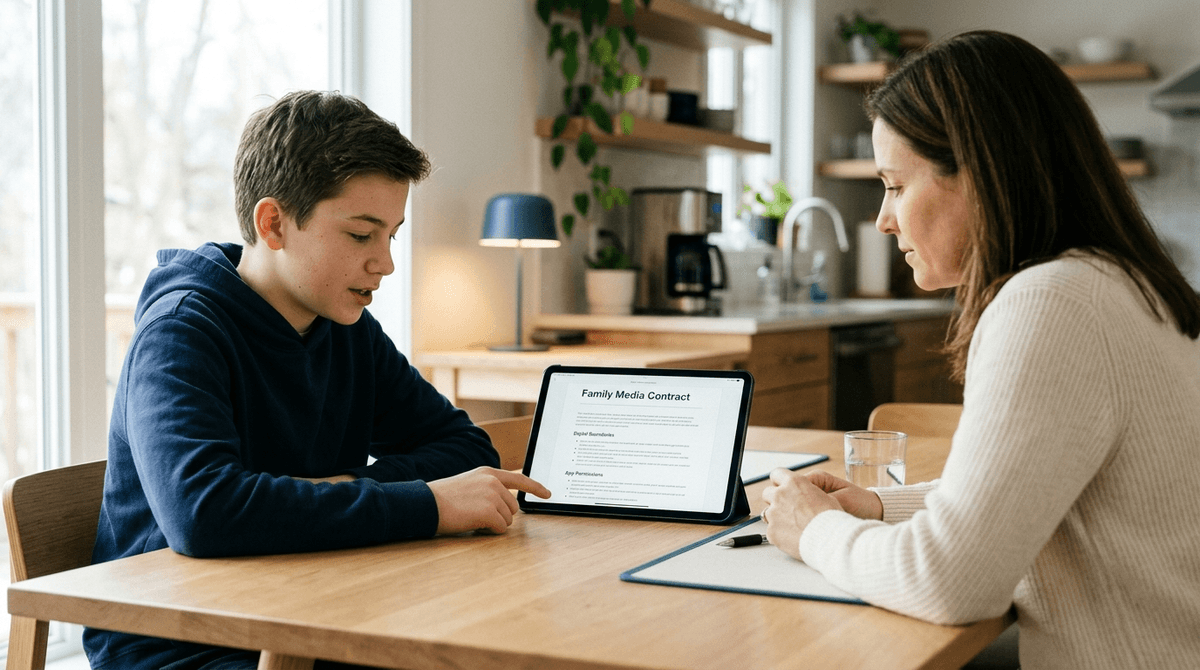
A family media contract works when it's built collaboratively with your kids, based on realistic expectations, and updated as they grow. The best contracts cover four areas: what (approved apps, games, and content), when (time limits and screen-free zones), where (device locations and public vs. private use), and how (behavior expectations and consequences). Use Screenwise community benchmarks to ground your rules in what families like yours actually do — not arbitrary numbers.
You've probably seen the templates. Print this PDF, have everyone sign it, stick it on the fridge. Problem solved!
Except it's not. Most family media contracts fail for three reasons:
- They're dictated, not negotiated. Kids who have zero input in the rules have zero investment in following them.
- They're based on vibes, not data. "Two hours of screen time" sounds reasonable, but is it? For a 5-year-old or a 14-year-old? On a school night or Saturday? Doing what — Minecraft or mindless YouTube autoplay?
- They never get updated. A contract written when your kid was 8 is useless when they're 11 and their friends are all on Discord.
Step 1: Start With Data, Not Feelings
Before you write a single rule, find out what's actually normal for families like yours. This isn't about peer pressure — it's about calibration.
Take the Screenwise family survey to see community benchmarks for your kid's grade. You might discover that 70% of 4th graders at your school already have YouTube access, or that most families in your grade set a 1-hour weeknight limit. That context turns "I think 1 hour is right" into "most families like ours do about 1 hour on school nights, and here's why that makes sense."
Kids respond better to "here's what the data shows" than "because I said so."
Step 2: Cover the Four Domains
Every effective family media contract addresses four areas:
What: Approved Content
List the specific apps, games, platforms, and content types that are approved — and the process for adding new ones.
For younger kids (ages 5-8):
- Approved apps and games by name (e.g., Khan Academy Kids, PBS Kids, Minecraft)
- Approved streaming services and any show-level restrictions
- "New app" process: kid asks, parent checks Screenwise WISE score, decision within 24 hours
For tweens (ages 9-12):
- Approved platforms with specific permissions (e.g., YouTube with SafeSearch, Roblox with chat restrictions)
- Social media policy (most families wait until 13, but check your community benchmarks)
- In-app purchase rules (allowance? approval required? hard no?)
For teens (ages 13+):
- Expanded platform access with behavior expectations
- Social media guidelines (public vs. private accounts, what not to post)
- Gaming boundaries (online multiplayer rules, voice chat expectations)
When: Time Boundaries
Avoid a single "screen time limit" — it's too blunt. Instead, define:
- School nights: Total recreational screen time (homework doesn't count)
- Weekends: More flexible, but with a cap
- Screen-free times: Meals, 30-60 minutes before bed, first hour after school
- Exceptions: Movie nights, travel, sick days — build in flexibility so the contract doesn't feel like a prison
Where: Physical Boundaries
- Devices charge outside bedrooms — this single rule has more impact than any time limit
- Shared spaces for younger kids — tablets and computers in common areas
- Headphone rules — when headphones are okay vs. when you need to hear what they're watching
- Car/travel rules — often more relaxed, and that's fine
How: Behavior Expectations
This is where most contracts skip to consequences. Don't. Lead with expectations:
- Respect the pause: When a parent says "time to stop," you get a reasonable wrap-up (save the game, finish the episode) — not an argument
- Be honest: If something weird or scary happens online, tell a parent. No punishment for reporting.
- Treat people well: Same kindness rules apply online as offline. No bullying, no meanness, no exclusion.
- Privacy basics: Don't share personal info, location, school name, or photos with strangers
Then consequences — and make them proportional:
- First violation: conversation about what happened
- Repeated violations: temporary loss of the specific privilege (not all screens)
- Serious violations (sharing personal info with strangers, cyberbullying): immediate device review and longer restriction
Step 3: Negotiate Together
Sit down with your kid and build the contract together. This isn't a trick — genuinely incorporate their input. They'll surprise you with reasonable suggestions, and they'll actually follow rules they helped create.
Good negotiation prompts:
- "What do you think is a fair amount of time on school nights?"
- "Which apps do you think should be on the approved list and why?"
- "What should happen if someone breaks the rules?"
- "What rules do you think are unfair, and what would you change?"
You still have veto power. But a contract where the kid contributed 30% of the rules gets followed 80% more than one where they contributed 0%.
Step 4: Build in Reviews
Set a specific review date — every 3 months for younger kids, every 6 months for teens. At the review:
- What's working? Keep it.
- What's causing constant fights? Renegotiate.
- What new apps/platforms have come up? Add them.
- Has their maturity changed? Adjust accordingly.
The contract is a living document, not a constitution. A good contract for a 3rd grader should look completely different by 5th grade.
Here's a starting template you can customize:
The [Family Name] Digital Agreement — Updated [Date]
We agree that screens are a tool, not a right. They can be amazing for learning, creativity, and connection — and they can also waste time and cause problems. These rules help us get the good stuff and avoid the bad.
Approved Apps & Games: [List — check WISE scores at screenwiseapp.com/recommendations]
Time Limits:
- School nights: ___ hours recreational screen time
- Weekends: ___ hours recreational screen time
- Screen-free: meals, ___ minutes before bed, [other]
Device Rules:
- Devices charge in [location] at night
- [Age-specific location rules]
Behavior:
- Be kind online — same rules as real life
- Tell a parent if something feels wrong — no punishment for reporting
- [Age-specific rules]
Consequences:
- [Graduated, proportional consequences]
Review Date: [3-6 months from now]
Signed: [Everyone in the family — including parents, who also have rules]
Here's what most contracts miss: parents should have rules too. No phones at dinner means no phones at dinner — for everyone. If you're asking your kid to charge their device outside their bedroom, yours should be there too.
Kids spot hypocrisy instantly. A contract where parents follow the same core rules (screen-free meals, no phones in bedrooms, kindness online) has dramatically more credibility than one that only applies to kids.
Q: What age should you start a family media contract?
Around age 5-6, when kids start having regular independent screen time. Keep it simple at first (3-4 rules) and add complexity as they grow. The earlier you establish the habit of negotiated rules, the easier the teen years will be.
Q: How much screen time should a family media contract allow?
There's no universal right answer — it depends on your kid's age, what they're doing on screens, and your family's values. Screenwise community benchmarks show what families at your kid's grade actually do, which is more useful than generic guidelines. The AAP recommends focusing on quality over quantity.
Q: Should a family media contract include consequences?
Yes, but proportional ones. Losing a specific privilege temporarily (no Roblox for 2 days) is more effective than nuclear options (no screens for a month). And always pair consequences with conversation about why the rule matters.
Q: How do you enforce a family media contract with teens?
Shift from enforcement to accountability. Teens who helped write the contract and understand the reasoning behind rules are more likely to self-regulate. Build in trust-based expansions: "Follow the contract for 3 months and we'll revisit the social media policy."
Q: What if co-parents disagree on the rules?
A family media contract can actually help here — it gives both parents a shared reference point. Use Screenwise community data as neutral ground: "Here's what most families at their school do" is less contentious than "I think you're too strict/lenient."
- Get your baseline: Take the Screenwise family survey to see what families like yours are doing
- Check your media: Browse WISE-scored recommendations to build your approved list
- Sit down together: Use the template above and negotiate with your kids
- Set a review date: Put it on the calendar — contracts that don't evolve don't survive