

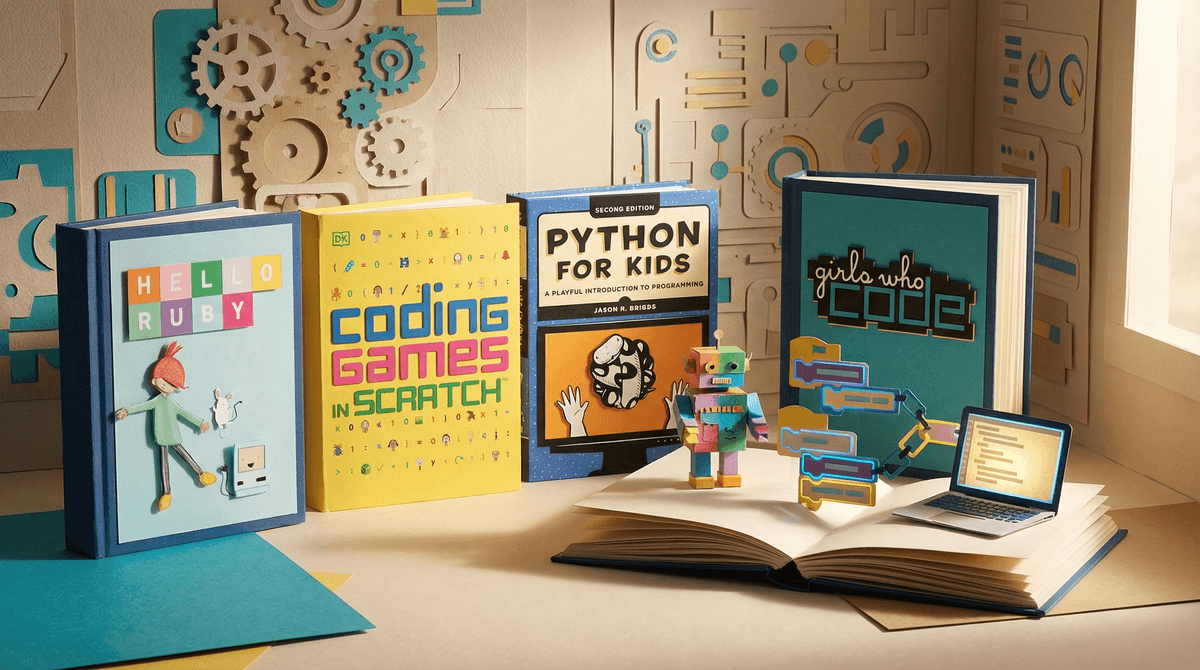
Coding books for kids are physical books (yes, the paper kind) that teach programming concepts, computational thinking, and sometimes actual coding languages. They range from picture books that introduce the idea of algorithms to your 4-year-old, all the way to legitimate Python textbooks for teenagers who are ready to build actual apps.
And honestly? In an age where we're all trying to figure out how much screen time is too much, coding books hit this sweet spot: they're teaching a digital skill without requiring a device. Your kid is learning logic, problem-solving, and sequencing while you get to say "go read a book" instead of "go stare at a screen."
But here's the thing — not all coding books are created equal. Some are genuinely engaging and teach real concepts. Others are basically just expensive coloring books with the word "coding" slapped on the cover to make parents feel good about the purchase.
Coding literacy is becoming as fundamental as reading literacy. I'm not saying every kid needs to become a software engineer, but understanding how technology works — how apps make decisions, how games are built, why your phone does what it does — is increasingly essential for navigating the world.
The kids who understand even basic coding concepts are better equipped to:
- Think critically about the technology they use every day
- Understand when they're being manipulated by algorithms
- Create things instead of just consuming them
- Solve problems systematically
Plus, let's be real: coding jobs pay well. If your kid discovers a passion for it early, you're setting them up for some solid career options.
Ages 3-5: Concept Books
At this age, you're not teaching Python. You're teaching the thinking behind coding: sequences, patterns, cause and effect.
Look for books that:
- Use stories to explain concepts like algorithms and loops
- Have interactive elements (lift-the-flap, choose-your-own-adventure)
- Don't actually require a computer
Good examples:
- Hello Ruby series by Linda Liukas — introduces computational thinking through adventure stories
- How to Code a Sandcastle by Josh Funk — teaches loops and conditionals through beach day fun
- My First Coding Book by Kiki Prottsman — uses puzzles and mazes to teach sequencing
The reality: Your preschooler is not going to learn to code from these books. But they will start thinking about problems in a logical, step-by-step way, which is the foundation of everything.
Ages 6-8: Unplugged Activities
This is the sweet spot for books that teach coding concepts without screens — "unplugged coding." These books use games, puzzles, and activities to teach real programming logic.
Look for books with:
- Hands-on activities that teach loops, conditionals, and variables
- Clear instructions and visual examples
- Activities that work without a computer
Good examples:
- Coding Games in Scratch by DK — yes, it's designed for Scratch, but the concepts translate
- Girls Who Code: Learn to Code and Change the World — great for building confidence, especially for girls
- Coding for Kids: Scratch — workbook-style with actual projects
The reality: Some kids this age are ready to jump into actual Scratch (the block-based coding platform). If your kid is interested, these books can be a great bridge between unplugged activities and actual coding on a device.
Ages 9-12: Block-Based and Beginner Text-Based
This is when kids can start learning actual coding languages — starting with visual, block-based languages like Scratch, then potentially moving to text-based languages like Python.
Look for books that:
- Teach a specific platform or language
- Include actual projects (games, animations, apps)
- Explain why code works, not just how to copy it
Good examples:
- Scratch 3 Programming Playground by Al Sweigart — project-based learning with clear explanations
- Python for Kids by Jason R. Briggs — genuinely funny and accessible intro to Python
- JavaScript for Kids by Nick Morgan — teaches real web development concepts
- Minecraft Modding with Minecraft Forge — if your kid is obsessed with Minecraft, this channels that energy into actual coding
The reality: At this age, books work best as companions to screen-based learning. Your kid will need computer time to actually practice what they're learning. The book provides structure, explanation, and projects — the computer is where they apply it.
Ages 13+: Real Programming Languages
Teenagers can learn real, professional-level coding. The best books at this level treat them like actual developers, not kids.
Look for books that:
- Teach industry-standard languages (Python, JavaScript, Java, C++)
- Include real-world projects
- Explain computer science concepts, not just syntax
Good examples:
- Automate the Boring Stuff with Python by Al Sweigart — practical, project-based Python
- Eloquent JavaScript by Marijn Haverbeke — deep dive into JavaScript
- Head First Java — if they're serious about computer science
The reality: At this point, books are competing with YouTube tutorials, coding bootcamp curricula, and online courses. The advantage of books? They're structured, comprehensive, and don't require staring at another screen. But your teen will also need online resources, Stack Overflow, and probably GitHub.
You Don't Need to Know How to Code
Seriously. You don't need to understand Python to support your kid learning Python. Your job is to:
- Provide the resources (books, computer time, maybe a class)
- Encourage problem-solving when they get stuck
- Celebrate when they build something (even if it's just a button that says "poop")
Books Work Best Alongside Doing
Coding books aren't novels. They're workbooks. Your kid needs computer time to actually practice what they're learning. Think of the book as the instruction manual, the computer as the workshop.
Not Every Kid Will Love It
And that's fine. Some kids will devour coding books and spend hours building games. Others will try one project and decide it's not their thing. Both outcomes are totally valid. Coding isn't for everyone , and forcing it rarely works.
Watch Out for "Coding" Books That Aren't Really Coding
Some books use "coding" as a marketing term but are really just logic puzzles or STEM activities. That's not necessarily bad — logic puzzles are great! — but know what you're buying. If the book never mentions an actual coding language or platform, it's probably teaching coding concepts, not coding itself.
The Roblox Question
Yes, Roblox teaches Lua scripting, and yes, there are books about coding for Roblox. If your kid is obsessed with Roblox and wants to learn to make their own games, this can be a fantastic entry point. Just know that Lua is a real programming language, but it's pretty specific to game development — it's not as broadly applicable as Python or JavaScript.
The best coding book for your kid is the one they'll actually use.
If your 7-year-old is obsessed with Minecraft, get them a Minecraft modding book. If your 10-year-old wants to make websites, start with JavaScript. If your teenager wants to automate tasks, go with Python.
Start with books that match their interests and current skill level. If they love it, they'll naturally want to go deeper. If they don't, no big deal — you tried, and they learned something.
And remember: the goal isn't to raise a software engineer (unless they want to be one). The goal is to raise a kid who understands how technology works, can think logically about problems, and maybe — just maybe — will stop asking you to buy them Robux because they'll learn to code their own Roblox game instead.
If you're just starting out: Grab an age-appropriate concept book from your library. See if your kid engages with it. If they do, invest in a more substantial workbook.
If your kid is already interested: Match the book to what they're already doing. Playing Scratch at school? Get a Scratch project book. Obsessed with YouTube tutorials? Get a book that complements what they're watching.
If you want more guidance: Find coding books for your kid's age and interests — it can help you narrow down options based on what your kid is already into.
And if you discover your kid has zero interest in coding? That's data too. There are plenty of other ways to build digital literacy and critical thinking. Coding books are one tool, not the only tool.