

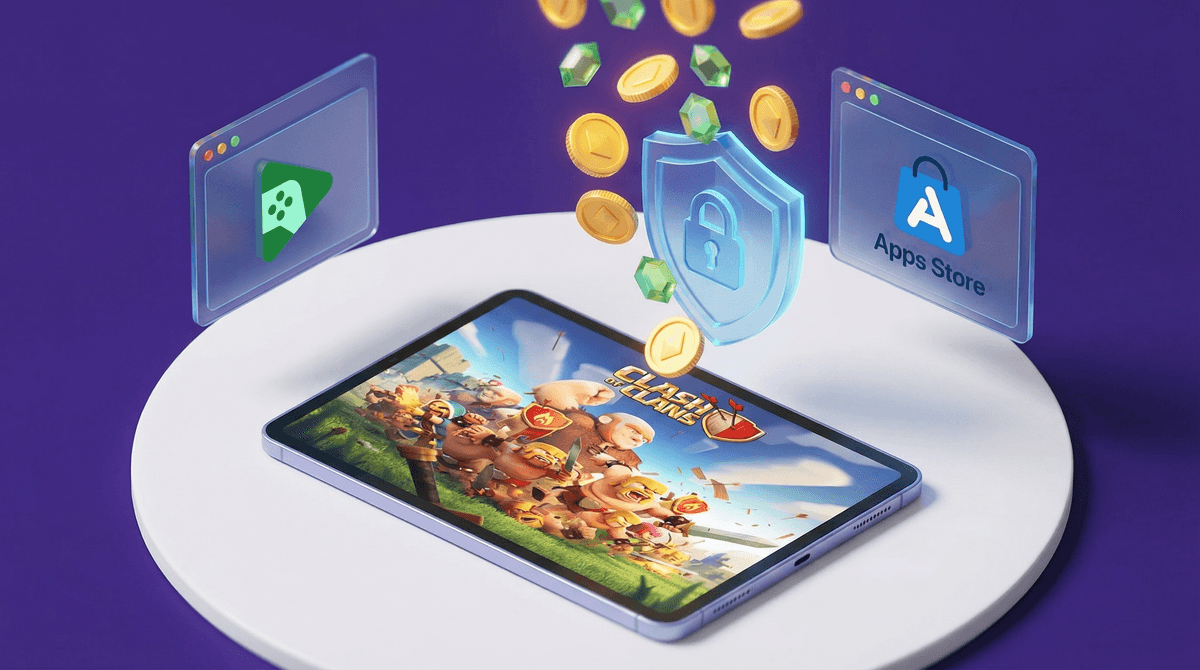
Clash of Clans is a mobile strategy game where players build villages, train troops, and attack other players' bases to collect resources. It's been around since 2012, which makes it ancient in mobile gaming years, but it's still massively popular—especially with kids in 4th through 8th grade.
Here's the thing: the game is free to download, but it's designed from the ground up to make you want to spend money. And not just a little money. We're talking about a game that has generated over $10 billion in revenue. That money comes from somewhere, and if you've got a kid playing, there's a decent chance some of it is coming from your credit card.
The game uses "gems" as premium currency—you can earn them slowly through gameplay, or you can buy them with real money. Those gems can speed up building times (which otherwise take days or even weeks), buy resources, and give you advantages that free players simply can't match.
Kids are drawn to Clash of Clans for legitimate reasons. It's social—they join clans with friends and coordinate attacks. It requires strategic thinking. There's a genuine sense of progression and accomplishment when you upgrade your town hall or win a tough battle.
But here's where it gets tricky: the game is masterfully designed to create impatience. Upgrade times get longer and longer as you progress. That archer tower upgrade? It'll be done in 3 days... unless you spend 500 gems to finish it now. Your clanmates are all online doing a war attack, but your army won't be ready for another hour... unless you spend gems.
For adults, we can (usually) resist these nudges. For kids—whose impulse control is still developing and who don't fully grasp the value of money—these mechanics are incredibly effective. According to our community data, 55% of families report their kids engage with gaming, and in-app purchases are one of the top concerns parents raise about games like this.
Let me paint you a picture: A parent recently shared that their 10-year-old racked up $347 in charges over two weeks before they noticed. The kid thought the purchases were "fake money" in the game. Another family discovered $89 in charges and their child genuinely didn't understand they were spending real dollars.
This isn't about bad kids or bad parents. This is about game design that deliberately blurs the line between virtual and real currency, combined with kids who don't yet have the cognitive development to fully understand the consequences.
Okay, let's get practical. Here's what you need to do today:
On iOS:
- Go to Settings → Screen Time → Content & Privacy Restrictions
- Turn on Content & Privacy Restrictions
- Tap iTunes & App Store Purchases
- Tap In-App Purchases and select "Don't Allow"
- Alternatively, set "Require Password" to "Always" so every purchase needs your approval
On Android:
- Open Google Play Store
- Tap your profile icon → Settings → Family → Parental controls
- Turn on parental controls and create a PIN
- Set restrictions for In-app purchases to "Require approval for all purchases"
- You can also go to Settings → Authentication → Require authentication for purchases and set it to "For all purchases"
Remove Saved Payment Methods:
This is crucial—go into your App Store or Google Play account and remove saved credit cards. Make it so that ANY purchase requires you to manually enter payment information.
Here's the truth: parental controls are necessary but not sufficient. You also need to have real conversations about money, game design, and why these companies want your cash so badly.
For ages 8-11: Explain that game companies are businesses trying to make money. Show them how much real money those gems cost. $4.99 might not sound like much to them, but translate it: "That's your allowance for two weeks" or "That's enough for a movie ticket."
For ages 12+: Go deeper. Talk about how free-to-play games are designed . Discuss artificial scarcity, FOMO (fear of missing out), and psychological manipulation. Make them critical consumers. Ask: "Why do you think they make you wait 3 days for this upgrade?"
Some families set a monthly gaming budget. Maybe it's $5, maybe it's $10, maybe it's zero—but the kid gets to decide how to spend it (or save it). This teaches budgeting while acknowledging that in-app purchases aren't inherently evil.
Other families have a "earn it" system: if the kid wants to spend money in the game, they need to earn it through chores or other responsibilities. This creates a direct connection between effort and reward.
And honestly? Some families just say no in-app purchases, period. According to our data, 68% of families in this age group don't give their kids smartphones yet, and many of those families are taking a hard line on in-app spending. That's a completely valid choice.
Yeah, this is real. Your kid probably does have friends whose parents let them spend freely. And it does create an uneven playing field in the game.
Here's what I tell parents: this is actually a great opportunity to talk about how different families have different values and different financial situations. Not everyone can or should spend money on games. The fact that the game is designed to make free players feel inferior is a problem with the game, not with your parenting choices.
If your kid is really struggling with this, it might be worth exploring games that don't have the same pay-to-win mechanics. Games like Stardew Valley or Terraria have one-time purchase prices but no in-app purchases. Minecraft has some in-app purchases but the core game doesn't require them.
Clash of Clans isn't going to ruin your kid, but unchecked in-app spending absolutely can become a problem—both financially and in terms of what it teaches kids about money and instant gratification.
Set up those technical controls today. Have the conversations about money and game design. And remember: you're not being mean or unfair by setting limits. You're being a parent.
- Right now: Set up parental controls on every device your kid uses for gaming
- This week: Have a conversation about in-app purchases and why they exist
- This month: Check your credit card statements for any charges you don't recognize
- Ongoing: Learn more about how free-to-play games make money so you can stay ahead of the next gaming trend
Want to understand what other games might have similar issues? Check out our guides on Roblox, Fortnite, and Brawl Stars—all popular games with their own in-app purchase ecosystems that parents need to understand.