

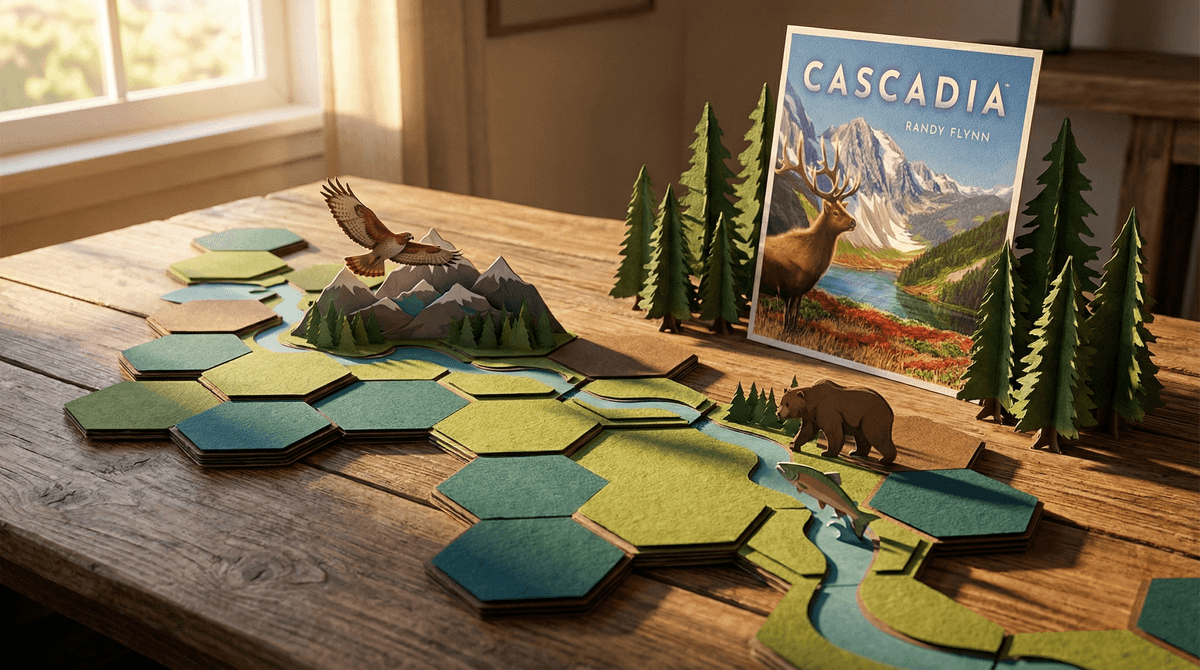
Cascadia is an award-winning tile-laying puzzle game where players create habitats for Pacific Northwest wildlife. Think of it as a nature-themed spatial puzzle that's genuinely engaging for both kids and adults—and here's the kicker: it has an excellent solo mode that takes under 45 minutes to play.
In the game, you're drafting habitat tiles (forests, wetlands, prairies, rivers, mountains) and matching them with wildlife tokens (bears, elk, salmon, hawks, foxes). Each animal has different scoring patterns—some want to be in large groups, others prefer pairs, some like long lines. You're essentially building an ecosystem while solving multiple puzzles simultaneously.
The solo variant is thoughtfully designed, not just a multiplayer game with a "beat your own score" tacked on. Setup takes less than two minutes, and cleanup is equally quick. For parents looking for screen-free activities that actually hold attention, this is gold.
Let's be real: our community data shows kids are averaging 4.2 hours of screen time daily (4 hours on weekdays, 5 on weekends). And look, 55% of families report regular gaming—I'm not here to shame that. But when you're trying to diversify how your kid spends their downtime, you need options that don't feel like punishment.
Cascadia works because it scratches similar itches to video games:
- Pattern recognition and strategy (like puzzle games)
- Immediate feedback (you see your ecosystem taking shape)
- Replayability (the game comes with different scoring cards that completely change your strategy)
- Achievement-oriented (trying to beat your previous score feels surprisingly satisfying)
Plus, there's something about physically manipulating tiles and tokens that engages the brain differently than tapping a screen. Kids who struggle with excessive gaming often need activities that provide similar dopamine hits through different mechanisms—not just "go read a book" (though we love books too).
Ages 8+ is the sweet spot, though I've seen motivated 7-year-olds handle it with minimal help.
Ages 8-10: They'll grasp the basic mechanics easily. Expect scores in the 70-90 range initially as they learn to balance the different animal scoring patterns. The visual nature of the game helps—they can see what works and what doesn't.
Ages 11-13: This is where strategy deepens. Kids start planning several moves ahead, recognizing which habitat tiles set them up for better wildlife options. First-time players typically score in the 90s, breaking into the 100s as they develop strategy. The game includes four different scoring card sets (A, B, C, D), so once they master one, there's built-in progression.
Teens and up: Honestly, this game holds up for adults. It's won multiple awards (including the prestigious Spiel des Jahres) for good reason. If you're worried about your teen thinking it's "babyish," play it yourself first—you'll be hooked, and your enthusiasm will sell it better than any pitch.
Independent play is the whole point here. If you're trying to encourage your kid to do something solo that isn't YouTube or Roblox, Cascadia's solo mode is legitimately designed for that. It's not lonely—it's meditative. Kids report feeling the same "flow state" they get from good video games.
The learning curve is gentle but rewarding. First game takes maybe 10 minutes of rule explanation, then they're off. Unlike some complex board games where you're constantly checking the rulebook, Cascadia's rules fit on a single reference card.
It's genuinely portable. The box is compact, components are sturdy, and setup/cleanup is fast. This matters for real life—you can actually take it to grandma's house or on vacation without it becoming a whole production.
Cost context: It typically runs $35-45, which feels steep until you realize it provides dozens of hours of engagement. Compare that to a new video game ($60-70) or the monthly cost of another streaming service.
If you're reading Screenwise, you're probably already thinking about intentional screen use rather than just trying to ban everything. Cascadia fits perfectly into that philosophy—it's not about replacing screens entirely, it's about having genuinely compelling alternatives.
The solo mode specifically addresses a challenge many families face: kids who default to screens when they're alone because that's the only engaging solo activity they know. Board games have historically been social, but Cascadia (and the growing category of solo-friendly games) changes that equation.
Worth trying if: Your kid enjoys puzzle games, strategy games, or anything with progression and achievement. Also great for kids who need help with independent play skills or transitioning away from constant screen stimulation.
Skip if: Your kid genuinely hates anything resembling "thinking games" or gets frustrated by trial-and-error learning. Some kids need more narrative or social elements in their games—and that's totally valid.
Start with one game together to teach the rules, then step back and let them try solo. Don't hover—the whole point is independent engagement. Check in after their first few games about what they're learning strategy-wise. You might be surprised by how quickly they develop meta-game thinking.
And hey, if you end up playing it more than your kid does? That's fine too. Sometimes modeling engaged, screen-free activities is the most powerful teaching tool we have.
Curious about other board games that work well solo? The category has exploded in recent years, and there are options for every age and interest level.