

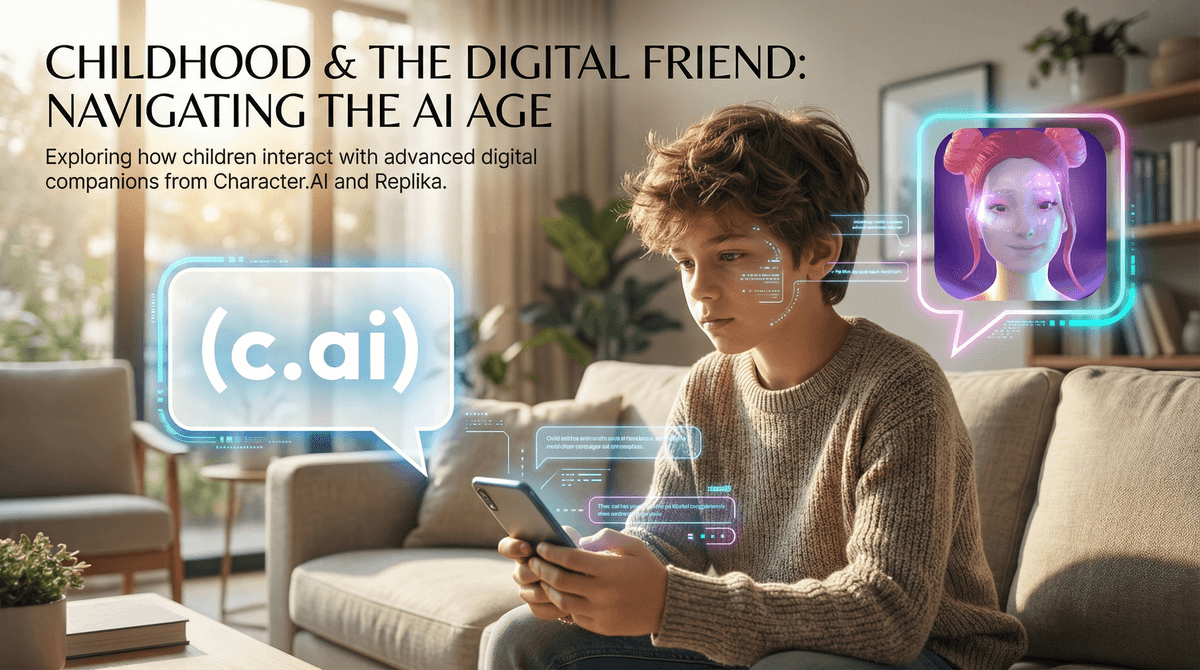
Can AI Chatbots Actually Teach Your Kid Social Skills?
TL;DR: AI chatbots like Character.AI, Replika, and conversation-focused tools are being marketed as social skills trainers for kids. The reality? They're not a replacement for human interaction, but they're not completely useless either. Here's what actually works, what's concerning, and how to think about AI companions in your kid's social development.
The pitch sounds almost too good to be true: your socially anxious middle schooler practices conversations with an AI before the school dance. Your neurodivergent 10-year-old role-plays difficult social scenarios in a judgment-free zone. Your shy teen builds confidence through daily chats with a digital companion who never rolls their eyes or ghosts them.
Companies developing AI chatbots are leaning hard into the "social skills training" angle, and honestly? Parents are listening. Because real talk: social skills are harder to develop now than ever. Kids are coming out of the pandemic with less practice reading facial cues, managing conflict, and navigating the messy reality of human relationships.
But can typing messages to an AI actually help? Or are we just adding another screen-based "solution" to a problem that screens partially created?
When people say "AI chatbots for social skills," they usually mean one of three things:
1. Companion chatbots like Character.AI or Replika that simulate friendship, offer emotional support, or let kids roleplay conversations with fictional characters or historical figures.
2. Therapeutic or educational AI specifically designed for social-emotional learning, like apps that coach kids through anxiety, practice active listening, or teach conflict resolution through branching dialogue trees.
3. Voice assistants like Alexa or Siri that kids naturally talk to, practicing question-asking, turn-taking, and conversational norms (even if accidentally).
The conversation gets complicated because these tools vary wildly in quality, safety, and actual educational value. Some are built by child development experts with real research behind them. Others are... well, they're not.
Let's start with what might actually work, because there IS some legitimate potential here:
Low-stakes practice space: For kids with social anxiety, autism, or selective mutism, AI can offer a genuinely helpful practice environment. No judgment, no social consequences, unlimited do-overs. A 12-year-old can practice asking someone to hang out fifty times until it feels natural, without the mortification of real-world failure.
Immediate feedback loops: Good AI tools can catch and correct social missteps in real-time. Interrupted someone? The AI can pause and explain turn-taking. Used a harsh tone? It can reflect that back and suggest alternatives. This kind of instant, specific feedback is hard to get from humans who are busy managing their own feelings in the conversation.
Accessibility for neurodivergent kids: Many autistic kids report feeling more comfortable with predictable AI interactions than unpredictable human ones. While this shouldn't replace human connection, it can serve as a bridge—a place to understand social rules explicitly before applying them in the wild.
Conversation volume: Kids need practice. Lots of it. If your middle schooler is getting 3 hours of screen time but only 20 minutes of actual conversation with peers, an AI that encourages back-and-forth dialogue isn't the worst way to fill that gap.
Early research (and yes, it's VERY early) suggests that structured AI roleplay can help some kids improve specific skills like:
- Recognizing emotional cues in text
- Generating appropriate responses to social scenarios
- Building conversational stamina
- Reducing anxiety around social interaction
But here's where it gets messy.
AI doesn't teach you to read a room: Social skills aren't just about what you say—they're about reading micro-expressions, adjusting to someone's energy, picking up on sarcasm, knowing when someone's laughing with you versus at you. AI can't teach that. It can't replicate the discomfort of eye contact, the split-second decision of whether to hug or high-five, or the art of knowing when to shut up.
The feedback is often... wrong: Most consumer AI chatbots aren't actually sophisticated enough to teach nuanced social skills. They're pattern-matching machines that can sound empathetic without understanding empathy. They might reinforce weird conversational habits, reward oversharing, or fail to flag genuinely inappropriate responses because they're optimized for engagement, not accuracy.
Emotional attachment to non-humans: This is the big one that keeps developmental psychologists up at night. Kids—especially lonely kids—can form intense attachments to AI companions. And unlike a pet or even a parasocial relationship with a celebrity, AI companions are designed to be perfectly responsive to your needs. They never have a bad day. They never prioritize someone else. They never grow or change in ways that challenge you.
That's not how real relationships work, and it's not how kids learn resilience, compromise, or emotional regulation.
The data privacy nightmare: Apps like Character.AI have faced serious criticism for how they handle children's data. Your kid is pouring their heart out about social anxiety, friendship drama, or worse—and that data is being stored, analyzed, potentially sold. The terms of service on most of these apps are genuinely alarming if you read them.
It can become avoidance: For anxious kids, AI chat can become a crutch. Why face the unpredictability of real friendship when you can have a "friend" who never disappoints you? This is especially concerning for teens who are already prone to social withdrawal.
If you're considering AI as part of your kid's social development, here's what the evidence and expert consensus suggests:
✅ Potentially Helpful:
- Structured, time-limited roleplay for specific scenarios (job interview practice, asking someone out, handling conflict)
- Therapeutic AI tools designed by actual child psychologists with clear learning objectives
- Supplement to real social practice, not replacement—think of it like training wheels
- Explicit discussion about how AI conversations differ from human ones
❌ Probably Not Helpful:
- Open-ended "friendship" with AI companions, especially for lonely or isolated kids
- Using AI chat as a primary source of emotional support
- Unsupervised use of consumer chatbots not designed for children
- Expecting AI to "fix" social skills without real-world practice
Ages 5-9: Honestly? Skip the AI chatbots entirely. This age needs physical play, face-to-face interaction, and learning to regulate emotions with actual humans. If you want tech that supports social development, look at cooperative games like It Takes Two that require communication, or video calls with grandparents where they practice conversation skills with real stakes and real love.
Ages 10-13: This is where structured AI roleplay might make sense for specific kids—particularly those with diagnosed anxiety or autism who are working with a therapist. But it should be:
- Time-limited (10-15 minutes max)
- Goal-oriented (practicing a specific skill)
- Discussed afterward with a parent or therapist
- Balanced with real social opportunities
Ages 14+: Teens are going to find these tools whether you introduce them or not. Better to acknowledge their existence, discuss the limitations openly, and set boundaries around use. If your teen is using Character.AI or similar apps, have regular check-ins about what they're getting from it and whether it's helping or replacing real friendships.
If you decide to let your kid use AI chatbots, you need to know:
Data privacy is a mess: Assume everything your child types is being stored and analyzed. Read the privacy policy (I know, I know) or at least search "[app name] privacy concerns children" before allowing use.
Content moderation is inconsistent: Even "safe" AI chatbots can generate inappropriate content, especially if kids are creative about their prompts. Character.AI has had multiple scandals involving romantic or sexual content with underage users.
Emotional manipulation is built-in: These apps are designed to be addictive. They use the same psychological tricks as social media—variable rewards, artificial scarcity, FOMO—to keep kids coming back.
No substitute for professional help: If your child is struggling with serious social anxiety, depression, or isolation, AI chatbots are not therapy. They might feel like therapy, but they're not. Get real help from real humans.
The fundamental question isn't "Can AI teach social skills?" It's "What kind of social skills are we talking about, and what's the cost?"
AI can probably help with some narrow, technical aspects of conversation: turn-taking, topic maintenance, generating appropriate responses to common scenarios. It's like practicing free throws alone in your driveway—useful, but not the same as playing a game.
What AI absolutely cannot teach:
- Reading nonverbal communication
- Managing the emotional complexity of real relationships
- Developing empathy through shared vulnerability
- Learning that other people's needs sometimes conflict with yours
- Building resilience when relationships are hard
The kids who seem to benefit most from AI social practice are those who:
- Have specific, diagnosed challenges (autism, selective mutism, severe social anxiety)
- Are using AI as ONE tool among many, including therapy and real social opportunities
- Have parents who are actively involved in discussing what they're learning
- Are clear that AI is practice, not the real thing
The kids most at risk are those who:
- Are already socially isolated
- Use AI companions as their primary source of emotional connection
- Have unsupervised access to consumer chatbots
- Are using AI to avoid rather than prepare for real interaction
AI chatbots aren't going to turn your shy kid into a social butterfly, and they're not going to replace the messy, uncomfortable, essential work of learning to be human with other humans.
But for some kids, in specific contexts, with clear boundaries and parental involvement? They might be a useful tool in the toolbox. Think of them like social skills training wheels—potentially helpful for building confidence, but you've got to take them off eventually.
The real work of social development happens in after-school activities, family dinners, playground conflicts, sleepovers that go sideways, and all the other uncomfortable, unscripted moments where kids learn that other people are complicated and relationships are hard and that's okay.
If AI chat helps your kid feel brave enough to show up for those moments? Great. If it's replacing them? That's a problem.
If you're considering AI social practice for your kid:
-
Start with the why: What specific skill are you hoping they'll develop? Is AI actually the right tool for that, or is it just the easy tool?
-
Look for evidence-based tools: Apps designed by child development experts, with clear learning objectives and research backing, are vastly different from consumer chatbots optimized for engagement.
-
Set clear boundaries: Time limits, supervised use, regular check-ins about what they're learning and how it feels.
-
Prioritize real social opportunities: AI practice only makes sense if it's preparing them for real interaction, not replacing it. Learn more about balancing digital and real-world social development
 .
. -
Talk about the limitations: Make sure your kid understands that AI companions aren't real friends, don't have real feelings, and can't teach them everything they need to know about being human.
And maybe most importantly: if your kid is struggling socially, the solution probably isn't more screen time, even if it's "educational" screen time. It's more opportunities for messy, imperfect, real human connection—with you, with peers, with trusted adults who can model and teach social skills through actual relationship.
Because here's the thing: social skills aren't really skills at all. They're practices. And you can't practice being human with something that isn't.