

Books with Deaf Characters: Building Empathy Through Representation
These are stories where deaf or hard-of-hearing characters take center stage—not as inspiration porn or tragic figures to be "fixed," but as fully realized people living their lives. Some are picture books featuring signing families, others are middle-grade adventures where the protagonist just happens to be deaf, and some are YA novels that dive deep into deaf culture, identity, and the complexity of navigating both hearing and deaf worlds.
The best ones? They're written by deaf or hard-of-hearing authors who actually know what they're talking about. Because there's a massive difference between a hearing author imagining what deafness is like versus someone who's lived it.
Here's the thing: most kids will grow up knowing someone who's deaf or hard-of-hearing. Maybe it's a classmate, a family member, or someone they meet at camp. But if their only exposure to deafness comes from that one kid in their class or some random TikTok video, they're missing out on understanding the richness and diversity of deaf culture.
Books do something really powerful here. They let kids see deafness as just one aspect of a person's identity—not the only thing that defines them. The main character might be deaf AND love skateboarding AND have a complicated relationship with their sister AND be terrible at math. You know, like an actual person.
Plus, for deaf and hard-of-hearing kids? Seeing themselves in stories matters enormously. It's the difference between feeling like an outsider in every narrative and finally seeing someone who communicates like you do, who gets what it's like when people talk over you or forget to face you when speaking.
Ages 3-7:
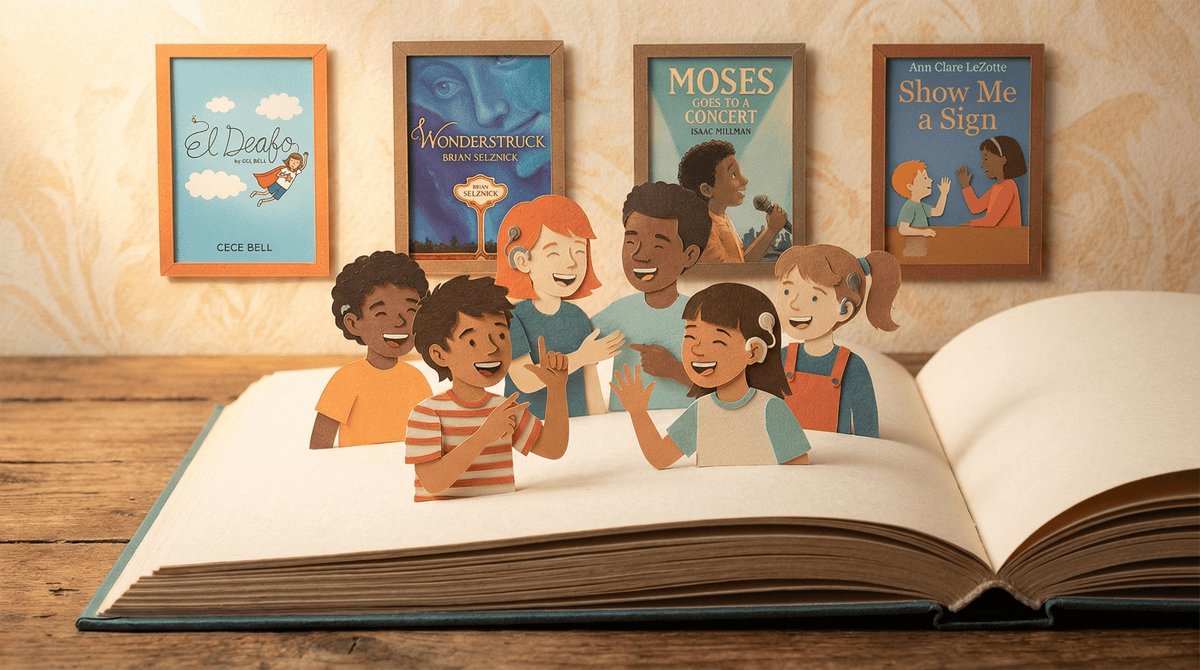
El Deafo by Cece Bell is technically a graphic novel for slightly older kids (we'll get there), but Moses Goes to School and Moses Goes to a Concert by Isaac Millman are perfect for younger readers. Moses is a deaf kid who uses sign language, and the books include ASL illustrations so kids can learn signs as they read.
A Quiet Place inspired some great picture books, but honestly? Skip those and go for I Am Deaf from the "I Am" series—straightforward, affirming, and written for kids who need to see themselves or understand a friend.
Ages 8-12:
El Deafo by Cece Bell is the gold standard here. It's a graphic memoir about Bell's childhood navigating elementary school with a giant hearing aid (the "Phonic Ear") that makes her feel like a superhero and an outcast at the same time. It's funny, heartfelt, and doesn't shy away from the awkwardness of being different. Bonus: it won a Newbery Honor, so it's also just a really good book.
Wonderstruck by Brian Selznick (the guy who wrote The Invention of Hugo Cabret) weaves together two stories—one in words, one entirely in pictures—about a deaf girl in 1927 and a boy in 1977 searching for connection. It's gorgeous and intricate.
Show Me a Sign by Ann Clare LeZotte is historical fiction set in 1805 Martha's Vineyard, where a significant portion of the population was deaf and everyone signed. It's a fascinating look at what community looks like when deafness isn't seen as a disability.
Ages 13+:
Deaf Republic by Ilya Kaminsky is poetry, not a novel, but it's stunning—an entire town goes deaf as an act of resistance. Heavy stuff, but powerful for teens ready for it.
True Biz by Sara Nović is a recent YA novel set at a school for the deaf, following three students navigating identity, family expectations, and the controversy around cochlear implants. Nović is deaf herself, and it shows—this isn't a hearing person's imagination of deaf life. It's the real deal, with all the complexity and community drama you'd expect from any high school story.
Switched at Birth isn't a book, but if your teen is into shows, the series features deaf characters and was praised for its authentic representation (multiple deaf actors, storylines about deaf culture, not just "deaf person overcomes obstacles").
Not all deaf people want to be "fixed." This is the big one. A lot of hearing people assume cochlear implants or hearing aids are an obvious choice, but within deaf culture, there's real debate about this. Some see deafness as a disability to be corrected; others see it as a cultural identity to be celebrated. Books like True Biz dive into this tension, and it's worth talking about with older kids.
Sign language isn't universal. ASL (American Sign Language) is different from BSL (British Sign Language), which is different from Auslan (Australian Sign Language). They're distinct languages with their own grammar and syntax. If your kid gets interested, there are great ASL resources online—check out apps and videos for learning ASL .
.
"Deaf" vs. "deaf." Capital-D "Deaf" often refers to people who identify with deaf culture and community. Lowercase "deaf" is more about the audiological condition. It's not a huge deal for kids to understand this distinction early on, but it's good context for parents.
Representation matters, but so does authorship. If a book about a deaf character is written by a hearing author, approach it with a bit more skepticism. Not that hearing authors can't write good stories, but deaf authors bring lived experience that's hard to replicate. El Deafo and True Biz are both by deaf authors, which is part of why they're so good.
If your kid is reading one of these books, ask open-ended questions:
- "What do you think it would be like to communicate mostly through sign language?"
- "How is the character's experience different from yours? How is it similar?"
- "What surprised you about this story?"
If your kid is deaf or hard-of-hearing, ask them what they think of the representation. Does it feel accurate? Is there anything that bugs them? Their perspective is the most important one here.
And if you're reading these books because your family is navigating hearing loss or deafness, know that there are parent communities and resources beyond just books—learn more about supporting deaf and hard-of-hearing kids.
Books with deaf characters aren't just for deaf kids—they're for all kids. They build empathy, expand understanding, and show that there are lots of ways to move through the world. Plus, they're often just really good stories.
Start with El Deafo if your kid is in elementary or middle school. It's accessible, funny, and a great entry point. For teens, True Biz is the move. And for younger kids, the Moses books are sweet and simple.
The goal isn't to turn your kid into an ASL expert overnight. It's just to show them that different doesn't mean less-than. And honestly? That's a lesson worth learning early.