

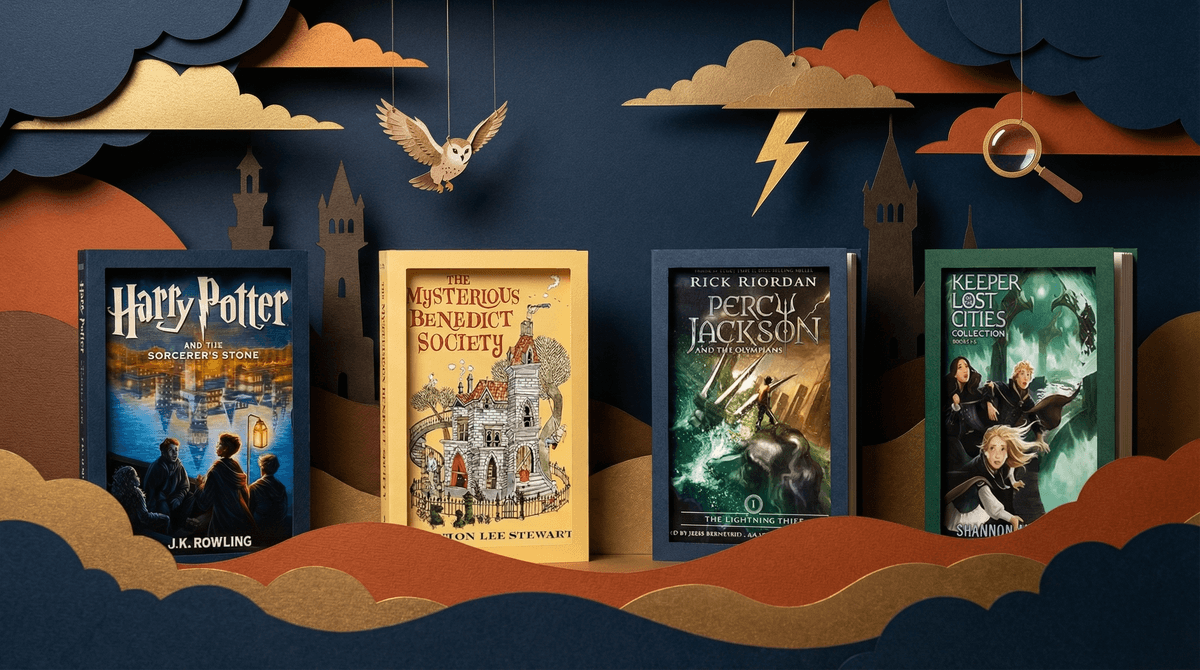
Books for Harry Potter Fans: What to Read Next After Hogwarts
So your kid has finished Harry Potter. Maybe for the first time, maybe for the third time. And now they're wandering around the house like a lost Hufflepuff, asking "what do I read now?" with genuine despair in their voice.
I get it. Harry Potter is a gateway drug for young readers — it creates this specific craving for magical worlds with boarding schools, chosen ones, found families, and stakes that feel genuinely important. And here's the thing: there are actually tons of incredible fantasy series out there that can scratch that same itch, but finding the right one depends on your kid's age, reading level, and what specifically they loved about Hogwarts.
Before we dive into recommendations, it helps to understand what your kid actually loved about the series. Was it:
- The magical school setting (classes, houses, teachers who care)
- The found family (Harry, Ron, and Hermione's friendship)
- The mystery elements (figuring out what's really going on)
- The hero's journey (ordinary kid becomes extraordinary)
- The world-building (every detail matters, everything connects)
- The darkness (real stakes, real loss, growing complexity)
Most kids love all of it, but there's usually one element that really hooks them. That can help you narrow down what to try next.
If your kid just finished the early HP books or isn't quite ready for the darker later books, these are solid next steps:
Percy Jackson and the Olympians by Rick Riordan is the obvious first choice, and honestly? It's that popular for a reason. Percy is dyslexic and has ADHD, which turns out to be demigod superpowers. The humor is more modern than HP, the chapters are shorter, and the mythology angle gives kids something concrete to latch onto. The found family vibes are strong, and there are like 15+ books across different series set in the same universe, so if they love it, you're set for months.
Fablehaven by Brandon Mull is less well-known but absolutely delivers on the "secret magical world hidden in plain sight" vibe. Two siblings discover their grandparents run a preserve for magical creatures. It's got genuine stakes, creative world-building, and that same sense of "wait, what if magic is real and just hidden?"
The School for Good and Evil by Soman Chainani literally IS a magical boarding school, but for fairy tale characters. It's clever, it subverts expectations, and it's got that same "houses/sorting" element that HP fans love. Fair warning: it gets surprisingly dark and complex as the series progresses.
This is the sweet spot where kids can handle more complexity but aren't quite ready for full YA darkness.
Keeper of the Lost Cities by Shannon Messenger is basically "what if Harry Potter but the magical world is elves and it's even MORE elaborate?" Sophie discovers she's an elf with special abilities and gets whisked away to their hidden world. It's got the school setting, the chosen one narrative, the mystery elements, and SO MUCH world-building. The series is long (10+ books) and actively ongoing, which is either a blessing or a curse depending on how you feel about waiting for releases.
Artemis Fowl by Eoin Colfer is perfect for kids who loved the clever plotting and mystery elements of HP. Artemis is a 12-year-old criminal mastermind who discovers fairies are real and tries to steal their gold. It's funny, it's smart, and the main character is morally complicated in a way that feels fresh. (Do NOT let them watch the Disney movie adaptation — it's simply unwatchable and bears no resemblance to the books.)
The Mysterious Benedict Society by Trenton Lee Stewart isn't fantasy, but it absolutely nails the "found family of misfit kids solving mysteries" vibe. Four gifted orphans are recruited for a secret mission. The puzzles are genuinely challenging, the friendships are deep, and the stakes feel real without being traumatizing.
If your kid has finished all seven HP books and is ready for something with similar emotional depth and complexity:
The Magicians by Lev Grossman is basically "Harry Potter goes to college and has a quarter-life crisis." It's darker, more mature, and explicitly grapples with the question "what if you got everything you wanted and it still wasn't enough?" This is for older teens who can handle depression, alcohol, and sexual content. It's brilliant but definitely not for younger readers.
A Deadly Education by Naomi Novik is a magical boarding school where the school itself is literally trying to kill you. El is prickly, sarcastic, and powerful in ways she doesn't want to be. The world-building is phenomenal, and the "chosen one" narrative gets completely subverted. This is for teens who want something darker and more morally complex.
Six of Crows by Leigh Bardugo isn't about a magical school, but it absolutely delivers on the found family, heist-with-magic, complex-world-building front. Six damaged teens pull off an impossible heist in a world where some people can manipulate matter. The character work is exceptional, and the plotting is tight as hell.
The Name of the Wind by Patrick Rothfuss is for advanced teen readers who want something literary and dense. It's got a magical university, a mystery about the main character's past, and prose that's genuinely beautiful. Fair warning: the third book has been in progress for over a decade, which is... frustrating.
Look, not every HP fan wants more fantasy. Some kids just want that same feeling of being completely absorbed in a world. For those kids:
- The Hunger Games has the chosen one narrative and found family in a dystopian setting
- Ender's Game has the boarding school (in space!) and the brilliant-kid-saves-the-world plot
- The Book Thief has that same sense of reading something that matters, with beautiful prose and real stakes
Here's the truth: nothing will be exactly like Harry Potter, and that's okay. Part of growing as a reader is learning that different books scratch different itches, and that's what makes reading exciting.
The best approach? Let your kid try a few different options. Most libraries will let you check out the first book in a series, and if they don't like it after 50 pages, it's fine to move on. The goal isn't to find a Harry Potter replacement — it's to find the next book that makes them want to stay up past bedtime reading under the covers with a flashlight.
And if they end up just re-reading Harry Potter for the fourth time? That's fine too. Sometimes you just want to go home to Hogwarts.
Not sure where to start? Get recommendations based on your kid's specific age and interests based on your kid's specific age and interests. Or check out our guide to age-appropriate fantasy series for even more options.