

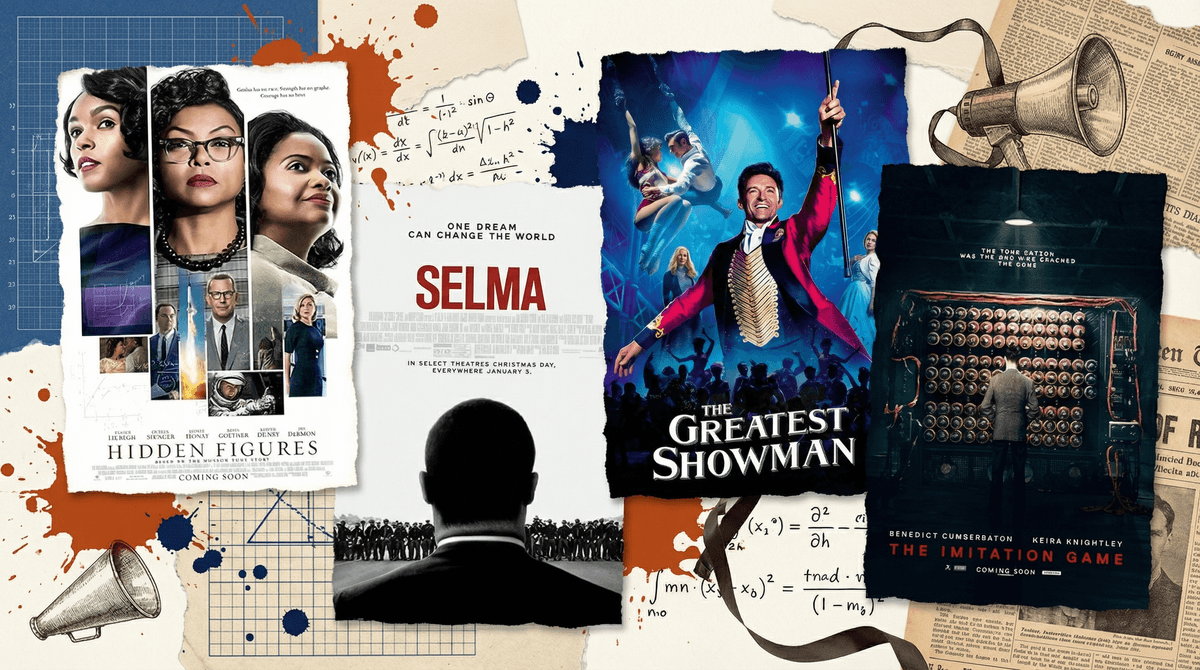
Biopics—biographical films based on real people's lives—are having a moment. From Oppenheimer to The Imitation Game, Hollywood loves a true story. And honestly? So should you.
Here's why biopics can be absolute gold for family viewing: they're pre-loaded with conversation starters. Unlike the 47th Marvel movie where you're debating CGI quality, biopics give you real humans who faced actual challenges, made genuine mistakes, and changed history. They're basically cheat codes for meaningful dinner conversations.
But not all biopics are created equal for family viewing. Some are brilliant. Some are... well, let's just say "historically accurate" doesn't always mean "appropriate for your 10-year-old."
There's something about knowing "this actually happened" that makes kids lean in. When my friend's daughter watched Hidden Figures, she spent the next week calculating orbital trajectories on scratch paper. The fact that Katherine Johnson was a real person who did real math to send astronauts to space? That landed differently than any fictional STEM character ever could.
Biopics also do something magical: they make history feel human. World War II isn't just a chapter in a textbook—it's Alan Turing cracking codes while hiding who he loved. The space race isn't just Cold War politics—it's Black women mathematicians fighting for recognition while literally calculating rocket science by hand.
Plus, biopics naturally introduce the concept that heroes are complicated. Real people make mistakes. They have flaws. They don't always get happy endings. This is actually healthy for kids to understand, especially in an age of superhero worship and influencer culture where everyone's life looks perfect.
Ages 7-10:
Hidden Figures (PG) is the gold standard. Math, space, civil rights, and not a boring minute in the whole film. Yes, there's racism depicted, but it's handled in a way that's educational without being traumatizing for younger viewers.
McFarland, USA (PG) follows a cross-country team in a predominantly Latino town. It's about perseverance, community, and Kevin Costner being wholesome. Solid choice.
Ages 10-13:
The Imitation Game (PG-13) is phenomenal for this age. Alan Turing's story touches on WWII, cryptography, neurodivergence, and LGBTQ+ persecution. It's heavy but important, and the codebreaking plot keeps it engaging.
A Beautiful Mind (PG-13) tackles mental illness, genius, and redemption. Fair warning: there are some intense scenes around John Nash's schizophrenia that warrant a conversation before or after viewing.
The Greatest Showman (PG) is technically a biopic, though it takes... creative liberties with P.T. Barnum's story. It's more "inspired by" than "based on," but the music slaps and it opens conversations about entertainment, exploitation, and who gets to tell their story.
Ages 13+:
Oppenheimer (R) is a masterpiece, but it's R for a reason. If your teen is interested in physics, ethics, or history, this is worth watching together. The atomic bomb's moral implications are exactly the kind of thing teens should be wrestling with.
The Social Network (PG-13) is basically required viewing for any teen on social media. Yes, it's about Facebook's founding, and yes, everyone comes across as kind of terrible. That's the point. Perfect conversation starter about tech ethics and friendship .
.
Selma (PG-13) covers MLK and the 1965 voting rights marches. It's powerful, necessary, and depicts violence that's historically accurate but difficult to watch. Preview it first.
Not every acclaimed biopic is family-appropriate, and that's fine. Bohemian Rhapsody is a fantastic film about Freddie Mercury, but the drug use and sexual content make it better for older teens. The Wolf of Wall Street? Absolutely not for family movie night unless your family is just you and other adults.
Lincoln is historically important and beautifully made, but let's be honest: it's also three hours of political procedure. Know your audience. If your kid can't sit through a 20-minute car ride, they're not ready for Spielberg's congressional deep-dive.
Here's the thing: just watching a biopic together isn't enough. The magic happens in the conversation.
Before watching: Give context. "This is about the women who did the math to get astronauts to the moon, and they had to fight racism and sexism to do it." Set the stage so kids know what they're looking for.
During watching: Pause when needed. If something confusing or heavy happens, hit pause. "Do you understand what just happened? Want to talk about it?"
After watching: Ask open questions. Not "did you like it?" but "What surprised you?" or "What would you have done in that situation?" or "Why do you think they made that choice?"
Also: look up the real story together. Hollywood takes liberties. Comparing the film to actual history is its own educational moment.
Biopics aren't just entertainment—they're empathy training. They show kids that real people changed the world, often while facing impossible odds. They demonstrate that history isn't boring dates and names, but actual humans making difficult choices.
Are they perfect? No. Hollywood dramatizes, simplifies, and sometimes straight-up invents stuff. But that imperfection is actually useful—it teaches media literacy and critical thinking.
The best family movie nights aren't about finding the "perfect" film. They're about finding the film that sparks a conversation you wouldn't have had otherwise. Biopics deliver that in spades.
Not sure where to start? Check out our full guide to movies for different age groups or explore alternatives to the same five Disney movies you've watched 100 times.
And if you want personalized recommendations based on your kid's actual interests and your family's values? That's literally what Screenwise does. Take the survey, get the recommendations, skip the "is this appropriate?" spiral at 7pm on Friday night.