

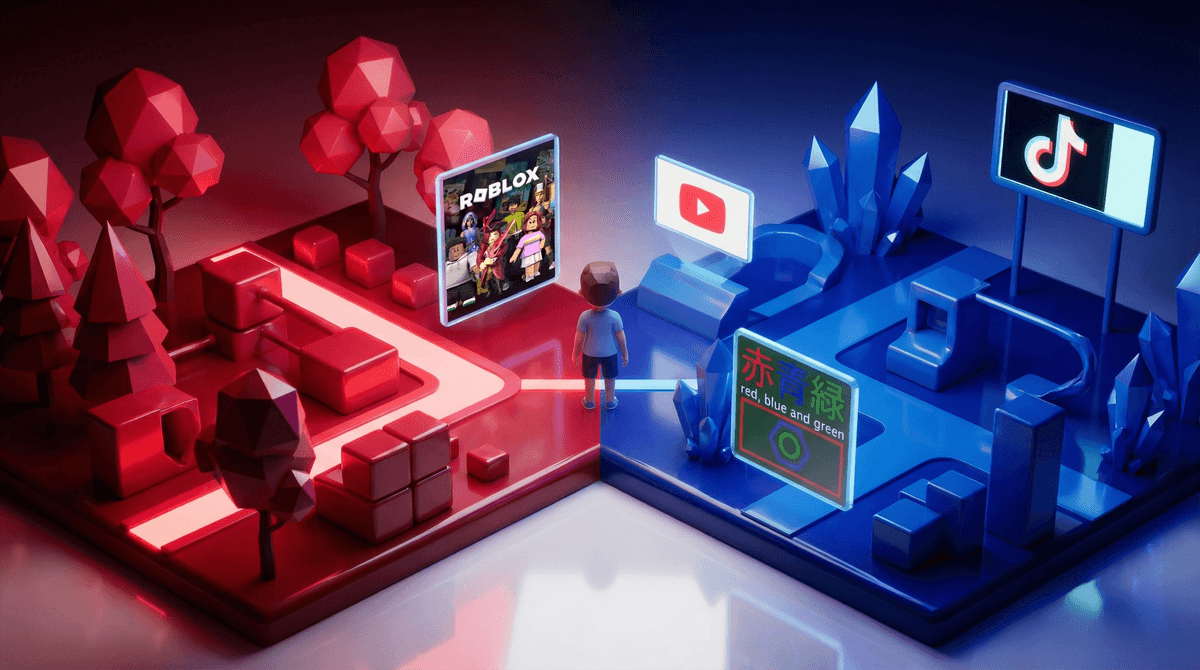
If your kid has been asking you to play a game that sounds suspiciously simple—"Would you rather be red or blue?"—welcome to one of the internet's latest viral phenomena. Between Red and Blue is a choice-based game that's been spreading through schools, YouTube, TikTok, and Roblox like wildfire.
Here's the basic premise: players are presented with two options—red or blue—and each color represents different powers, abilities, or scenarios. Sometimes it's "Red = super strength, Blue = invisibility." Other times it's more abstract: "Red = you can fly but everyone knows your location, Blue = you're immortal but you age normally." The game has spawned countless variations, from simple playground debates to elaborate Roblox games with full storylines and competitive elements.
The trend started gaining serious traction in late 2024, with kids creating their own versions, YouTubers making "Red vs Blue" content, and the whole thing becoming a genuine cultural moment in kid spaces online and offline.
This game hits a sweet spot for kids developmentally, which is why it's everywhere right now.
It's about identity and choices. Kids, especially ages 8-14, are figuring out who they are. Being "Team Red" or "Team Blue" gives them a low-stakes way to express preferences and align with a group. It's the same psychology behind Hogwarts houses or Pokémon teams, but even simpler.
It sparks genuine debate. Unlike a lot of digital content that's passive consumption, this game requires thinking through hypotheticals and defending choices. Kids love arguing about whether flying is better than super speed, and honestly? That's not the worst thing they could be doing online.
It's infinitely customizable. Kids aren't just consuming this trend—they're creating it. They make up their own red vs blue scenarios, draw characters, create Roblox games, and film YouTube videos about it. About 55% of kids in our community data are gaming regularly, and a huge chunk of that creative energy is going into making their own versions of viral trends like this.
It works everywhere. You can play it on the bus, in a Roblox game, through text messages, or just sitting at lunch. No equipment needed, no app to download (though there are plenty of apps and games capitalizing on it).
Let's talk about what this trend really looks like in practice and what actually matters.
The content varies wildly. Some versions are totally innocent ("Red = pizza for every meal, Blue = unlimited ice cream"). Others get into more complex moral territory ("Red = save your family, Blue = save 100 strangers"). And yes, some versions on YouTube or TikTok include inappropriate scenarios or crude humor. With 42% of kids in our community using YouTube solo (unsupervised), they're definitely encountering the full spectrum.
The Roblox games are the real ecosystem. There are dozens of Between Red and Blue Roblox games, and they range from simple voting games to elaborate battle arenas. Some are well-designed and genuinely creative. Others are cash grabs trying to get kids to spend Robux. If your kid is playing these, it's worth checking which specific games they're in—the quality and appropriateness vary dramatically.
It reveals how kids think about choices. Pay attention to what your kid picks and why. Are they choosing based on what's "cool" or what their friends choose? Are they thinking through consequences? Are they picking the selfless option or the self-serving one? This game is actually a fascinating window into their developing moral reasoning and decision-making.
The social pressure is real. In some friend groups, being "Red" or "Blue" has become a whole identity thing. Kids might feel pressure to pick a side and stick with it, or get teased for choosing "wrong." It's usually harmless, but if your kid seems stressed about it, that's worth a conversation.
Ages 6-8: At this age, kids can handle simple "would you rather" scenarios, but they might not grasp the more complex hypotheticals. If they're playing, keep it to straightforward choices and use it as a conversation starter. They probably shouldn't be watching YouTube videos about this unsupervised—stick to YouTube Kids if they want video content.
Ages 9-12: This is the sweet spot. They get the game, they love debating the scenarios, and they're probably creating their own versions. This is also the age where they're most likely to encounter inappropriate versions online. The 38% of kids in our community using YouTube with supervision? That's a solid approach for this age group. Check in on what they're watching and what Roblox games they're playing.
Ages 13+: Teens will roll their eyes at the simpler versions but might still engage with more complex moral dilemmas. They're also more likely to see this as "kid stuff" unless it's packaged in a more sophisticated way. They can handle most content, but it's still worth knowing what they're consuming and who they're playing with online.
Instead of just monitoring or restricting, try engaging with it:
Play it with them. Seriously, just ask your kid to give you some red vs blue scenarios. You'll learn how they think, what they value, and you might actually have fun. Plus, you can introduce more thoughtful scenarios that make them think deeper.
Use it as a teaching tool. These hypotheticals are perfect for discussing consequences, trade-offs, and values. "If you picked red because you get super strength, what would you actually do with that? How would it change your life? What are the downsides?"
Check the Roblox games together. If they're playing Between Red and Blue games on Roblox, spend five minutes watching or playing with them. You'll quickly see if it's a quality game or a sketchy cash grab, and you'll understand what they're actually doing online.
Set boundaries on the YouTube rabbit hole. With 42% of kids in our community using YouTube solo, we know most kids are watching unsupervised. But this trend is one where the content quality varies so dramatically that some guardrails make sense. Consider using supervised mode or at least having periodic check-ins about what they're watching.
Between Red and Blue is mostly harmless and actually kind of interesting as far as viral trends go. It encourages decision-making, sparks conversation, and gives kids a creative outlet. The main concerns are the same as with any viral trend: content quality varies, there's potential for inappropriate stuff on YouTube and TikTok, and some Roblox games are trying to extract money from your kid.
This isn't a trend worth panicking about or banning outright. It's worth understanding, engaging with, and using as an opportunity to talk with your kid about how they make choices and what they value. And honestly? If the worst thing your kid is doing online is debating whether they'd rather have teleportation or time travel powers, you're doing okay.
- Ask your kid to explain their favorite red vs blue scenario and why they picked what they did
- If they're playing on Roblox, check which specific games they're in
- Consider whether your YouTube setup (20% no usage, 38% supervised, 42% solo in our community) is working for your family
- Use this as a jumping-off point for bigger conversations about decision-making and online content