

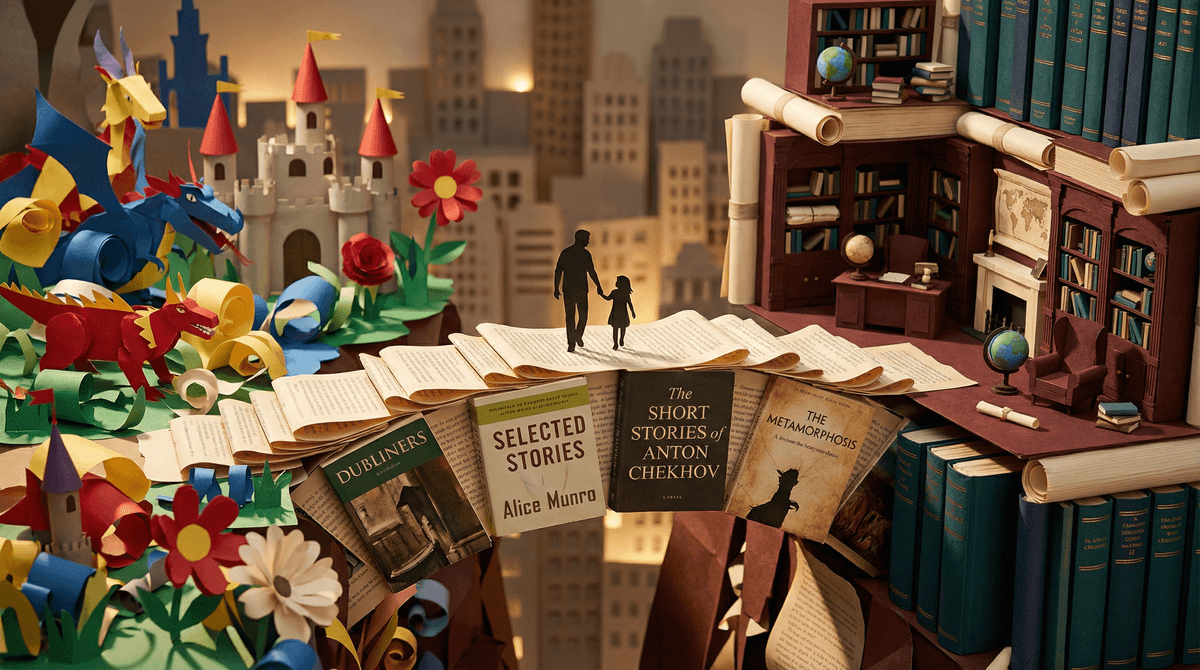
Literary Short Stories That Bridge the Gap Between Picture Books and Kafka
If you've been reading Chekhov and Munro yourself and wondering when your kid will be ready for that level of storytelling craft, here's the path forward:
For advanced readers ages 12+: Selected Stories by Alice Munro and The Short Stories of Anton Chekhov (Restless Classics edition)
For easing in ages 10-14: Little Apples and Other Early Stories by Chekhov and Dubliners by James Joyce
For younger readers ages 8-12: The Oxford Book of Children's Stories and curated short story anthologies
You're raising a reader. Not just someone who reads, but someone who gets it—the way a perfectly placed comma can change everything, how a story can end without resolution and still feel complete, why Chekhov's gun matters. You want your kid to experience that same electric jolt you felt the first time you read Kafka's "The Metamorphosis" or Munro's "The Bear Came Over the Mountain."
But here's the problem: most children's literature—even the good stuff—doesn't prepare kids for the narrative sophistication of literary short fiction. There's a massive gap between "Charlotte's Web" and "The Lady with the Dog," and nobody really talks about how to bridge it.
Literary short stories teach something that novels often can't: economy of language, subtext, and the power of what's left unsaid. Chekhov famously said that if there's a gun on the wall in Act One, it must go off by Act Three. But he also knew that the most important moments happen in the pauses between dialogue, in what characters don't say.
Kids who grow up reading only plot-driven middle-grade fiction or YA fantasy can struggle when they hit their first Kafka story in high school. Not because they can't read the words, but because they've never learned to read the silences.
The good news? You can start building that literary muscle earlier than you think—if you choose the right books.
Little Apples and Other Early Stories (Seven Stories Press) is genuinely brilliant for this. These are Chekhov's magazine pieces from his twenties—before he became Chekhov. They're "fresh, yet mature, snapshots" that balance dark humor with compassion, and they're short enough (many under 10 pages) that a 12-year-old won't feel overwhelmed.
What makes these work for younger readers? They're funny. Chekhov's early work has a lightness that his later masterpieces often lack. Your kid will laugh at the absurdity of "The Death of a Government Clerk" (a man literally worries himself to death over sneezing on a superior) while absorbing lessons about social class, anxiety, and the human condition.
Ages 12-15 is the sweet spot here, especially for kids who've read some Roald Dahl or are into dry British humor. The stories don't have the heavy themes of infidelity, alcoholism, or existential despair that populate Chekhov's later work.
The Short Stories of Anton Chekhov (Restless Classics edition) is the real deal. This is "sensitivity, wisdom, precision, verve, soulfulness, and economy" all in one collection. Stories like "The Lady with the Dog" and "Gooseberries" showcase mature Chekhov at his finest.
But let's be real: these are adult stories. They deal with affairs, disappointment, mortality, and the quiet tragedies of ordinary life. Ages 15+ minimum, and honestly, they hit different at 17 than they do at 30 than they do at 50. That's part of their genius.
Many high schools assign Chekhov in AP Lit or advanced English classes, so if your teen is already reading The Great Gatsby or Beloved, they're ready for this.
Selected Stories (Penguin Clothbound Classics) compiles "the best, most touching and powerful short stories ever written" from Munro's career. If Chekhov is the grandfather of the literary short story, Munro is its contemporary queen.
Her stories are deceptively simple. They often focus on women in small Canadian towns, dealing with marriage, children, aging parents, affairs. But the way she structures time—jumping decades within a single paragraph, revealing crucial information through seemingly casual asides—is masterful.
The challenge? Munro's stories are deeply interior and often require life experience to fully appreciate. A 14-year-old can technically read "The Bear Came Over the Mountain" (about a woman with dementia), but will they understand the devastating weight of a 50-year marriage slowly dissolving? Maybe not yet.
Ages 16+ is realistic, and honestly, these might be better as college reading or early twenties discovery. But if you have a particularly mature reader who's interested in character-driven literary fiction, they're worth trying at 15.
Dubliners deserves mention here because it's frequently taught in high school and occupies a similar space to Chekhov—stories about ordinary people, moments of revelation (Joyce's famous "epiphanies"), and endings that don't tie up neatly.
"The Dead" is one of the greatest short stories in English, full stop. But the collection as a whole is more accessible than you might think. Stories like "Araby" (about a boy's first crush) and "Eveline" (about a young woman deciding whether to leave Dublin) work beautifully for ages 14-16.
Joyce's prose is denser than Chekhov's, but the stories are shorter and the themes are often more universal to adolescence—identity, escape, disillusionment, the gap between dreams and reality.
If your kid is 8-12 and you want to start building literary taste, you need different tools.
The Oxford Book of Children's Stories brings together classic fairy tales and folk narratives with actual literary merit. These aren't Disney versions—they're the real deal, with darkness and moral complexity intact.
The BookTrust short story collections list is also fantastic for age-sorted picks. Look for anthologies that include authors like Neil Gaiman, Kelly Link, and Angela Carter—writers who bring literary sophistication to fantasy and magical realism.
Reading level ≠ emotional readiness. Your 12-year-old might technically be able to read Munro, but that doesn't mean they should. These stories deal with adult relationships, sexuality, aging, death, and moral ambiguity. Use your judgment.
Start with one story, not the whole collection. Pick a single Chekhov story ("The Bet" is great for teens) and read it together. Talk about it. See if they're engaged or just slogging through because you assigned it.
Context helps. Knowing that Chekhov was a doctor who wrote stories on the side, or that Munro spent decades as a housewife before becoming famous, or that Joyce was trying to capture the spiritual paralysis of Dublin—this stuff matters. It makes the stories come alive.
Let them find their own way in. Maybe your kid won't love Chekhov but will devour Flannery O'Connor or Raymond Carver. The goal isn't to create mini-yous—it's to expose them to literary craft and let them discover what resonates.
Ages 8-11: Stick with curated children's anthologies and fairy tale collections. Focus on story structure and language.
Ages 12-14: Try Chekhov's early work, Joyce's "Araby" and "Eveline," and modern literary anthologies like collections from Kelly Link.
Ages 15-17: Full Chekhov, Joyce's "The Dead," and potentially Munro if they're interested in character-driven literary fiction.
Ages 18+: Everything is on the table. Also consider Kafka, Borges, and Carver.
You can't force literary taste, but you can create the conditions for it to develop. Start with stories that are age-appropriate but still challenging. Read them together. Talk about craft—how does this writer create mood? What's left unsaid? Why does this ending feel satisfying even though nothing is resolved?
The kids who grow up reading Chekhov and Munro alongside Percy Jackson and The Hunger Games develop a different kind of literacy—one that values nuance, ambiguity, and the quiet moments that make us human.
And when they're 25 and they text you about rereading "The Lady with the Dog" and finally getting it? That's the whole point.