

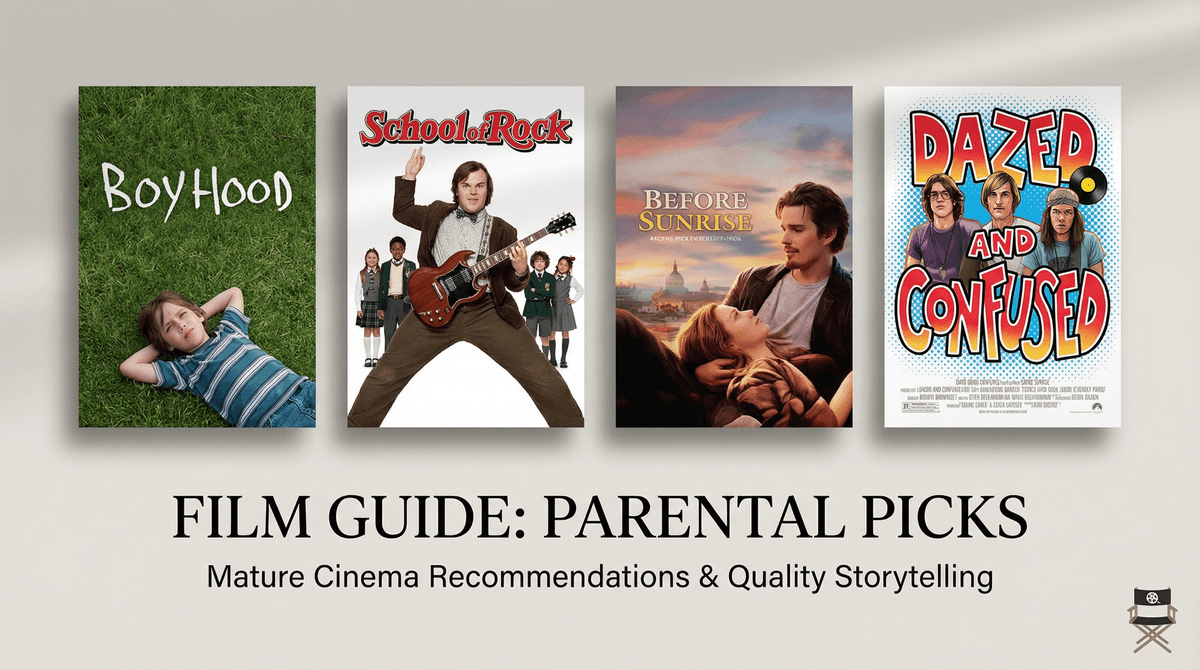
The Linklater Problem: Why His Best Films Aren't Tween-Friendly (And What to Watch Instead)
TL;DR: Richard Linklater is one of America's most celebrated filmmakers, but his work is overwhelmingly rated R. Even Boyhood—literally about growing up—is R-rated. If you're looking for Linklater films for tweens, you're mostly out of luck. But if you have a mature 15-17 year old, there's gold here for meaningful conversations about time, identity, and what it means to be human.
Quick picks for older teens:
- Ages 15+: Boyhood (R, but mostly for language)
- Ages 16+: Dazed and Confused (R for drugs/language)
- Ages 17+: Before Sunrise trilogy (R for mature themes)
- Ages 13+ (barely Linklater): School of Rock (PG-13, his most accessible)
Richard Linklater is the master of the mundane profound. He makes movies where people just... talk. Walk around. Exist. His films unfold in real-time or across decades, capturing the texture of life rather than manufactured drama.
This makes him brilliant. It also makes him terrible for tweens.
His signature style—naturalistic dialogue, long takes, philosophical musings about existence—requires patience and life experience to appreciate. More problematically, his commitment to authentic human experience means his characters swear, do drugs, have sex, and grapple with adult disillusionment. The MPAA has rewarded this authenticity with R ratings across most of his filmography.
Rating: PG-13
Ages: 11-13+
Why it works: This is Linklater's crowd-pleaser, and honestly, it barely feels like a Linklater film. It's got Jack Black doing Jack Black things, a predictable underdog story, and a lot of guitar solos.
But here's what makes it Linklater: the kids are treated as real people with agency, the adults are flawed and trying, and there's genuine respect for the transformative power of art. It's not deep, but it's got heart.
Discussion prompts:
- What does Dewey learn from the kids that he couldn't learn from adults?
- Why do you think the kids' parents react the way they do when they discover the truth?
- What's the difference between following rules and doing the right thing?
The catch: Even this has some mild language and Jack Black's character is... not a role model for the first two acts. But if your tween can handle The Goonies or Ferris Bueller's Day Off, they can handle this.
If you have a 15-17 year old who's ready for more complex, adult-adjacent content—and you're willing to co-watch and discuss—here's where Linklater shines.
Boyhood (Ages 15+)
Rating: R (for language and teen drinking)
Runtime: 2 hours 45 minutes
The premise: Filmed over 12 years with the same cast, following Mason from age 6 to 18.
This is Linklater's masterpiece and the most obvious choice for older teens. The R rating is mostly for authentic teenage behavior—parties, swearing, some drinking. There's no graphic violence or sex scenes.
Why it's powerful: Your teen will watch a kid their age grow up in real-time. They'll see the small moments that shape a life—a haircut, a birthday, a move to a new city, a parent's new partner. It's like watching a time-lapse of childhood, and it hits different when you're still in it.
Discussion prompts:
- What moments in Mason's life felt most familiar to your own experience?
- How do Mason's relationships with his parents change as he grows up?
- The movie doesn't have a traditional plot—why do you think Linklater made that choice?
- What do you think the movie is saying about time and memory?
Parent note: There's a domestic violence scene in the middle that's intense but not graphic. The stepdad is verbally and physically abusive. Know your kid's sensitivities.
Dazed and Confused (Ages 16+)
Rating: R (drugs, language, hazing)
The premise: The last day of school in 1976 Austin, Texas. That's it. That's the movie.
This is a nostalgia trip for Gen X parents and a time capsule for teens. It's about that liminal space between childhood and whatever comes next—the summer after school ends, when everything feels possible and nothing feels certain.
The problem: There's a LOT of marijuana use (it's basically a contact high of a film), underage drinking, and a hazing sequence that's uncomfortable to watch. The teenage characters make consistently bad decisions, which is kind of the point.
Why it might be worth it: If you can get past the drug use, this is one of the most honest depictions of teenage social dynamics ever filmed. The hierarchies, the insecurities, the performance of coolness—it's all there.
Discussion prompts:
- How are the social dynamics in this 1976 high school similar or different from your school?
- Why do you think the characters are so focused on "what comes next"?
- The hazing scenes are hard to watch—why do you think people participate in traditions like this?
- What does the movie suggest about the relationship between freedom and responsibility?
Before Sunrise (Ages 17+)
Rating: R (language, mature themes)
The premise: Two strangers meet on a train and spend one night walking around Vienna, talking.
This is the first film in Linklater's "Before" trilogy (Before Sunset, Before Midnight), and it's pure conversation. If your teen can't handle 90 minutes of two people just talking about life, love, death, and connection, skip it.
Why it's special: This is what romance looks like when it's about intellectual and emotional connection rather than physical attraction (though that's there too). It's about the magic of really being seen by another person, even briefly.
Discussion prompts:
- Why do you think Jesse and Céline decide to spend the night together?
- What makes their connection feel real despite only knowing each other for hours?
- The movie is all dialogue—how does that change the way you experience their relationship?
- Do you think they made the right choice at the end?
Parent note: The sequels are also R-rated and get progressively more adult. Before Midnight includes frank discussions of sex and a brutal marital argument. Save those for 18+.
The rating system is your friend here. Linklater's R ratings are earned—not because of gratuitous violence or exploitation, but because his characters behave like real people. Real teenagers drink and experiment with drugs. Real adults swear and have complicated relationships with sex.
This is not "kids watching R-rated movies" territory. This is "older teens ready for adult-adjacent content with parental context" territory. There's a meaningful difference.
Co-watching is essential. These films are conversation starters, not entertainment to consume alone. If you're not prepared to discuss what you're watching, wait until your teen is older.
Consider your teen's maturity, not just age. A sophisticated 15-year-old cinephile might be ready for Boyhood. A sheltered 17-year-old might not be ready for the Before trilogy. You know your kid.
Richard Linklater makes beautiful, humanistic films about the texture of lived experience. Unfortunately, lived experience includes a lot of content that's not appropriate for tweens.
If you're looking for Linklater for 10-12 year olds, School of Rock is basically your only option, and even that's PG-13.
For older teens (15-17), his work offers something rare: movies that trust young viewers to grapple with complexity, ambiguity, and the messy reality of growing up. In a media landscape that often talks down to teens or sensationalizes their experience, Linklater's films treat adolescence with respect and nuance.
Just make sure you're watching together and ready to talk about what you see.
- Looking for more coming-of-age films that are actually age-appropriate? Check out best coming-of-age movies for tweens
- Want other directors with similar sensibilities but more accessible content? Try Wes Anderson films for families or Studio Ghibli movies by age
- Curious about how to talk to teens about mature content in media? Learn more about co-viewing strategies
