

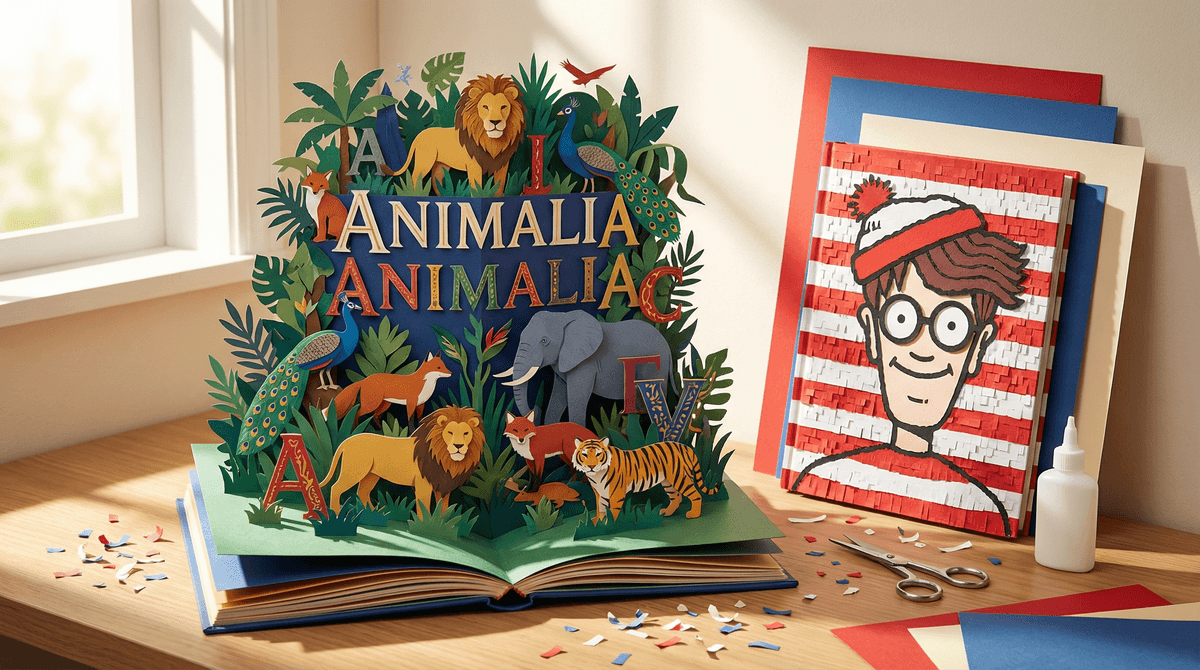
Animalia is one of those rare picture books that works magic at multiple ages. Published in 1986 by Australian author-illustrator Graeme Base, it's an alphabet book that transcends the genre entirely. Each page features a letter of the alphabet with an accompanying alliterative sentence and an absolutely packed illustration featuring animals and objects that begin with that letter.
But calling it just an "alphabet book" is like calling a Pixar movie "just a cartoon." The illustrations are so densely detailed that you could spend ten minutes on a single page finding hidden objects, animals, and clever visual jokes. It's basically "Where's Waldo?" meets vocabulary building meets fine art.
Here's the thing about Animalia: it grows with your kid in a way that most picture books simply don't.
For preschoolers (ages 3-5): They're learning letter sounds and animal names. "Look, the alligator is eating apples!" Mission accomplished.
For early readers (ages 5-7): They're sounding out the alliterative sentences ("An Armoured Armadillo Avoiding An Angry Alligator") and feeling like absolute geniuses when they can read the whole thing.
For confident readers (ages 7-10): They're on a treasure hunt, finding the hidden boy that appears in every illustration, counting how many objects they can spot that start with each letter, discovering visual puns and jokes in the artwork.
For tweens and beyond: They're appreciating the artistic skill, the humor, the sheer ambition of the project. Some adults still pull this book out just to marvel at the craftsmanship.
According to parent reviews on Common Sense Media, families report reading this book for years without getting bored. One parent noted: "I read this book as a child, and it still holds up today."
Let's be real: a lot of "educational" books feel like homework in disguise. Animalia doesn't have that problem because it's genuinely entertaining first and educational as a side effect.
Vocabulary building: The alliterative sentences use sophisticated vocabulary ("Ingenious Iguanas Improvising an Intricate Impromptu on Impossibly Impractical Instruments"). Kids absorb these words through context and repetition without it feeling like a vocabulary lesson.
Observation skills: Finding all the hidden objects is a legitimate cognitive workout. It teaches sustained attention, visual discrimination, and pattern recognition—all critical pre-reading skills.
Alphabet reinforcement: Even kids who know their letters benefit from the phonetic awareness practice. Hearing and seeing multiple words that start with the same sound strengthens those neural pathways.
Art appreciation: The illustrations are museum-quality. Exposing kids to this level of artistic detail and technique actually matters for developing visual literacy.
Some parents initially hesitate because Animalia doesn't have a traditional narrative. There's no plot, no character arc, no beginning-middle-end. As one reviewer on Don't Read This to My Kids notes: "There's not much to it; it's not a story. It's a series of incredibly detailed illustrations."
But that's actually a feature, not a bug. The lack of story means:
- You can open to any page without needing context
- Reading sessions can be 2 minutes or 20 minutes depending on your kid's attention span that day
- It works for mixed age groups because each kid can engage at their level
- It never gets old because there's always something new to discover
Think of it less like a traditional picture book and more like an interactive art gallery you can return to over and over.
Ages 2-4: They'll mostly just enjoy looking at the colorful animals. The text might be over their heads, but that's fine. Let them point and name animals. You can simplify: "Look at all the B animals! Bear, butterfly, bee..."
Ages 4-7: Prime Animalia years. Read the full alliterative sentences, help them find objects, make it a game. "Can you find five things that start with M?"
Ages 7-10: They can read it independently and will love the challenge of finding everything. Great for quiet time or as a "I spy" activity during waiting rooms, car trips (if they don't get carsick), or restaurant waits.
Ages 10+: Still works as coffee table art, a nostalgia read, or an introduction to detailed illustration techniques for budding artists.
It's a commitment book. This isn't a quick bedtime read. If your kid gets into it, expect 20-30 minutes of intense focus per session. That's actually wonderful for building attention span, but don't crack this open when you need to get out the door in five minutes.
The binding matters. Get the hardcover if possible. This book gets used. Kids will flip through it constantly, and paperback editions don't hold up well to repeated page-turning.
It's genuinely beautiful. Multiple parents on Goodreads mention that "no parent or child will ever be disappointed in getting Graeme Base's Animalia as a gift." It's one of those rare kids' books that adults actually enjoy having on the shelf.
Screen-free engagement that actually works. In an age where keeping kids engaged without screens feels impossible, Animalia delivers. The hidden object hunt provides the same dopamine hit as a video game, but with zero blue light and maximum cognitive benefit.
Animalia is the rare book that justifies its shelf space for years. It's not cheap (usually $20-30 for a hardcover), but the cost-per-read is phenomenal because kids return to it again and again.
If you're looking for something that bridges the gap between "baby board book" and "chapter book," or if you need a gift for a family with multiple kids of different ages, Animalia is a genuinely smart choice.
It's also a great answer to the eternal grandparent question: "What should I get them?" Because unlike most toys that get played with once, this book becomes part of a family's reading rotation for potentially a decade.
And in a world where kids are constantly asking for more screen time, having a book that can hold their attention for 30 minutes feels like finding a parenting cheat code.