

Look, American history can feel like a snooze-fest when it's taught through textbooks that make the founding of our country sound about as exciting as watching paint dry. But here's the thing: the American Revolution is actually full of drama, impossible odds, teenage soldiers, spy networks, and genuinely wild decisions that changed the world. The key is finding books that treat it like the incredible story it is rather than a list of dates to memorize.
The good news? There are actually tons of books out there that make this period come alive for kids—from picture books for the youngest readers to middle-grade novels that'll have tweens staying up past bedtime. The challenge is knowing which ones are worth your time and which ones are, well, still basically textbooks in disguise.
Beyond the obvious "they need to learn this for school" reason, the American Revolution is genuinely one of the best entry points for kids to understand how government works, why rights matter, and how ordinary people can change the course of history. It's also a great opportunity to talk about the complexity of history—yes, the founders did some remarkable things AND they also enslaved people and committed atrocities against Native Americans. Kids can hold both truths at once, and the right books help them do that.
Plus, if we're being honest, a lot of the founding mythology is getting deconstructed in real-time on their feeds anyway. Better to give them actual historical context than let them learn it from a TikTok with a 15-second attention span.
Ages 4-7: Picture Books That Spark Interest
Can't You Make Them Behave, King George? by Jean Fritz is legitimately funny and tells the story from King George's perspective, which is a refreshing angle. The illustrations are charming, and it doesn't talk down to kids.
Henry's Freedom Box by Ellen Levine isn't technically about the Revolution, but it's a powerful introduction to the concept of freedom and what people will risk for it. The story of Henry "Box" Brown is unforgettable.
The Revolutionary John Adams by Cheryl Harness is part of a whole series on the founders that's actually engaging. Adams is an underrated entry point for kids—he's cranky, principled, and didn't own slaves, which matters.
Ages 8-11: Chapter Books and Graphic Novels
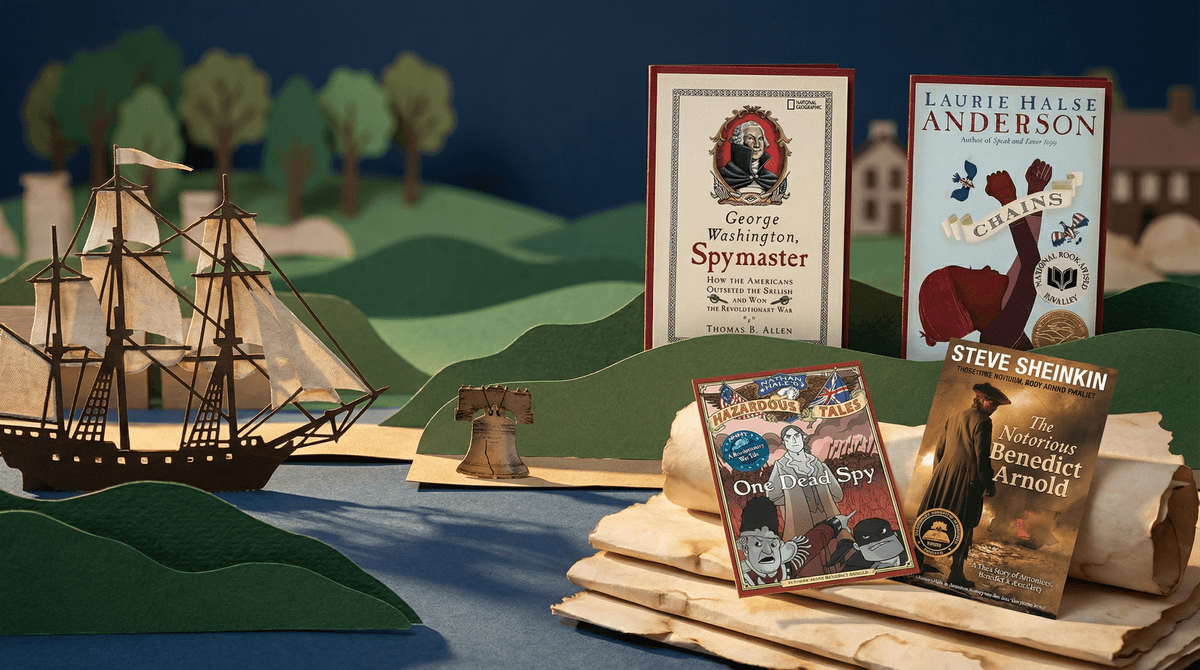
Chains by Laurie Halse Anderson is the gold standard here. It follows Isabel, a 13-year-old enslaved girl in New York City during the Revolution, and it does not pull punches about the hypocrisy of fighting for freedom while enslaving people. It's the first in a trilogy, and kids absolutely tear through these books. Fair warning: there are some intense scenes, so maybe read it first if your kid is sensitive.
Nathan Hale's Hazardous Tales series—specifically "One Dead Spy" and "Big Bad Ironclad!"—are graphic novels that make history genuinely entertaining. Yes, the author shares a name with the Revolutionary War spy, and yes, he leans into that. The humor is kid-friendly, the facts are solid, and reluctant readers will actually pick these up voluntarily.
George Washington, Spymaster by Thomas B. Allen focuses on the espionage network during the war, which is basically the most interesting angle for this age group. Invisible ink! Code names! The Culper Ring! It's history that feels like a thriller.
The Notorious Benedict Arnold by Steve Sheinkin is phenomenal for upper elementary/middle school. Sheinkin writes history like a novel, and this book shows how Arnold went from war hero to traitor. It's nuanced and doesn't oversimplify.
Ages 12+: Complex Narratives
Forge by Laurie Halse Anderson (sequel to Chains) and Ashes complete the trilogy. By this age, kids can handle the full complexity of the contradictions in the founding era.
My Brother Sam Is Dead by James Lincoln Collier is a classic for a reason—it shows how the Revolution tore families apart and doesn't present either side as purely good or evil. It's been challenged in some schools for violence and moral ambiguity, which honestly makes it more worth reading.
1776 by David McCullough isn't technically a kids' book, but strong readers in middle school can absolutely handle it, and it reads like a story rather than a textbook.
The "founding fathers were perfect heroes" narrative is dead. Most modern books for kids acknowledge the complexity—that people like Washington and Jefferson did remarkable things AND owned human beings. This isn't "woke revisionism"; it's just... history. If you're worried about this, maybe explore how to talk about historical complexity with kids .
.
Graphic novels are real books. If your kid gravitates toward Nathan Hale's Hazardous Tales instead of a traditional chapter book, that's completely fine. They're learning the same history, and the visual format actually helps with retention.
Some of these books deal with violence. The Revolution was a war. People died, often brutally. Books like Chains and My Brother Sam Is Dead don't glorify violence, but they also don't pretend it didn't happen. Use your judgment based on your kid's sensitivity level.
Look for diverse perspectives. The Revolution wasn't just fought by white men in powdered wigs. Books that include the experiences of enslaved people, women, Native Americans, and regular soldiers give a much fuller picture of what actually happened.
The American Revolution is one of those topics where the right book can completely change how a kid sees history. Instead of memorizing dates, they can understand the ideas, the conflicts, and the very real people who risked everything for a vision of a different world—even if that vision was incomplete and hypocritical in many ways.
Start with whatever format your kid naturally gravitates toward—picture books, graphic novels, historical fiction, straight narrative nonfiction—and go from there. The goal isn't to turn them into history scholars (though that's cool if it happens). The goal is to help them see that history is made by real people making hard choices, and that understanding the past helps them make sense of the present.
And honestly? If they finish one of these books and want to talk about why the founders didn't extend freedom to everyone, or how the Revolution affected Indigenous peoples, or what "all men are created equal" actually meant in 1776... that's exactly the kind of critical thinking we should be encouraging.
Next Steps: Check out alternatives to screen time that actually work if you're looking for more ways to encourage reading, or explore how to build a family reading habit if getting kids to pick up books feels like pulling teeth.