

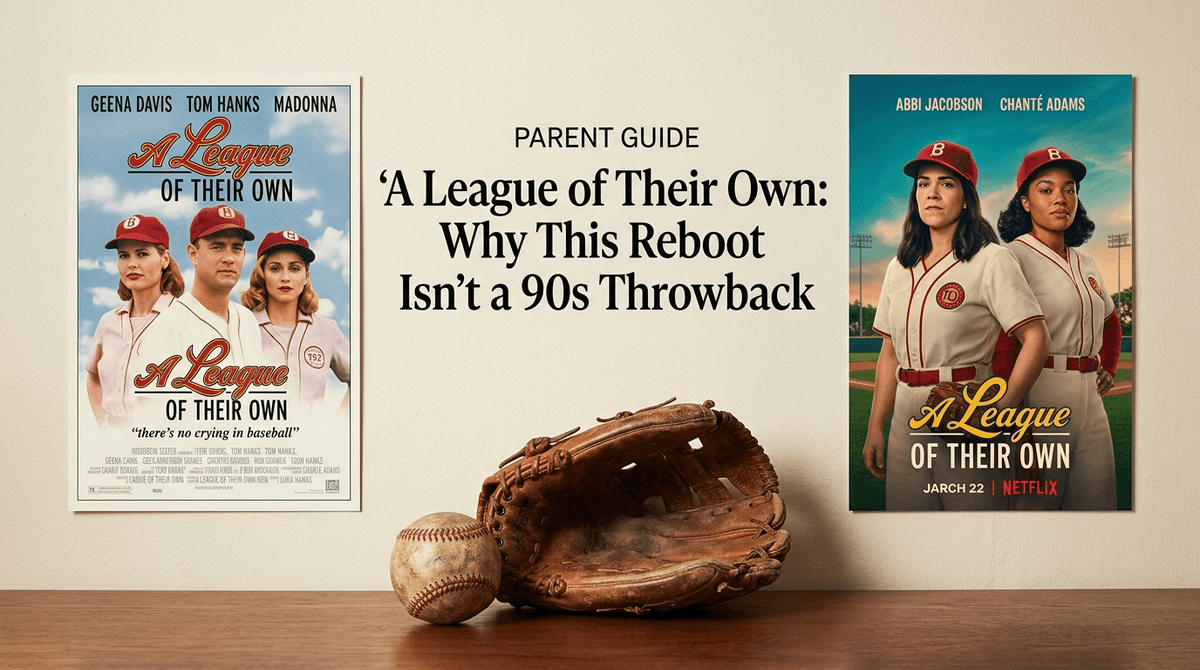
TL;DR: A League of Their Own (show) is not a shot-for-shot remake of the 1992 classic. It’s a queer-centric, historically gritty reimagining that swaps the "crying in baseball" jokes for deep dives into racial segregation and LGBTQ+ identity in the 1940s. It’s excellent television, but it’s rated TV-MA for a reason. Best for older teens (15+) who can handle heavy themes and plenty of f-bombs.
Find historical dramas for teens
If you grew up with the A League of Their Own movie, you probably remember Geena Davis, Tom Hanks, and a generally "wholesome for the whole family" vibe. This 2022 series, created by Abbi Jacobson and Will Graham, takes the basic premise—women playing professional baseball during WWII—and tells the stories that the 90s movie wasn't allowed to tell.
The show follows two parallel tracks. One is Carson Shaw (Jacobson), a catcher who leaves her small town while her husband is at war to try out for the Rockford Peaches. The other is Max Chapman (Chanté Adams), a talented Black pitcher who isn't even allowed to try out for the league because of Jim Crow laws and must find her own path to play the game she loves.
While the movie was a sports comedy, the show is a character-driven drama. It’s about "finding your team" in a world that doesn't want you to exist, specifically focusing on the queer community and the Black experience in the 1940s.
For intentional parents, this show is a massive opportunity to talk about "erasure" in history. The 1992 movie hinted at things—remember the scene where a Black woman throws a ball back to Geena Davis with incredible heat? That was a 10-second nod to the fact that Black women were excluded. This show makes that 10-second nod the entire point.
It also highlights that LGBTQ+ people didn't just "appear" in the 2000s. They were there in 1943, living complicated, secret, and often beautiful lives. If you want your kids to understand that history isn't just a list of wars and presidents, but a struggle for people to be themselves, this is a top-tier resource.
Learn more about how to talk to teens about historical representation
Let’s be real: this isn't a show for your 10-year-old who just started Little League. If you're looking for that, stick to The Sandlot. Here is the breakdown of why the TV-MA rating is actually earned:
Language
The characters talk like real people under pressure. There are a lot of f-bombs. It’s not gratuitous in a "shock value" way, but it’s constant. If your household is a "no swearing" zone, this will be a dealbreaker.
Sexual Content
This is a queer-centric show. There are multiple storylines involving women falling in love, and there are several sex scenes. They aren't "Game of Thrones" level graphic, but they are explicit enough that you probably don't want to be sitting on the couch with your middle-schooler during them. It’s about intimacy and discovery, not just "smut," but it is adult.
Violence and Intense Themes
The "violence" isn't physical brawls; it’s the systemic kind. There are scenes involving police raids on underground queer bars, the constant threat of being "found out," and the pervasive, crushing weight of racism. For a sensitive kid, the scene where a character has a mental health crisis or the scenes of blatant discrimination might be more upsetting than any action movie.
If you’re deciding whether to let your 14 or 15-year-old watch this, here are the three big conversation starters:
- The "Pinky" Code: In the 40s, queer people had to use coded language and secret spots to find each other. This is a great way to talk about how far we've come and what "safety" looks like for different communities.
- The Intersection of Race and Gender: Max’s story is arguably more compelling than Carson’s because she faces a double barrier. Watching her navigate a world that rejects her for being Black and for being a woman who wants to do "men's work" is a masterclass in intersectionality.
- The "Brain Rot" Factor: Zero. This is high-quality, nutritious television. It requires attention, empathy, and a bit of historical context. It’s the opposite of Skibidi Toilet or mindless Roblox sessions.
If your teen finishes the eight episodes and wants more (and they will, even though Amazon tragically canceled it after one season), here are some solid follow-ups:
If the draw was "women of color kicking butt in a historical setting where they weren't wanted," this is the gold standard. It’s much more family-friendly (PG) and focuses on the Black women at NASA.
Another "misfit women find a community through sports" show. It’s set in the 80s and involves professional wrestling. Like A League of Their Own, it’s TV-MA and deals with heavy themes, but it has that same "team as family" heartbeat.
If they just want a sports show that is actually about feelings and interpersonal growth, Ted Lasso is the move. It’s less "historically significant" but equally "intentional" in its storytelling.
For a younger teen (12+) who is interested in queer identity stories but isn't ready for the MA-rated sex scenes of League, this Netflix movie is a beautiful, smart, and quiet coming-of-age story.
If you watch this with your teen, don't make it a lecture. Just ask a few "no-BS" questions:
- "Do you think Carson would have been happier if she just stayed home and waited for her husband?"
- "Why was it so much harder for Max to find a team than it was for Carson?"
- "What do you think happens to these women after the war ends and the men come back to take their jobs?"
These aren't "school" questions; they're "real life" questions that help kids develop a "Screenwise" lens—the ability to look at media and see the layers beneath the surface.
Check out our guide on how to talk to teens about mature themes in streaming
A League of Their Own (show) is a 10/10 on the "intentional media" scale, but a 4/10 on the "watch with grandma" scale. It’s a bold, queer, unapologetic look at history that doesn't pull its punches.
If you have a teen who is starting to ask questions about identity, history, or why the world is the way it is, this is an incredible tool. Just be prepared for the language and the adult relationships. It’s a "grown-up" show that respects its audience’s intelligence—and your teen will probably appreciate being treated like they’re smart enough to get it.
- Watch the 1992 movie first: It’s a great baseline. You can find it here: A League of Their Own (movie).
- Check your settings: Since it’s on Prime Video, make sure your parental controls are set if you have younger kids who might accidentally click on it thinking it’s a cartoon about baseball.
- Have the "Historical Context" talk: Briefly explain Jim Crow and the "Lavender Scare" so they understand the stakes for Max and Carson.