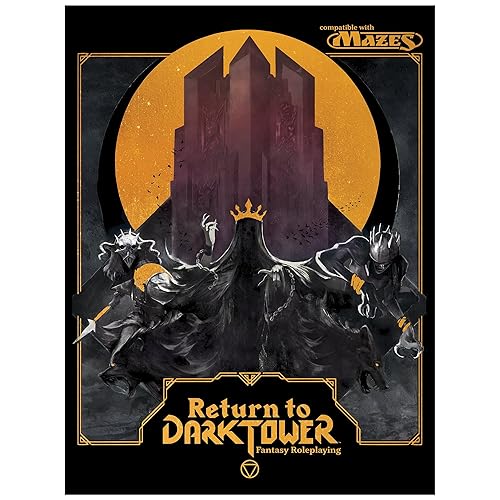
The tabletop supergroup
If you follow the board game world, the designer list for Return to Dark Tower is basically a "Justice League" lineup. You have Isaac Childres, the mind behind the massive success of Gloomhaven, and Rob Daviau, the man who essentially invented the "Legacy" genre. When names like that collaborate with Restoration Games—a studio dedicated to taking classic 80s titles and fixing their broken mechanics—you aren't just getting a nostalgia trip. You’re getting a refined strategy engine.
While the original 1981 version was a battery-guzzling novelty, this version is a legitimate tactical challenge. It manages to be "lower mid-level" in complexity, meaning you won't spend three hours reading a manual, but you will spend those three hours debating whether to reinforce a kingdom or hunt a dragon.
A villain with actual presence
Most cooperative games use a deck of cards or a dice roll to simulate the "bad guy." In Return to Dark Tower, the villain is a literal, foot-tall plastic monolith sitting in the center of your table. It’s the star of the show.
The tower isn't just there for aesthetics. It’s mechanically alive. It tracks your turns, rotates to face different players, and occasionally drops "corruption" skulls into the world with a physical clatter that genuinely raises the heart rate. There is a specific kind of dread that sets in when the tower starts whirring and you realize it’s about to ruin someone’s afternoon. This physical presence makes it much easier to keep younger players engaged for the full two-hour runtime because the "enemy" isn't an abstract concept—it’s right there, and it’s menacing.
The app integration that actually works
There is often a lot of eye-rolling when a board game requires a tablet or phone to play, but this is one of the few instances where the tech is essential. The app acts as a digital dungeon master. it handles the combat math, tracks the "Adversary" movements, and triggers random events that keep the game from feeling repetitive.
Crucially, the app doesn't turn this into a "video game on a table." You aren't staring at the screen for the whole session. You’re looking at the map, your hero board, and your teammates. The app just sits to the side, handling the bookkeeping so you can focus on the drama. For more info on how the game flows, the official Restoration Games site has a solid breakdown of the digital-physical hybrid.
If they liked Zelda or D&D
If your kid spent their summer exploring The Legend of Zelda: Tears of the Kingdom or is starting to show interest in Dungeons & Dragons, this is the perfect bridge. It captures that "hero's journey" feeling—starting weak, gathering allies, and eventually storming the castle—without the steep learning curve or the need for a parent to spend hours prepping a story.
It’s an investment at $175+, but it’s built like a piece of furniture. The BoardGameGeek community rates it an 8.2 for a reason. It’s a centerpiece game that turns a standard game night into an event. If you have the shelf space and the budget, it’s one of the few "gimmick" games that actually lives up to the hype.