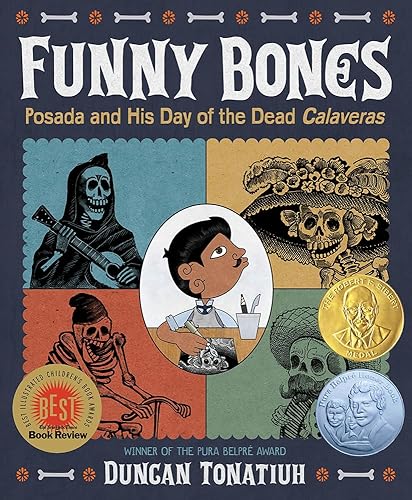
Funny Bones

Funny Bones

book

2015, Children's Books, Geography & Cultures

WISE
91%

WISE Score

4.7

Amazon

The vibrant story of the artist who gave us dancing skeletons—part biography, part art lesson, all heart.

Amazon4.7
Common Sense Media

Where to Read

Our reviews and ratings are 100% unbiased, but as an Amazon Associate, Screenwise earns an affiliate fee if you buy a book or game by clicking one of our links. We don't get any credit if you just Google it instead :)

Screenwise Verdict

This is the kind of picture book that does heavy lifting without breaking a sweat. Duncan Tonatiuh takes José Guadalupe Posada—a Mexican artist whose calaveras became synonymous with Día de Muertos—and makes his life story sing for kids. The skeletons are whimsical and joyful, the cultural context is rich without being preachy, and the book doubles as an art history lesson that actually feels relevant.

What sets this apart is Tonatiuh's visual approach: his own artwork (inspired by ancient Mixtec codices) sits alongside reproductions of Posada's work, creating a dialogue between past and present. Kids see how art evolves and how one creator can honor another. The Sibert Medal and Pura Belpré Honor aren't just shiny stickers—they signal this is informational writing done right.

It's not a quick, fluffy read. There's substance here about freedom of speech, artistic technique, and cultural identity. But it never feels heavy. If you want a book that introduces Mexican culture with respect and depth, or if you have a kid who loves art and wants to know how things are made, this is a solid pick.
Age Fit

Best for ages 6-11, especially kids interested in art, culture, or biography. Younger kids (4-5) can appreciate the visuals and basic story, while older elementary readers will engage with the historical and artistic depth. The picture book format keeps it accessible, but the content has real substance.

WISE Breakdown
Wholesome
92

Celebrates life, joy, and cultural traditions through the lens of Día de Muertos. Tonatiuh presents José Guadalupe Posada's work with warmth and respect, showing how art can provide humor and commentary without cruelty. The calaveras are explicitly described as not frightening but celebratory—dancing, playing music, living fully. This is emotionally healthy cultural education wrapped in accessible storytelling.

Imaginative
88

Blends biography with art history in a visually distinctive way—Tonatiuh juxtaposes his own artwork (inspired by ancient Mixtec codices) with Posada's iconic calaveras. Kids see how one artist interprets another's legacy across time. The book demonstrates multiple artistic processes (printing, political cartooning, skeleton illustration) and invites kids to think about art as both craft and social commentary. It's a meta-creative experience.

Safe
95

A picture book about skeletons celebrating life—zero gore, zero scares. The cultural context of Día de Muertos is handled with care and accuracy. Posada's political cartooning is mentioned (he worked in a country 'not known for freedom of speech') but kept age-appropriate. The skeletons are whimsical, not macabre. Books are inherently safe, and this one has no content that would surprise or upset a young reader.

Enriching
94

Winner of the Robert F. Sibert Medal (for informational books) and a Pura Belpré Illustrator Honor, plus a New York Times Best Illustrated Book. This is serious cultural and artistic education disguised as a picture book. Kids learn about Mexican history, freedom of expression, printmaking techniques, and the origins of an iconic cultural symbol. It builds empathy across cultures and shows how art can be both beautiful and politically meaningful. High cognitive and cultural value.

Parent Info
✓

Why It Might Be Great

  • Award-winning introduction to José Guadalupe Posada and the origins of Día de Muertos imagery—real cultural education that doesn't feel like homework
  • Tonatiuh's distinctive visual style (inspired by ancient Mixtec codices) makes this a work of art in its own right, showing kids how artists build on each other's legacies
  • Handles political themes (freedom of speech, social commentary through art) in an age-appropriate way that respects kids' intelligence
  • Skeletons are joyful and celebratory, not scary—great for families navigating how to talk about death and cultural traditions
  • Strong 4.7 Amazon rating and multiple prestigious awards signal this is a keeper
⚠

What to Watch For

  • Skeletons are central to the story—if your kid is genuinely spooked by bones, this might not land, though they're drawn in a playful, non-threatening way
  • Brief mentions of political cartoons and lack of freedom of speech in historical Mexico—good conversation fodder but might need context for younger readers
  • Dense with information about printmaking and artistic processes—some kids will eat this up, others might want a simpler story

Conversation Starters

  • "Why do you think people draw skeletons doing everyday things like dancing and riding bikes? What does that say about how they think about life and death?"
  • "Posada used his art to make fun of politicians. If you could draw a cartoon about something you think is unfair, what would it be?"
  • "How is Duncan Tonatiuh's art style different from Posada's? Which do you like better, and why?"
  • "Have you ever seen calaveras before—maybe around Halloween or Día de Muertos? What do you think makes them special to Mexican culture?"

Ask Anything

Get a personalized guide on any topic