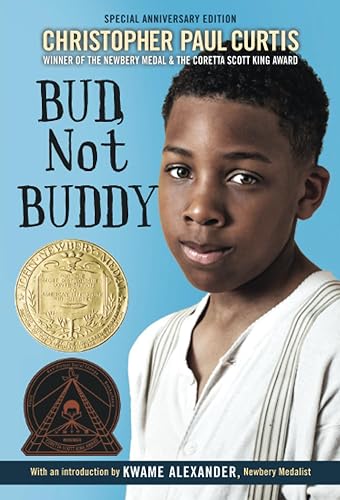
Bud, Not Buddy

Bud, Not Buddy

book

2002, Children's Books, Literature & Fiction

WISE
85%

WISE Score

4.7

Amazon

A motherless 10-year-old hits the Depression-era road to find his father—armed with a suitcase, survival rules, and unshakeable hope.

Amazon4.7
Common Sense Media

Where to Read

Our reviews and ratings are 100% unbiased, but as an Amazon Associate, Screenwise earns an affiliate fee if you buy a book or game by clicking one of our links. We don't get any credit if you just Google it instead :)

Screenwise Verdict

This is the real deal—a Newbery winner that earned its medal. Curtis doesn't sugarcoat the Depression or what it meant to be a Black orphan in 1936, but he also doesn't wallow. Bud is funny, scrappy, and deeply human, and his voice carries you through some genuinely hard moments.

The foster care abuse scenes are brief but intense enough that sensitive kids may need a heads-up or a lap to sit on. But the payoff—Bud finding his place with the Dusky Devastators—is worth it. This is the kind of book that builds empathy and historical understanding without feeling like homework.

Fair warning: compared to modern middle-grade fare, the pacing is slower and more character-driven. Some kids will devour it; others may need encouragement to stick with it. But for kids ready for real historical fiction with heart, this is a must-read.


Age Fit

Best for ages 10-13. The reading level is accessible for strong 4th graders, but the emotional weight—foster care abuse, parental death, racial discrimination—is better processed by kids 10+. Upper middle schoolers will still connect with Bud's journey and the historical context.

WISE Breakdown
Wholesome
88

Models resilience, kindness, and perseverance through hardship. Bud maintains humor and heart despite being orphaned during the Depression. The found-family arc with Herman E. Calloway's band shows intergenerational care and community. Some harsh realities (foster care abuse, homelessness, racism) are present but handled age-appropriately without gratuitous detail.

Imaginative
82

Curtis creates a vivid Depression-era world with memorable characters and Bud's quirky 'Rules and Things' that show creative problem-solving. The jazz band setting and Bud's journey from Flint to Grand Rapids offer rich sensory details and period flavor. Not fantastical, but the historical setting and Bud's voice invite curiosity about the era and human ingenuity during hard times.

Safe
75

No graphic content, but includes realistic depictions of foster care mistreatment (locked in a shed with wasps, physical abuse from foster brother), racial discrimination in 1930s America, and the grief of losing a parent. These are handled with care and age-appropriateness, but sensitive kids may find some scenes distressing. The overall tone is hopeful rather than traumatic.

Enriching
92

Newbery Medal winner that offers genuine insight into Depression-era Black American life, the Great Migration, and jazz culture. Builds empathy for foster children and homeless youth. Strong themes of perseverance, resourcefulness, and the search for belonging. The historical context is educational without being preachy, and Bud's character growth is authentic and moving.

Parent Info
✓

Why It Might Be Great

  • Newbery Medal winner that nails the balance between humor and heartbreak—Bud's voice is funny, real, and utterly winning
  • Window into Depression-era Black American life and jazz culture that feels authentic without being a history lecture
  • Shows resilience and resourcefulness in a kid who's been dealt a terrible hand but refuses to give up
  • The found-family payoff with Herman E. Calloway's band is genuinely moving
  • Bud's homemade 'Rules and Things for Having a Funner Life' are clever and show creative problem-solving
⚠

What to Watch For

  • Foster care abuse scenes (locked in shed with wasps, hit by foster brother) are age-appropriate but may upset sensitive kids
  • Bud's mother has died before the story begins; grief is a constant undercurrent
  • Period-accurate racism and discrimination in 1930s Michigan—handled thoughtfully but present
  • Some kids may find the pacing slow compared to modern middle-grade books; this is character-driven historical fiction

Conversation Starters

  • "What do you think of Bud's 'Rules and Things'? Would any of them work for you?"
  • "How do you think kids your age survived during the Great Depression compared to now?"
  • "Why do you think Bud held onto hope about finding his father even when things got really hard?"
  • "What did you learn about jazz music and the musicians who played it during the 1930s?"
  • "If you had to pack one suitcase with your most important things, what would you bring?"

Ask Anything

Get a personalized guide on any topic