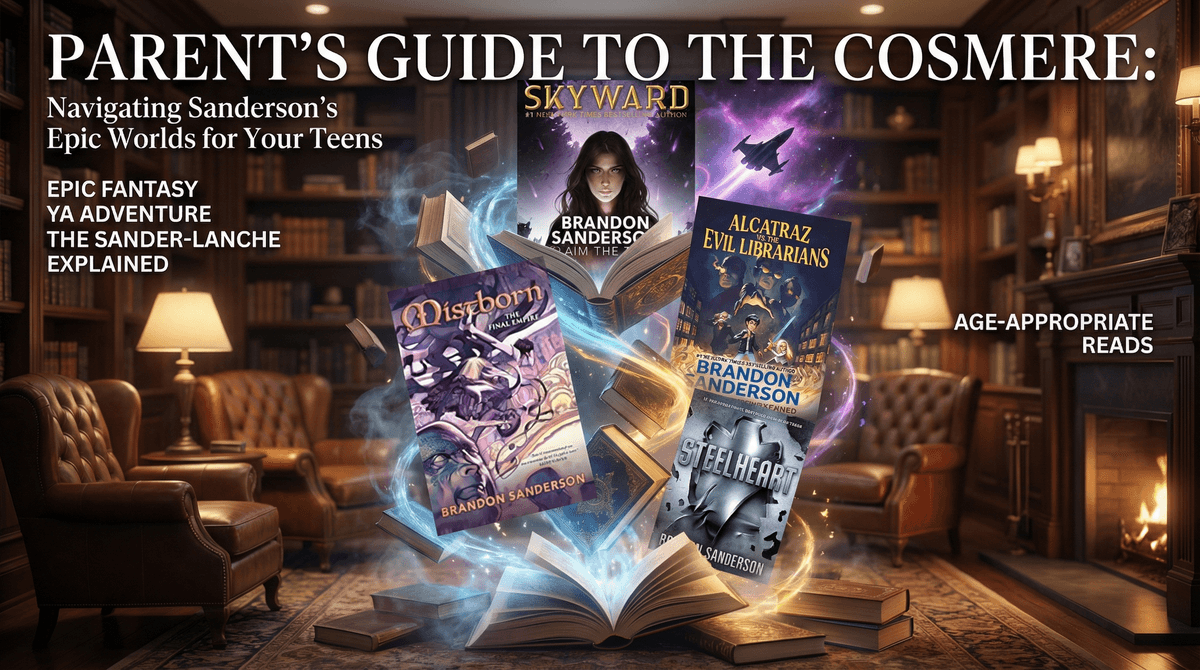
The Sanderson starter drug
If you follow the world of fantasy at all, you know the author is basically a machine who produces thousand-page doorstops for adults. This series is his pivot to the middle-grade crowd, and it’s arguably where his specific brand of "magic with rules" shines the brightest. Most kids' fantasy relies on vague "believe in yourself" magic. Here, the magic is mechanical, logical, and deeply weird.
If your kid is already a fan of this series and looking for what comes next, you should know that his other work scales up in complexity and intensity pretty quickly. You can check our guide on Brandon Sanderson YA books to see which of his older-skewing series like Mistborn are actually ready for your shelf.
The "Lemony Snicket" factor
The biggest hurdle for some readers—and the biggest draw for others—is the voice. Alcatraz Smedry is a meta-narrator. He stops the story to complain about authors, mock the tropes of fantasy novels, and remind you that he is a "bad person."
It’s a very specific type of snark that we saw popularized by A Series of Unfortunate Events. For a literal-minded child, this can be confusing. They might ask why the hero keeps saying he's a jerk. But for the kid who feels like they’re "too cool" for standard hero stories, this self-aware humor is the hook that keeps them turning pages. It makes the reader feel like they’re in on a private joke against the rest of the literary world.
Why the "Evil Librarian" trope works
We’ve all seen the "secret world" trope before—wizards in London, demigods in New York. But the idea that librarians are a global cabal of villains who use "misinformation" (like teaching kids that the Earth is round or that gravity is a thing) is a hilarious way to introduce the concept of media literacy.
It’s not a preachy book, but it naturally leads to conversations about who controls the narrative. When the book claims that "Hushlanders" (us) are being kept in the dark by boring people who love filing systems, it gives kids a fun, rebellious framework to think about the information they consume. It’s the perfect choice for the kid who is starting to question why things are the way they are.
If your kid liked Percy Jackson
This is the natural successor to Rick Riordan’s work. While Percy Jackson leans into mythology, Alcatraz leans into pure, chaotic invention.
- The Pacing: It’s breathless. There are very few chapters where someone isn't running, breaking something, or narrowly escaping a librarian hit-squad.
- The Stakes: Even though it’s funny, the danger feels real. Characters get hurt, and the consequences of the "Talents" (like being really bad at math or arriving late to everything) are used in genuinely clever, tactical ways.
- The Longevity: This isn't a one-and-done. It’s a full series that grows with the reader, getting slightly more complex as it goes without losing its sense of absurdity.
If you have a reluctant reader who thinks books are "boring" or "too long," hand them this. It’s a book that actively tries to prove it isn't a "book" in the traditional, stuffy sense, and that’s usually enough to win over the skeptics.