

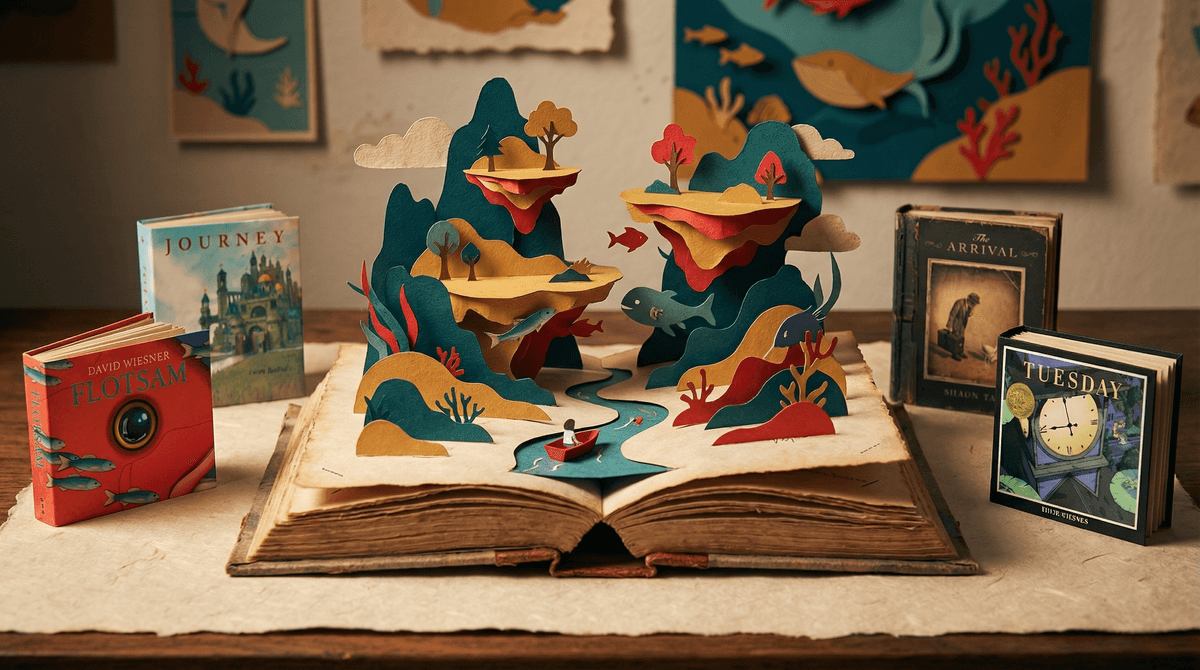
Wordless books are exactly what they sound like: picture books that tell entire stories without using any text. No words, no labels, just sequential images that convey narrative, emotion, and meaning through visual storytelling alone.
Think of them as the analog precursor to scrolling through Instagram or TikTok—except instead of passive consumption, kids are actively constructing meaning, making inferences, and building their own narratives from visual cues.
Some classics you might recognize: Journey by Aaron Becker, The Arrival by Shaun Tan, or Flotsam by David Wiesner. These aren't "baby books"—many wordless books are sophisticated enough to engage adults.
Here's the thing: our kids are growing up in a world where they'll encounter more visual information before breakfast than previous generations saw in a week. Memes, video thumbnails, app interfaces, AI-generated images, misleading screenshots—visual literacy isn't optional anymore, it's survival.
Wordless books teach kids to:
Read images critically - What's happening in this picture? What happened before? What might happen next? These are the same skills they'll need when they see a screenshot on Discord or a thumbnail on YouTube and need to assess: is this real? Is this clickbait? What's the actual story here?
Construct their own narratives - Unlike most screen content that spoon-feeds meaning through dialogue, music, and text, wordless books require active interpretation. Kids have to build the story themselves, which exercises the exact cognitive muscles that atrophy during passive scrolling.
Notice details and sequence - Understanding cause and effect, reading body language and facial expressions, picking up on environmental clues—all essential for both reading comprehension AND navigating social media, where context is everything and misinformation thrives on people not looking closely.
Develop patience with ambiguity - Not everything is spelled out in a wordless book. Kids learn to sit with uncertainty, to revise their understanding as they turn pages. Compare that to the algorithm-driven certainty of most digital content, where everything is explained, captioned, and optimized for immediate comprehension.
When we talk about "pre-reading skills," we usually mean letter recognition and phonics. But in 2026, visual literacy IS a pre-reading skill—maybe the most important one.
Before your kid can critically evaluate whether that Roblox YouTube video is actually a tutorial or just someone trying to scam them out of Robux, they need to understand how images tell stories, how visual sequences work, and how to question what they're seeing.
Wordless books are like strength training for this. They're slow, intentional, and require genuine cognitive effort. They're the opposite of the frictionless scroll, and that's precisely why they're valuable.
Ages 2-5: Start simple with books like Pancakes for Breakfast by Tomie dePaola or Good Dog, Carl series. At this age, wordless books help kids understand that pictures can tell stories, practice sequencing, and build vocabulary as you talk through the images together.
Ages 6-9: Move to more complex narratives like the Journey trilogy or Tuesday by David Wiesner. These books have plot twists, visual jokes, and details that reward multiple readings. Kids this age can start "reading" these books independently and telling YOU the story.
Ages 10+: Try sophisticated works like The Arrival or Shaun Tan's The Red Tree, which deal with immigration, depression, and complex emotions entirely through imagery. These can spark incredible conversations about interpretation, perspective, and how different people can "read" the same images differently—a crucial lesson for the age when they're starting to encounter manipulated images and selective framing online.
This isn't about avoiding screens - It's about building skills that make screen time more enriching and less exploitative. A kid who's spent time with wordless books will approach Minecraft differently, noticing environmental storytelling and visual patterns. They'll watch Bluey more critically, picking up on visual gags and character emotions that other kids miss.
Reading them together is the point - Unlike traditional books where you're just the narrator, wordless books invite conversation. "What do you think is happening here?" "How do you think she feels?" "What do you notice in the background?" These are open-ended questions with no wrong answers, which is increasingly rare in kids' lives.
They're not a replacement for word-based books - Think of them as a complement. Wordless books develop different skills than traditional reading. You want both in your rotation.
They work for struggling readers - No text means no reading anxiety. Kids who find traditional books frustrating can experience the joy of "reading" a complete, complex story independently. This builds confidence and keeps them engaged with books during challenging periods.
In a world where your kid will encounter deepfakes, AI-generated images, and visual misinformation before they hit middle school, teaching them to read images critically isn't precious or old-school—it's essential digital literacy.
Wordless books are a low-tech, high-impact way to build these skills. They slow down visual processing, encourage active interpretation, and teach kids that images require the same critical thinking as words.
Plus, they're just really beautiful. In an era of overstimulating screen content, there's something powerful about sitting with your kid and a gorgeously illustrated book, constructing a story together from nothing but pictures.
Start with one - Hit your library (they usually have a wordless book section) or grab Journey as a starter. It's visually stunning and works for ages 4-10.
Make it a conversation - Ask open-ended questions. Let your kid tell YOU the story. There are no wrong answers.
Connect it to their screen life - After reading a wordless book together, watch a scene from a favorite show with the sound off. Can they follow the story? What visual clues are they using? It's the same skill set.
Build a rotation - Keep 2-3 wordless books in your regular reading rotation alongside traditional books. They're quick reads but reward multiple visits.
And hey, if you want to understand more about building critical viewing skills for the digital age, check out our guide on media literacy for kids. Because whether it's a wordless book or a YouTube thumbnail, the skill is the same: learning to question what you see.