

When the Levees Broke: A Requiem in Four Acts is Spike Lee's 2006 four-hour HBO documentary about Hurricane Katrina and its aftermath in New Orleans. It's not just about a natural disaster—it's about what happens when systemic racism, government failure, and poverty collide during a crisis.
The documentary uses interviews with survivors, news footage, and Lee's unflinching direction to show how the storm exposed deep inequalities in America. It's powerful, it's devastating, and honestly? It's one of those pieces of media that changes how you see the country.
Look, this isn't light viewing. But if you're raising kids who you want to understand how systems work (and fail), how race and class shape people's lived experiences, and why "just work hard" isn't the full story of American opportunity—this documentary does that work better than almost anything else.
Here's what makes it essential:
It's a masterclass in media literacy. Your kids are bombarded with news clips, TikToks, and hot takes about disasters and crises. When the Levees Broke shows them how to look deeper—how the framing of "looters" vs. "survivors" reveals bias, how government press conferences can be performative BS, how the stories we tell about who "deserves" help are shaped by race and class.
It humanizes history. This isn't a textbook chapter about Katrina. It's people telling their stories—where they were when the water rose, what they lost, how they were treated at the Superdome, how they rebuilt (or couldn't). When your teen learns about climate disasters or systemic inequality in the future, they'll remember these faces and voices.
It's about resilience without toxic positivity. The documentary doesn't sugarcoat the trauma or slap a happy ending on it. But it also shows New Orleans culture, music, community strength, and the determination to rebuild. It's honest about both the pain and the power of the people who survived.
Ages 13+ is the sweet spot, though mature 11-12 year olds with strong media literacy skills could handle it with parental co-viewing.
What they'll see:
- Disturbing footage of bodies in floodwater (not graphic but present)
- People describing traumatic experiences—death, separation from family, violence
- Strong language throughout (this is raw testimony, not sanitized for TV)
- Anger and grief—lots of it, and it's justified
- Systemic racism laid bare in ways that might be uncomfortable
What they won't see:
- Graphic violence or gore
- Sexual content
- Exploitation—Lee treats his subjects with dignity
This is not background viewing. It requires attention, emotional bandwidth, and probably conversation breaks. Consider watching it in segments rather than all four hours at once.
The runtime is real. Four hours. But here's the thing—it's structured in acts, so you can absolutely watch it over multiple nights. In fact, that's probably better for processing.
It will make you angry. At the government response. At the media coverage. At the systems that left people stranded on rooftops while help was slow to arrive. That anger is part of the point. The question is what you and your kids do with it.
It's explicitly about race. Lee doesn't dance around it. The documentary makes clear that the response would have been different if the people stranded were wealthy and white. If your family isn't used to having direct conversations about systemic racism, this will push you there. That's actually a feature, not a bug .
.
New Orleans culture is front and center. The music, the food, the traditions, the community bonds—it's all here. This isn't just a story of suffering; it's a love letter to a city and its people.
It pairs well with current events. Every hurricane season, every climate disaster, every infrastructure failure—When the Levees Broke gives your kids a framework for understanding what's happening and asking the right questions about who gets help and who gets left behind.
Set the stage. Before you start, talk about what they know about Hurricane Katrina. Probably not much if they're Gen Alpha. Give them basic context: the storm hit in 2005, the levees (walls holding back water) failed, the city flooded, and the government response was catastrophically slow.
Plan for pauses. This is heavy. Build in time to stop and talk. "What are you feeling right now?" "What surprised you?" "What questions do you have?"
Follow their lead on processing. Some kids will want to talk immediately. Others will need time to sit with it. Both are fine.
Connect it to action. After watching, talk about what they can do with what they've learned. Support climate justice work? Understand how local infrastructure works? Question media narratives? Volunteer with disaster relief organizations? The point isn't to leave them feeling helpless—it's to channel the discomfort into awareness and agency.
Acknowledge your own learning. If this is new information for you too, say so. "I didn't understand how bad the response was" or "I'm realizing I believed some of the media framing at the time" models intellectual honesty.
When the Levees Broke isn't comfortable viewing. It's not supposed to be. But it's the kind of documentary that builds critical thinking, empathy, and civic awareness in ways that matter.
If you're raising kids who you want to understand how power works, how media shapes narratives, and why "natural" disasters are never just natural—this is required viewing.
Is it intense? Yes. Is it worth it? Absolutely.
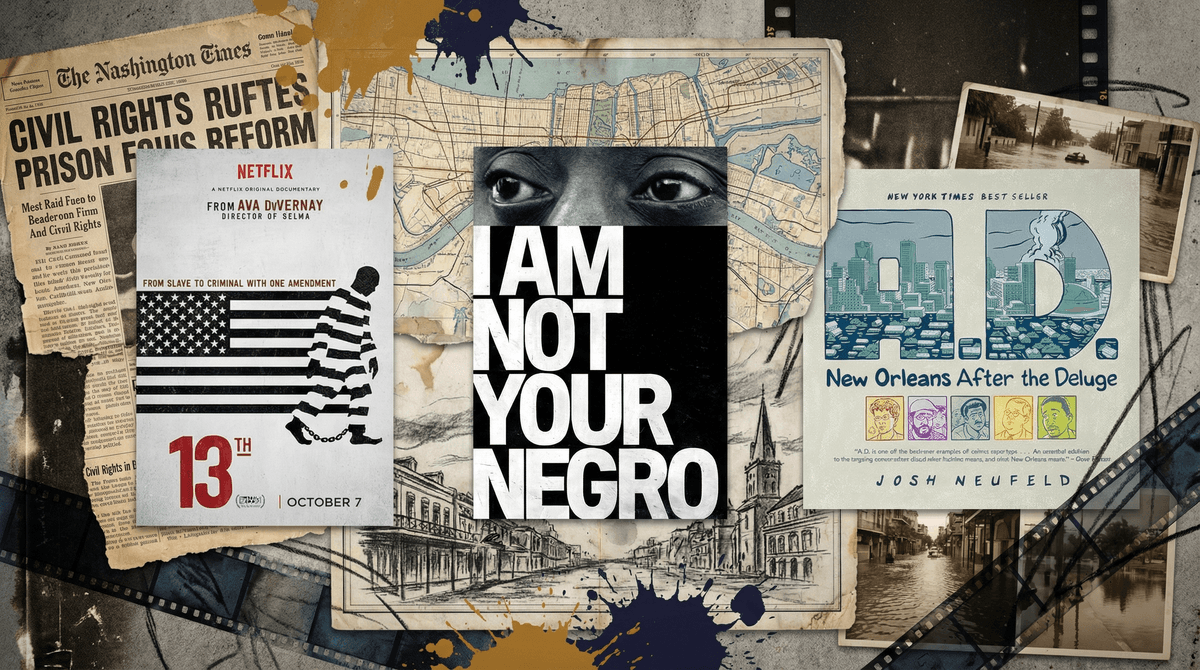
Pro tip: After you finish, check out 13th (also on Netflix) for another essential documentary about systemic injustice, or I Am Not Your Negro for James Baldwin's perspective on race in America. These three together form a hell of an education.
- Stream it: Available on Max (formerly HBO Max) and for rent on most platforms
- Read together: Pair it with A.D.: New Orleans After the Deluge by Josh Neufeld (graphic novel, ages 14+)
- Explore more: Learn about other documentaries that tackle systemic issues
This is the kind of media that sticks with you. Watch it together. Talk about it. Let it change how your family sees the world.