

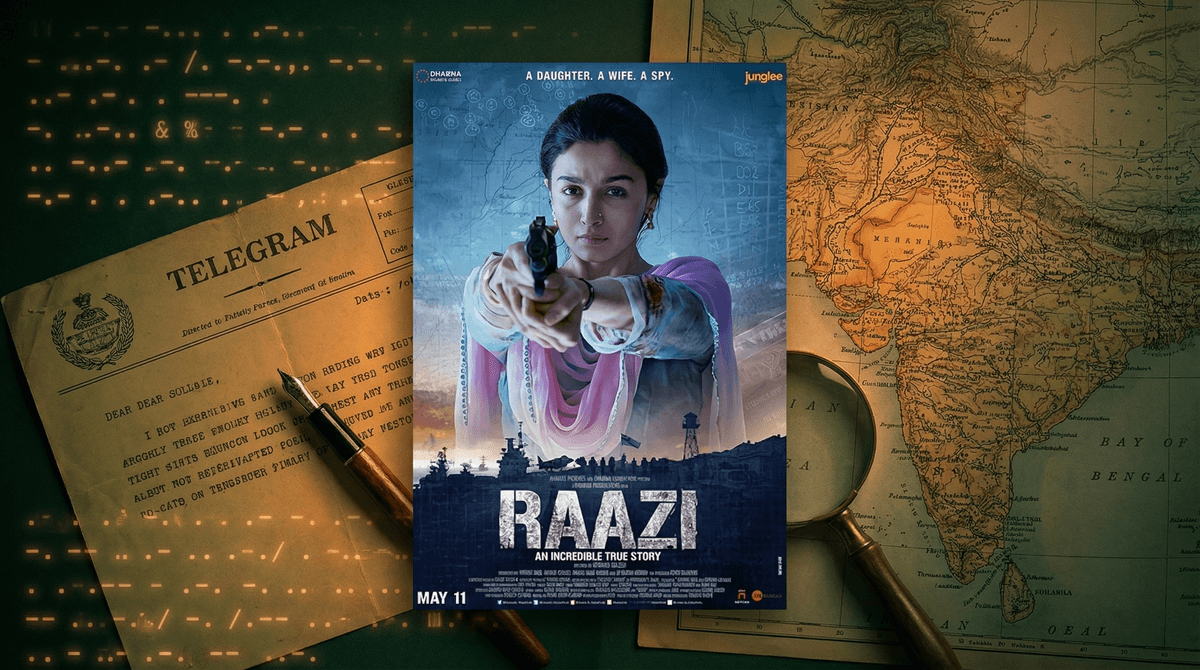
Why Raazi Is the Greatest Female Spy Thriller Ever: A Parent's Guide
TL;DR: Raazi (2018) is a Hindi-language spy thriller that puts every Western "girlboss" spy movie to shame. Based on a true story, it follows a young Indian woman who marries into a Pakistani military family to spy for India during the 1971 war. It's intense, morally complex, and features zero leather catsuits or quippy one-liners. If you're looking for movies that show strong female characters without the Hollywood formula, this is it. Ages 14+ due to war violence, emotional intensity, and mature themes.
Most spy thrillers give us glamorous assassins in designer clothes who never break a sweat. Raazi gives us Sehmat Khan (played brilliantly by Alia Bhatt), a 20-year-old college student thrust into espionage because her dying father asks her to serve her country. There's no training montage set to pop music. No romantic subplot that saves the day. Just a young woman trying not to get caught while living in constant fear.
The movie opens with Sehmat studying in college, completely unprepared for what's coming. Her father, a longtime Indian intelligence asset, is dying and wants her to take his place. Within weeks, she's learning Morse code, memorizing Pakistani military intelligence, and being married off to a Pakistani army officer she's never met. The marriage is her cover. Her mission: gather intelligence about Pakistan's plans during the 1971 Indo-Pakistani War.
What follows is 138 minutes of the most stressful, emotionally devastating spy craft you'll ever watch. And it's based on the real story of an Indian woman who actually did this.
If you've got teens who think they understand geopolitics from TikTok, or who view war as something abstract that happens in video games, Raazi offers something rare: a human-scale view of conflict where nobody wins.
Sehmat isn't a superhero. She's terrified most of the time. She kills people and it destroys her. She falls in love with her husband (her target) and has to maintain her cover while genuinely caring for him. The movie never lets her—or us—off the hook morally. Every piece of intelligence she gathers could save Indian soldiers but might kill Pakistani soldiers, some of whom she knows personally.
This is the kind of moral complexity that most teen-targeted content avoids. Raazi sits with the discomfort. It asks: What does patriotism cost? When is sacrifice worth it? Can you ever really go back to normal after living a lie?
Director Meghna Gulzar crafts tension like a master. There's a scene where Sehmat is trying to photograph documents in her father-in-law's study while the family is downstairs. The camera work is so tight you can barely breathe. Every footstep, every door opening, every moment someone might walk in—it's excruciating.
The film also uses music sparingly, which makes it hit harder when it appears. The background score by Shankar-Ehsaan-Loy builds dread without being manipulative. And the song "Ae Watan" (which translates to "Oh Motherland") is devastating in context—a beautiful, mournful meditation on what nations ask of their citizens.
Alia Bhatt's performance is career-defining. She was 24 when she filmed this, playing a 20-year-old, and she carries the entire emotional weight of the film. Watch her face in the scenes where she's alone—the way the mask drops and you see the toll this life is taking. It's the opposite of the "strong female character" who never shows vulnerability. Sehmat is strong because we see her breaking.
1. The cost of war isn't abstract. The movie shows both Indian and Pakistani perspectives with humanity. Nobody is cartoonishly evil. The Pakistani family Sehmat marries into are kind, loving people. Her husband genuinely cares for her. The film refuses to dehumanize "the enemy," which makes everything more complicated and more real.
2. Patriotism is complicated. Sehmat serves India because her father asked her to, because she believes in the cause, and because she's trapped. The movie doesn't present this as simple heroism. By the end, you're left wondering if any of it was worth it—not because the cause was wrong, but because the personal cost was so high.
3. Women's agency in impossible situations. Sehmat has almost no control over her circumstances—she's married off, sent to enemy territory, and given impossible tasks. But within those constraints, she makes choices. Some are brave, some are desperate, some haunt her forever. It's a more honest portrayal of female strength than most "empowerment" narratives.
4. Espionage isn't glamorous. Forget James Bond and Mission: Impossible. Real spycraft is terrifying, lonely, and psychologically damaging. If your kid thinks being a spy sounds cool, this movie is the antidote.
Recommended for ages 14+, but know your teen. The content warnings:
- War violence: People die, some on-screen. It's not gratuitously graphic, but it's intense. There's a scene involving a car accident/assassination that's particularly brutal.
- Emotional intensity: This movie is relentlessly stressful. If your teen struggles with anxiety, watch together so you can process it.
- Mature themes: Arranged marriage, duty vs. desire, PTSD, the ethics of killing. These aren't background elements—they're central to the story.
- Language: It's in Hindi with English subtitles. If your teen isn't used to subtitled films, here's how to make that transition easier
 .
.
Not appropriate for younger kids. This isn't Spy Kids or even Agent Cody Banks. The emotional weight alone would be too much for anyone under 13.
Before you start: Give context about the 1971 Indo-Pakistani War. You don't need a history degree—just explain that India and Pakistan have a complicated history since partition in 1947, and this war led to the creation of Bangladesh. Here's a quick primer.
During the movie: Don't be afraid to pause and discuss. This is dense material. If your teen is confused about who's who or what's happening, clarify. The tension is more effective when you understand the stakes.
After watching: Process together. Ask questions like:
- "Do you think Sehmat made the right choices?"
- "How do you think this affected her after the war?"
- "What would you do in her situation?"
- "How does this compare to other spy movies you've seen?"
This is also a great entry point for discussing how different cultures tell stories about war and heroism. Bollywood approaches these themes differently than Hollywood, and that difference is worth talking about.
I'm going to say it: Raazi is better than Atomic Blonde, better than Red Sparrow, better than most of the Jason Bourne movies. Not because those films are bad (well, Red Sparrow kind of is), but because Raazi understands something they don't: the most interesting part of being a spy isn't the action—it's the psychological toll.
Western spy movies often treat their female protagonists as either sex objects or superhuman badasses. Raazi gives us a fully realized human being who is brave and terrified, capable and overwhelmed, loyal and conflicted. Sehmat doesn't have perfect aim or martial arts skills. She has intelligence, determination, and the ability to think fast under pressure. That's it. That's enough.
The film also trusts its audience. There are no exposition dumps explaining how everyone feels. No voice-over narration. You have to pay attention to facial expressions, to what's said and what's left unsaid. It treats viewers like adults who can handle complexity.
Raazi is the spy thriller for parents who want their teens to understand that heroism is complicated, that war has human costs, and that strong female characters don't need to be superhuman to be compelling. It's a masterclass in tension, a showcase for incredible acting, and a story that will stick with you long after the credits roll.
Is it the greatest female spy thriller ever? That's subjective, but I'd argue yes. Not because it has the best action sequences or the highest body count, but because it tells a spy story with genuine emotional stakes and moral complexity. It shows us what espionage actually costs a person—and makes us question whether that cost is ever justified.
Watch it with your teen. Talk about it. Let them sit with the discomfort. That's where real learning happens.
- Watch Raazi on Netflix or Amazon Prime (availability varies by region)
- Looking for more films like this? Check out international films that challenge American perspectives
- Want more complex female protagonists? Try Portrait of a Lady on Fire or The Handmaiden (both also ages 16+)
- Interested in true spy stories? Read about real women in espionage or watch The Spy on Netflix