

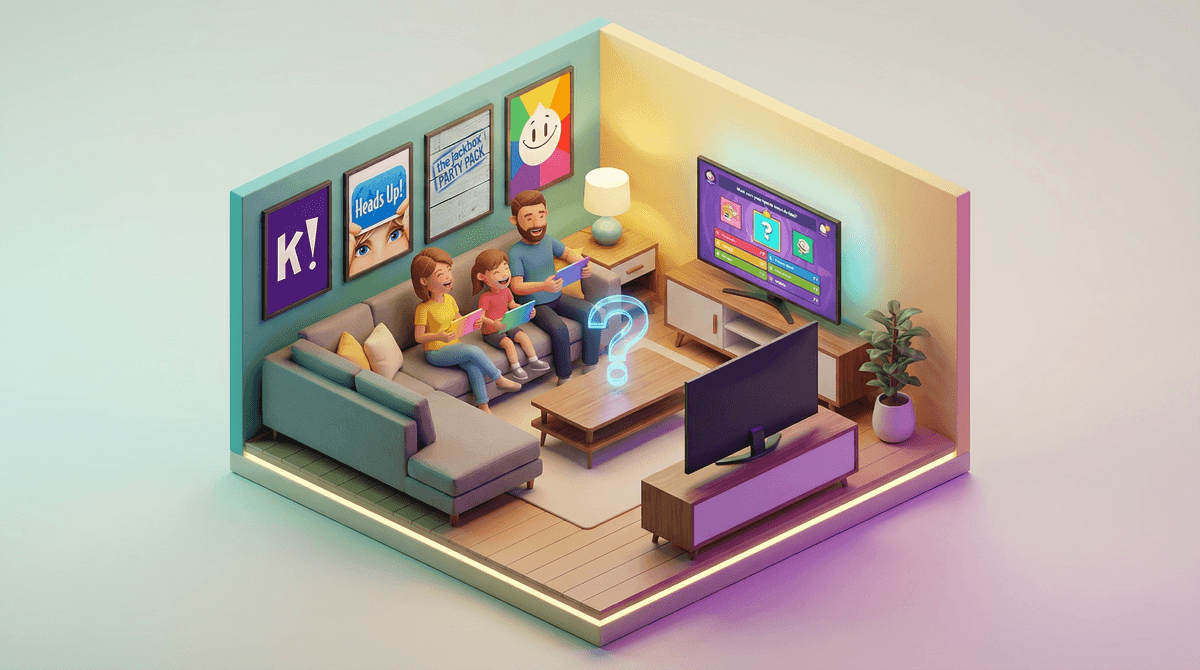
Family trivia games are exactly what they sound like—games that test knowledge across topics like history, science, pop culture, and random facts—but here's the thing: the digital versions have gotten really, really good at making this fun for mixed-age groups.
We're talking apps like [Trivia Crack](https://screenwiseapp.com/media/trivia-crack-game, QuizUp, and Kahoot!, plus console games like Jackbox Party Packs that turn your TV into a game show. There are also classic board game adaptations like Trivial Pursuit that now have digital versions.
The beauty of these games? They're one of the few screen activities where everyone's actually looking up, talking, laughing, and—dare I say it—learning something without it feeling like homework.
Look, most family screen time is parallel play at best. Everyone's on their own device, in their own world. But trivia games create something different: shared attention and genuine interaction.
Here's what makes them special:
They level the playing field. Your 8-year-old might destroy you in Minecraft knowledge. Your tween might know every Taylor Swift lyric. You might actually remember what year the Berlin Wall fell. Everyone gets moments to shine.
They spark real conversations. When a question comes up about space exploration or ancient Egypt or 90s music, it opens doors. Kids ask follow-up questions. You share stories. Someone inevitably says "wait, really?" and you end up down a fascinating rabbit hole together.
They're naturally time-limited. Unlike open-ended games that can stretch forever, trivia games have clear rounds and endings. You can play for 15 minutes or an hour, and everyone knows when it's done.
They teach critical thinking. Good trivia isn't just memorization—it's making educated guesses, using context clues, and thinking through logic. These are actual skills.
Ages 6-8: Getting Started
At this age, look for games with visual clues, multiple choice answers, and topics they actually know about.
- Heads Up! - The charades-style guessing game that gets everyone moving and laughing. Categories include animals, movies, and kid-friendly topics.
- [National Geographic Kids Quiz Whiz](https://screenwiseapp.com/media/national-geographic-kids-quiz-whiz-game - Questions designed specifically for elementary ages with gorgeous photos.
- Kahoot! - You can create custom quizzes about your family, their favorite books, or topics they're learning in school. Makes it personal and achievable.
Ages 9-12: Building Confidence
This age can handle more complex questions and loves the competitive element.
- [Trivia Crack](https://screenwiseapp.com/media/trivia-crack-game - The classic. Six categories, turn-based play, and you can play as a family team against other players online.
- Jackbox Party Pack (specifically games like Trivia Murder Party) - Hilarious, slightly dark humor that tweens love, everyone plays on their phones while the TV shows the action.
- QuizUp - Thousands of topics from Harry Potter to soccer to science. Find your family's niche interests.
Ages 13+: Full Family Competition
Teens can play adult-level trivia and often enjoy showing off their knowledge.
- Jeopardy! World Tour - The real deal, actual Jeopardy! format and questions.
- HQ Trivia - Live game show format (when available) where you can win actual prizes. The time pressure makes it exciting.
- Any Jackbox Party Pack - These are legitimately funny for adults too. Great for family game nights with teens.
The Good Stuff
Educational value is real. Kids are absorbing information about history, geography, science, and culture without realizing they're learning. One parent told me her son became obsessed with Greek mythology after it kept coming up in trivia games—he's now read all the Percy Jackson books.
It's inclusive. Unlike video games that require controller skills or board games that need reading fluency, trivia games work for different ability levels. You can read questions aloud, work as teams, or give hints.
Conversation starter gold. When a question about the 1960s comes up, suddenly you're telling stories about grandparents. When it's about climate change, you're having that discussion naturally.
The Watch-Outs
Ads in free apps. Many free trivia apps are loaded with ads between questions. It breaks the flow and can be annoying. Consider paying for ad-free versions if you're using these regularly—usually $3-5 and worth it.
Online play concerns. Some apps let you play against random people online and include chat features. For younger kids, stick to family-only modes or turn off chat. Learn more about managing online interactions in games .
.
Difficulty frustration. If questions are too hard, younger kids check out fast. Look for games with difficulty settings or create custom quizzes at their level using Kahoot!.
The "Google temptation." With everyone holding phones, it's easy to cheat. Set a family rule: no searching during play. Honor system, but make it part of the game culture.
Start with one game night a week. Friday pizza + trivia = instant tradition.
Mix it up. Rotate who picks the game or topic. Let your kid create a Kahoot! quiz about their favorite YouTube channel or book series.
Make it collaborative sometimes. Instead of competing against each other, play as a family team against the app or other online teams. Removes sibling rivalry, adds teamwork.
Use it as a screen time "bridge." After individual device time, transition to 20 minutes of family trivia. Shifts the energy from isolated to connected.
Create your own categories. Use Kahoot! or similar platforms to make quizzes about your family history, vacations, inside jokes. Kids LOVE this.
Here's the truth: not all screen time is created equal. An hour of everyone scrolling their own feeds? That's one thing. An hour of everyone huddled around trivia questions, shouting out answers, laughing at ridiculous wrong guesses, and learning random facts together? That's genuinely quality time.
Trivia games won't replace board games or outdoor play, and they shouldn't. But they're a legitimate tool for connection in a digital age. They use screens as a gathering point rather than an isolation chamber.
And honestly? In a world where it's increasingly hard to find activities that work for your 7-year-old AND your 14-year-old AND you, trivia games are kind of a miracle.
Try one game this week. Pick from the age-appropriate list above and commit to 20 minutes after dinner.
Ask your kids. They might already know about trivia games or apps their friends play. Start there.
Check out more family-friendly games if you want to expand beyond trivia.
Explore Kahoot! for creating custom quizzes - it's free and surprisingly easy to use.
The goal isn't perfect screen-free living. It's intentional screen time that actually adds something to your family life. Trivia games? They actually deliver on that promise.