

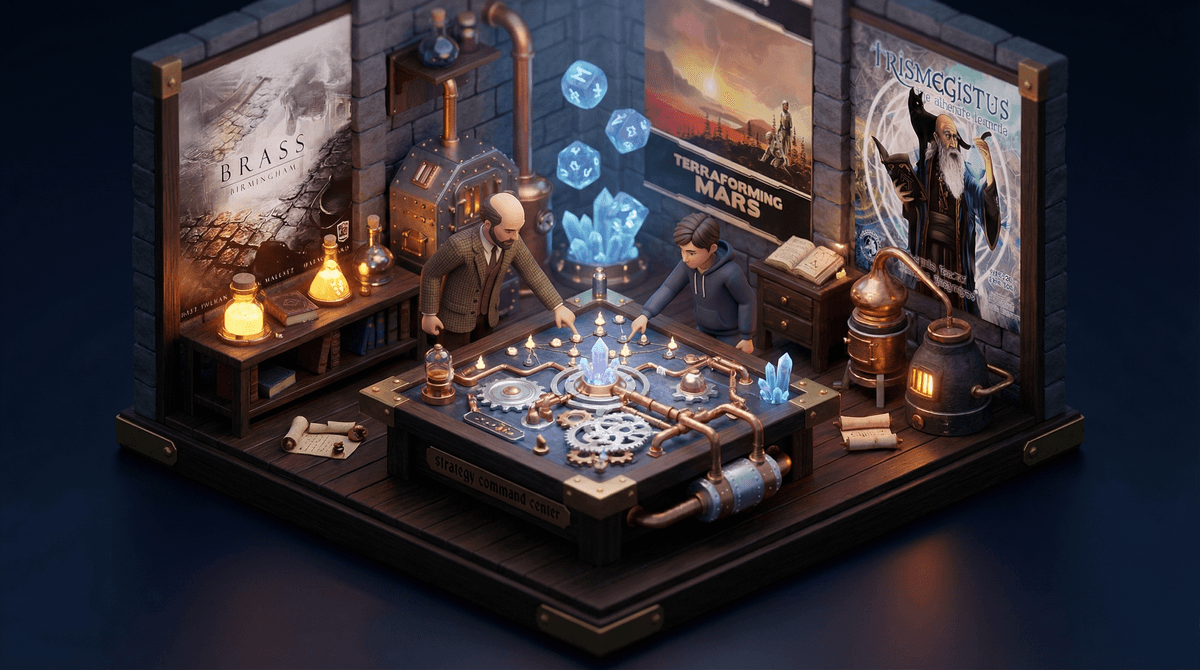
Trismegistus: The Ultimate Formula is a heavyweight eurogame that's basically the board game equivalent of taking an AP Chemistry exam while simultaneously solving a Rubik's cube. Published in 2019, it's themed around alchemy and the pursuit of the Philosopher's Stone, with players taking on the role of alchemists trying to transmute materials, publish research, and master the elements.
The game uses a dice-drafting mechanism where players select dice to perform actions across different tracks—think of it as choosing your adventure path, but every choice creates a cascade of strategic implications that'll have you second-guessing yourself for the next 20 minutes. It's designed by Daniele Tascini and Federico Lucchini, published by Board&Dice, and plays 1-4 players in about 90-120 minutes (though let's be real, your first game is hitting the 3-hour mark easy).
This is not Ticket to Ride. This is not even Catan. This is the deep end of the strategy game pool.
Here's the thing about Trismegistus: it's genuinely brilliant if you're into complex decision-making and optimization puzzles. The game offers:
Real Strategic Depth: Every turn presents multiple viable paths forward. Do you focus on transmutation? Publishing? Mastery tracks? Artifacts? The game rewards long-term planning but forces you to adapt when someone takes the dice you needed.
Minimal Luck: Despite using dice, this isn't a roll-and-hope situation. You're selecting from a shared pool of already-rolled dice, so it's all about reading the board state and making optimal choices with imperfect options.
Educational Value (Actually): The resource management, pattern recognition, and multi-variable optimization skills here are genuinely transferable to real-world problem-solving. Kids who can handle this game are exercising serious executive function muscles.
Screen-Free Engagement: In a world where "family time" often means everyone scrolling separately, a game this engaging forces genuine interaction and discussion. You're all present, all thinking, all problem-solving together.
Let's cut through the BS here: the box says 14+, and that's optimistic for most kids.
Ages 12-13: Possible but rare. You'd need a kid who already loves complex strategy games, has played gateway euros like Wingspan or Azul, and has the patience to sit through a 30-minute rules explanation. Even then, their first few games will likely be frustrating as they grasp the interconnected systems.
Ages 14-16: This is the sweet spot if your teen is already into strategy gaming. They can understand the rules, but they'll need a few plays to develop actual strategy beyond "I'll just do this action because the dice are here."
Ages 17+: Ideal. At this point, it's really about interest level rather than capability.
Adults: If you're a parent who enjoys heavy strategy games, this could be a fantastic way to connect with an older teen on equal footing. Nobody's dumbing anything down here—you're both wrestling with the same complex puzzle.
Time Commitment Is Real: Block out a full evening. Between setup (10-15 minutes), rules explanation (20-30 minutes for first-timers), and gameplay (90-180 minutes depending on player count and experience), you're looking at a 3-hour commitment minimum for your first game. This isn't "let's play a quick game before dinner."
The Learning Curve Is Steep: The rulebook is dense. The iconography takes time to internalize. Your first game will involve constant rule-checking. Some families will find this rewarding; others will find it tedious. Know your audience.
It's Not for Everyone (And That's Fine): If your family game nights typically involve Codenames or Splendor, jumping straight to Trismegistus is like going from casual jogging to an ultramarathon. There's no shame in sticking with lighter fare—not every family needs to conquer Everest.
The Payoff Can Be Huge: For families who click with it, games like this create memorable experiences. The shared problem-solving, the "aha!" moments when strategy clicks, the good-natured trash talk when someone blocks your perfect move—this is quality time that builds genuine connection.
Solo Mode Exists: The game includes a solid solo mode, which is great for a parent or teen who wants to learn the system before teaching others. It's also just a good puzzle for anyone who enjoys optimization challenges.
If you're trying to figure out where Trismegistus sits in the complexity spectrum:
- Lighter than this: 7 Wonders, Splendor, Ticket to Ride
- Similar complexity: Terraforming Mars, Brass: Birmingham
- Heavier than this: Twilight Imperium, 18xx games

Trismegistus: The Ultimate Formula is an excellent game for what it is: a complex, brain-burning eurogame that rewards strategic thinking and careful planning. But "excellent" doesn't mean "right for your family."
Get this game if:
- You have a teen (14+) who already loves strategy games and wants more challenge
- You're looking for a screen-free activity that provides genuine intellectual engagement
- You enjoy learning complex systems and don't mind a steep learning curve
- You have 3+ hours to dedicate to a game night
- You want to teach resource management and strategic planning in a concrete, engaging way
Skip this game if:
- Your family prefers lighter, faster games
- You're looking for something that's easy to teach to varying age groups
- Game nights at your house are more about casual fun than intense focus
- You don't have patience for heavy rulebooks and frequent rule-checking
The real question: Does your family want a game that's genuinely challenging, or do you want a game that everyone can enjoy without homework? Both are valid answers, but they lead to very different purchases.
If you're curious about other strategy games that might be a better fit, check out our guide to gateway eurogames or explore alternatives to complex board games that still offer meaningful engagement without the 3-hour commitment.