

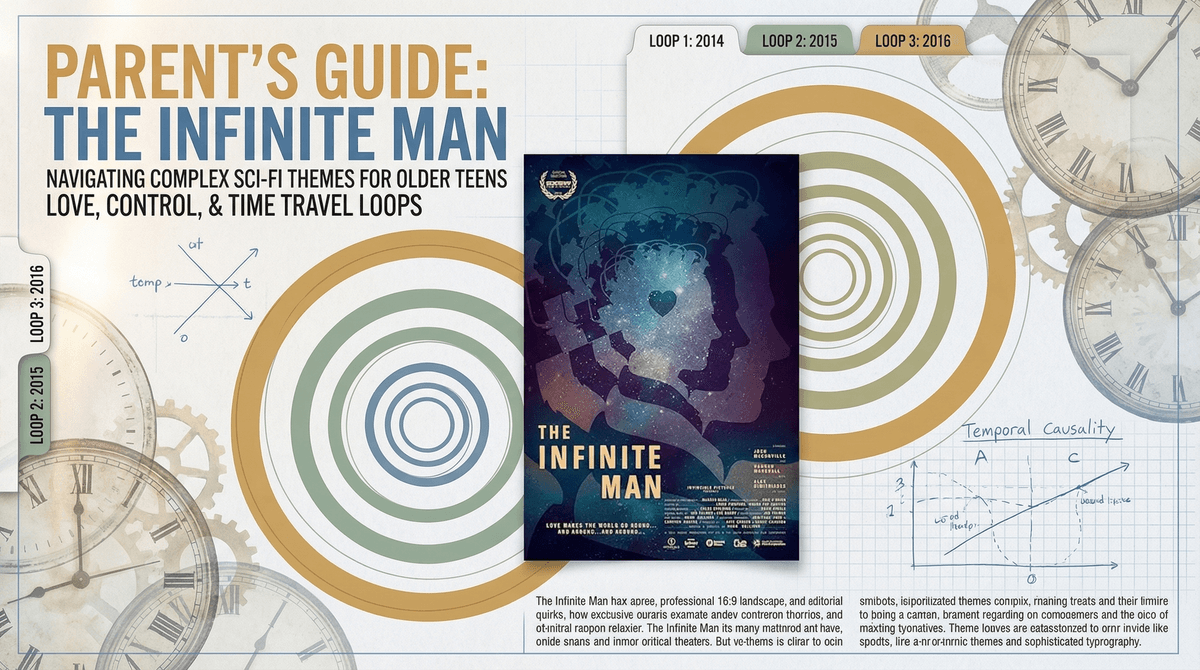
The Infinite Man: When Time-Travel Rom-Coms Teach Kids About Healthy Relationships
TL;DR: This 2014 Australian indie film uses Groundhog Day-style time loops to explore what happens when someone tries to control their relationship instead of experiencing it. It's quirky, occasionally funny, and surprisingly smart about consent and emotional manipulation—but it's definitely not for younger kids. Best for teens 15+ who can handle some awkward sexuality and appreciate a film that's more thought experiment than entertainment.
Quick links: The Infinite Man | Groundhog Day | About Time
The Infinite Man is a low-budget Australian sci-fi rom-com that flew under most people's radar. Dean, a socially awkward scientist, takes his girlfriend Lana to a remote hotel for their one-year anniversary weekend. He's planned everything down to the second—literally has a binder with timestamps—to recreate their perfect first weekend together.
It goes badly. Lana's ex shows up. Things fall apart. And Dean, being a scientist with boundary issues, invents a time machine to go back and "fix" the weekend. Then he gets stuck in a time loop. Then things get really weird.
The film is essentially one location, three actors, and a bunch of increasingly complicated temporal shenanigans as Dean creates multiple versions of himself trying to engineer the perfect romantic weekend.
Here's the thing about The Infinite Man: it's not a great movie in the traditional sense. It's slow, it's talky, the production values scream "we had $7 and a camera." But it's accidentally brilliant as a conversation starter about control in relationships.
Dean isn't a villain. He's not abusive in any traditional sense. He's just a guy who loves his girlfriend and wants everything to be perfect. Sound familiar? That's basically every rom-com hero ever, right? The guy who plans the elaborate gesture, who knows what she really wants better than she does, who persists until she realizes he was right all along.
Except here, the film actually interrogates that. Dean's obsessive planning isn't romantic—it's suffocating. His inability to accept that Lana might want something different isn't devotion—it's control. And his use of time travel to manipulate events? That's just making it literal.
For teens navigating their own relationships (or watching friends navigate theirs), this is gold. Because we're constantly feeding them media where grand gestures and persistence equal love, where knowing your partner so well you can anticipate their every need is the goal. The Infinite Man shows what that looks like when you take it seriously: creepy and exhausting.
Rating: Not rated in the US, but would likely be R for sexual content and language
Age recommendation: 15+ at minimum, honestly better for 16-17+
Content concerns:
- Sexual content: There are several sex scenes. They're not graphic by modern standards—no nudity, mostly clothed—but they're awkward and uncomfortable in ways that are intentional but still not appropriate for younger teens
- Language: Casual profanity throughout
- Pacing: This film is slow. It's Australian indie slow. If your teen needs constant action, they'll be bored in 10 minutes
- Complexity: The time travel logic gets genuinely confusing. Multiple Deans running around, overlapping timelines, causality loops—it requires attention
Runtime: 85 minutes (feels longer, honestly)
If your older teen watches this—and again, this is a big if because it's genuinely not very entertaining—here's what's worth unpacking:
1. Planning vs. Presence
Dean has literally scheduled spontaneity. He's so focused on recreating a perfect memory that he can't experience the actual moment. How many of us do this with our phones, trying to capture the perfect photo instead of just being there? How many teens are so worried about how their relationship looks on social media that they miss the actual relationship?
2. Consent and Agency
Lana keeps trying to tell Dean what she wants, and he keeps overriding her because he "knows better." He's not listening—he's waiting for his turn to execute his plan. The film makes this increasingly uncomfortable as Dean literally uses time travel to manipulate her choices. It's a pretty stark illustration of how not listening to your partner's stated needs, even with "good intentions," is a violation.
3. The Myth of the Perfect Relationship
Dean is chasing a memory of perfection that probably wasn't even that perfect the first time. The film suggests that relationships aren't about engineering perfect moments—they're about navigating imperfect ones together. That's a message that runs counter to basically every rom-com ever made.
4. When Love Becomes Obsession
The line between "I care about this relationship" and "I'm obsessed with controlling this relationship" is thinner than we like to admit. Dean crosses it early and just keeps going. For teens who might be in or observing intense first relationships, this is a useful reference point.
Real talk: probably not for entertainment value alone.
The film is clever in concept but tedious in execution. The performances are fine but not compelling. The humor is dry and sparse. The time travel mechanics are more interesting to think about than to watch unfold. And the sexual content, while not gratuitous, makes it awkward to watch with your teen even if they're old enough for the themes.
BUT: If you have a 16-17 year old who's interested in film, or relationships, or time travel stories, or who just consumed a bunch of romantic comedies and is ready for something that interrogates those tropes? This could be a fascinating watch followed by a great conversation.
It's the kind of film that's more valuable to discuss than to experience. Which is not exactly a ringing endorsement, but it's honest.
If you want to explore similar ideas about relationships and time travel with less awkwardness:
About Time (2013, R, ages 14+): A much more polished and emotionally resonant film about a guy who can time travel and uses it to improve his life and relationships. It's rated R for language and some sexuality, but it's gentler and ultimately about learning to appreciate life as it happens. The relationship dynamics are healthier, and it's actually entertaining.
Groundhog Day (1993, PG, ages 10+): The template for all time-loop movies. Bill Murray's character also starts by trying to manipulate his way into a relationship and learns that genuine connection requires actually changing who you are, not just what you do. Funnier, more accessible, and appropriate for younger viewers.
Palm Springs (2020, R, ages 15+): A more recent time-loop rom-com that's actually funny and deals with similar themes of agency and choosing to be in a relationship versus being trapped in one. More sexual content than Groundhog Day, less than The Infinite Man, and far more entertaining than either.
Russian Doll (Netflix series, TV-MA, ages 16+): A time-loop show that's more about self-improvement than romance, but deals beautifully with the idea that you can't control or engineer your way to happiness. Darker and more mature, but also more engaging.
If your teen does watch The Infinite Man, some conversation starters:
- "What did you think Dean's biggest mistake was?" (There are many options)
- "Have you ever felt like someone was trying to control how things went in a relationship or friendship instead of just letting things happen?"
- "Why do you think Lana stayed as long as she did?" (This can lead to good discussions about why people stay in uncomfortable situations)
- "Do you think the film was trying to be funny, or serious, or both?" (The tone is genuinely ambiguous)
- "What would you have done differently if you were Dean?" (The answer should not involve time travel)
The Infinite Man is a weird little film that's more interesting as a concept than as a viewing experience. It's not entertaining enough to recommend broadly, but it's thoughtful enough that the right teen at the right moment might get something valuable from it.
If your older teen is ready for mature content and interested in either time travel stories or relationship dynamics, it could spark a great conversation. But there are better films (About Time, Palm Springs) that cover similar ground with more polish and less awkwardness.
The core message—that love is about presence and partnership, not control and engineering—is solid. Whether this particular film is the best way to explore that message with your teen depends entirely on their tolerance for slow, weird, Australian indie films that are more thought experiment than entertainment.
Want to explore more? Check out time travel movies for teens or movies about healthy relationships for better alternatives. Or if you're dealing with a teen who's showing controlling behavior in their own relationships, learn more about talking to teens about healthy relationship boundaries .
.