

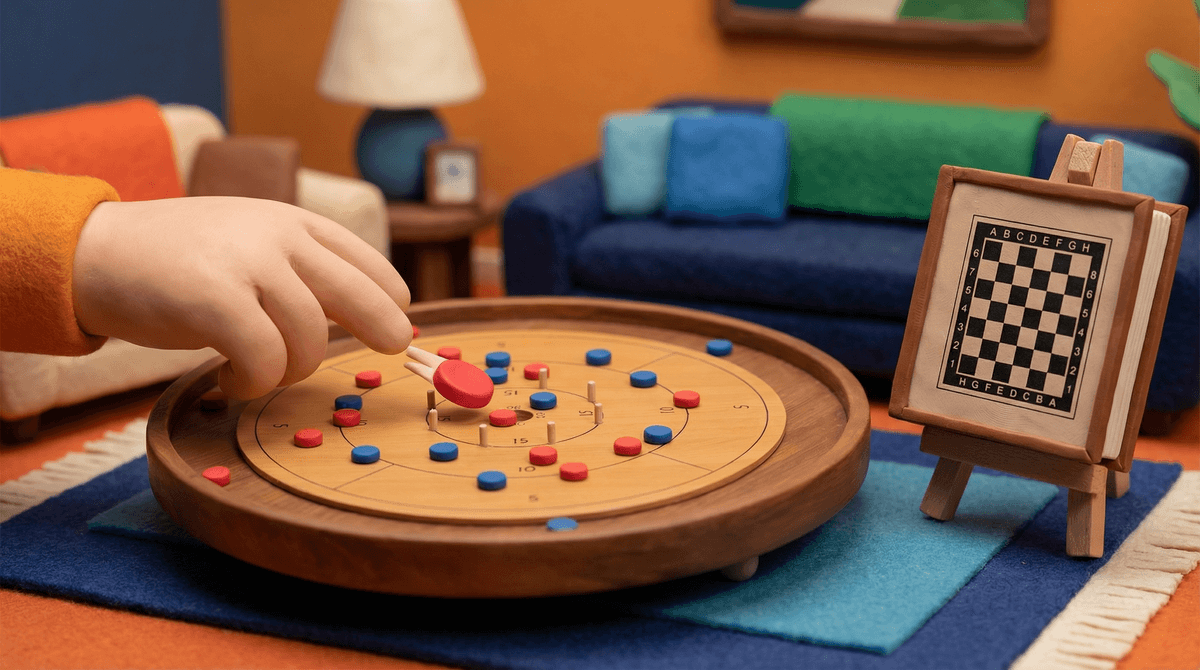
If you've never heard of crokinole, you're not alone—but once you play it, you'll wonder where it's been all your life. It's a Canadian dexterity board game (think shuffleboard meets curling on a circular wooden board) where players flick wooden discs toward the center hole, trying to score points while knocking opponents' pieces out of the way. The game requires precision, strategy, and just enough chaos to keep things interesting.
The beautiful thing about crokinole? It's genuinely screen-free fun that doesn't feel like a consolation prize. No batteries, no updates, no in-app purchases. Just a gorgeous wooden board, some discs, and the satisfying thwack of a well-aimed shot. But here's the thing: the standard rules can be brutally difficult for young kids who are still developing fine motor skills and strategic thinking.
Kids are drawn to crokinole for the same reason adults are—it's tactile, immediate, and surprisingly dramatic. There's something deeply satisfying about flicking a disc and watching it glide across polished wood. When it actually goes where you want it to? Pure dopamine.
But the standard game can be frustrating for younger players. The 20-point center hole is tiny, the finger-flicking technique takes practice, and the strategic element of deciding whether to go for points or play defense is genuinely complex. Without modifications, you risk the classic scenario where the 7-year-old gets demolished by their older sibling, declares the game "stupid," and asks if they can play Minecraft instead.
The goal is to find that sweet spot where kids feel challenged but not crushed, where they're developing skills but still having fun, and where family game night doesn't end in tears.
Ages 4-6: The "Just Have Fun" Stage
At this age, forget about official rules entirely. The goal is exploration and building confidence with the flicking motion.
- Free flicking: Let them shoot from anywhere on the board, not just from the outer ring
- Collaborative play: Work together to get discs in the center hole rather than competing
- Bigger target: Use a small bowl or cup placed in the center as a larger target
- Simplified scoring: Everything that stays on the board = 1 point, center hole = 5 points
- Gentle discs: If they're struggling with the standard wooden discs, try checkers pieces temporarily—they're lighter and easier to control
Ages 7-9: Training Wheels Mode
Kids this age can handle basic strategy but still need handicaps to compete with older players or adults.
- Shoot from closer: Let younger players shoot from the inner ring instead of the outer rail
- Extra shots: Give them 2 shots per turn instead of 1
- No removal rule: Their discs can't be knocked off the board by opponents (but they still have to shoot to hit an opponent's disc if one is on the board)
- Simplified zones: Just three scoring areas—outer ring (5 points), middle ring (10 points), center hole (20 points)—instead of the traditional four
- "Do-overs": Allow one mulligan per round for obviously bad shots
Ages 10-12: Almost There
At this stage, kids can usually play pretty close to standard rules with just minor handicaps.
- Score multiplier: Their points count as 1.5x or 2x
- First shot advantage: They always shoot first in each round
- Gentler removal: If an adult knocks their disc off, it goes back in the 5-point zone instead of being removed
- Strategic coaching: Let them ask "what would you do?" once per game without judgment
Beyond age-based handicaps, some rule modifications just make crokinole more fun for mixed-age family play:
The "Closest to Center" Bonus: At the end of each round, whoever has a disc closest to the center hole (even if it didn't go in) gets 5 bonus points. This rewards accuracy even when the center hole proves impossible.
Team Play: Pair younger kids with older siblings or adults. Each team member takes alternating shots, and you strategize together. This naturally teaches the game while keeping everyone engaged.
Progressive Handicaps: Start the game with handicaps in place, but reduce them as the game goes on. Maybe the first round, the 6-year-old shoots from the inner ring, but by round three they're shooting from the proper position. This builds confidence and skills simultaneously.
The "Spectacular Shot" Rule: If anyone makes an objectively amazing shot—a perfect center hole, a double-knock that saves your disc while removing two opponents, etc.—everyone has to acknowledge it. This builds a culture of appreciating good play regardless of who's winning.
The learning curve is real: Even with modifications, expect the first few games to be rough. Kids need time to develop the flicking technique, and it's genuinely hard at first. Don't expect competitive games right away.
The board matters: If you're buying a crokinole board, get a decent one. The cheap versions with rough surfaces or warped wood will frustrate everyone. You don't need a $500 tournament board, but a solid mid-range option (around $100-200) makes a huge difference in playability.
It's legitimately educational: Crokinole teaches geometry (angles and trajectories), physics (momentum and friction), fine motor skills, strategic thinking, and emotional regulation (dealing with a bad shot or getting knocked off). It's the rare game where "but it's educational!" isn't just parent cope.
Adjust in real-time: If you notice a kid getting frustrated, add a handicap mid-game. If they're dominating, dial it back. The goal is engagement, not rigid rule adherence.
Physical setup matters: Make sure younger kids can comfortably reach all parts of the board. Sometimes this means standing instead of sitting, or using a lower table.
Crokinole is one of those rare games that can genuinely bridge the age gap in families—but only if you're willing to abandon the rulebook for a while. The standard rules were designed for adults, and there's no shame in modifying them extensively for younger players.
The real win here isn't teaching kids to play "proper" crokinole—it's creating an experience where a 7-year-old, a 12-year-old, and two adults can all be engaged and competitive at the same table. Without screens. Without batteries. Just wood, physics, and the occasional dramatic upset when the youngest player actually nails the center hole.
Start with heavy modifications and gradually work toward standard rules as skills develop. Some kids will be ready for "real" crokinole by age 8, others won't get there until 11 or 12. That's fine. The goal is to build positive associations with the game so that when they are ready for competitive play, they're excited about it rather than burned out.
And honestly? Even adults often prefer some of these house rules. The "spectacular shot" acknowledgment rule and team play variations make the game more social and less cutthroat, which is kind of the whole point of family game night anyway.
If you're looking for more screen-free games that work across age ranges, Catan and Ticket to Ride both offer similar opportunities for modifications and handicaps that keep everyone engaged.