

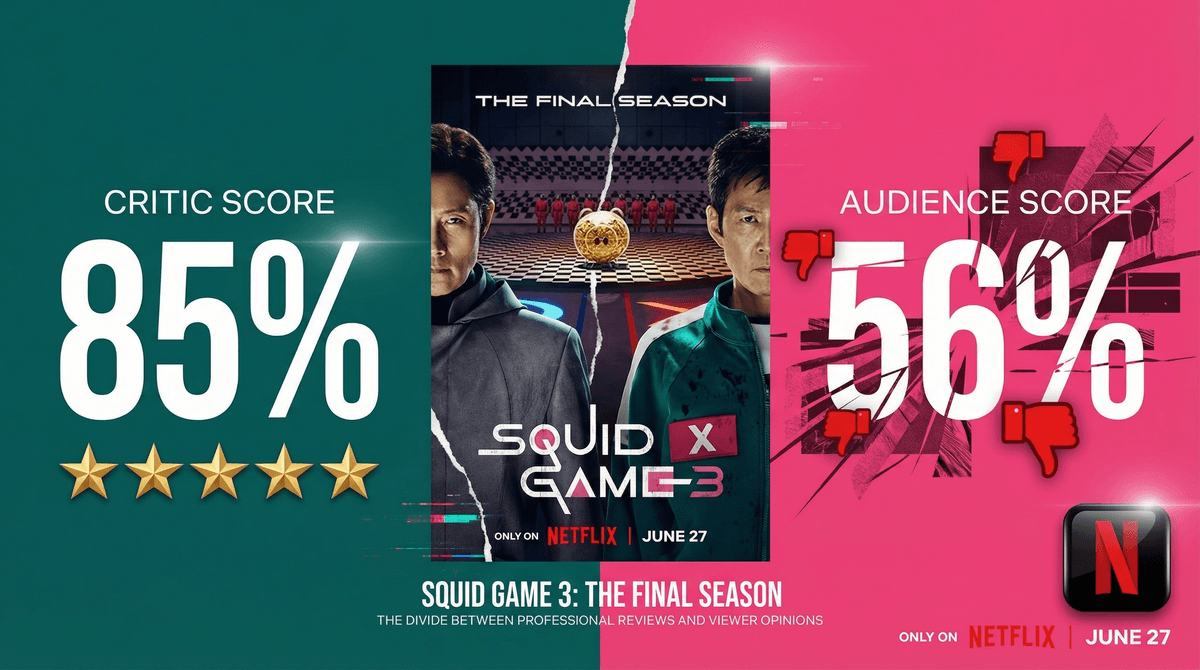
If you've been scrolling through Netflix trying to decide whether your teen should watch Squid Game, you might've noticed something weird: critics gave Season 2 pretty solid reviews (around 80-85% on Rotten Tomatoes), but the audience score? It's sitting at like 56%. That's a massive gap. And if you're a parent trying to figure out what this means for your family, it's genuinely confusing.
Here's the thing: this split isn't just about whether the show is "good" or not. It's actually revealing something really interesting about how we consume media in 2026, and it matters when you're making decisions about what your kids watch.
Professional reviewers tend to evaluate Season 2 on things like:
- Thematic depth - Does it explore capitalism, inequality, human nature in interesting ways?
- Cinematography and production value - The show looks incredible, full stop
- Performance - Lee Jung-jae continues to be mesmerizing
- World-building - Season 2 expands the universe and adds complexity
Critics are essentially asking: "Is this well-crafted television that has something to say?" And by those metrics, yeah, Season 2 delivers. It's thoughtful, beautifully shot, and the performances are stellar.
But here's where it gets interesting. Regular viewers—the people binge-watching at 11pm on a Tuesday—are rating it much lower. Why?
Pacing issues: Season 2 is slower. Way slower. It's more setup than payoff, and after the adrenaline rush of Season 1, a lot of viewers felt like they were waiting for something to happen that... didn't really happen.
The cliffhanger ending: Without spoiling anything, Season 2 ends in a way that feels incomplete. Like, aggressively incomplete. People who waited three years for answers got more questions instead, and they're pissed.
Expectation vs. reality: Season 1 was a cultural phenomenon. It was shocking, fast-paced, and had that perfect blend of social commentary and visceral entertainment. Season 2 is more cerebral, more political, less... fun? That's not necessarily bad, but it's not what many viewers wanted.
The Netflix binge model: When you watch all 7 episodes in one sitting and realize you just spent 7 hours on what feels like Act One of a three-act story, you're gonna be frustrated. Critics watched it differently—more analytically, with breaks, knowing it's part of a larger narrative.
Okay, so why does any of this matter when you're deciding if your 15-year-old can watch it?
The content hasn't changed: Both seasons are brutal. Graphic violence, psychological horror, people dying in disturbing ways. The rating split doesn't make Season 2 more or less appropriate—it's still firmly in the 16+ range, and honestly, even mature 16-year-olds might find it intense.
But the appeal might be different: If your teen loved Season 1 for the shock value and fast-paced games, they might be disappointed by Season 2's slower burn. That's not a content concern, but it's worth managing expectations so they don't feel like they wasted their time.
The conversation is different: Season 2 leans harder into political themes—revolution, class warfare, systemic corruption. If you're watching with your teen (which, honestly, is probably the best approach for this show), you're going to have different discussions than you did after Season 1.
Look, Squid Game is violent. Like, really violent. People get shot, stabbed, and killed in creative and disturbing ways. There's psychological torture. The whole premise is about desperate people killing each other for money.
If your teen watched Season 1 and handled it okay, Season 2 isn't significantly worse in terms of content. It's more of the same violence-wise, just with a different narrative structure.
If you're considering it for the first time, ask yourself:
- Can your teen handle graphic violence in a fictional context?
- Are they mature enough to understand it as social commentary, not just gore?
- Can you watch together and discuss what they're seeing?
The critic/audience split doesn't change these questions. It just tells you that Season 2 is a different kind of experience—less immediately gratifying, more deliberately paced, more overtly political.
The ratings gap for Squid Game Season 2 is less about quality and more about expectations and viewing experience. Critics approached it as prestige TV with something to say. Audiences wanted the rush of Season 1 and got a slow-burn setup for Season 3 instead.
For parents, this split is actually useful information: it tells you that Season 2 might not hold your teen's attention the same way Season 1 did, but the content concerns remain the same. It's still intense, still violent, still requires maturity to process.
If you decide your teen is ready for it, consider watching it together . The conversations you'll have about class, power, and human nature under pressure? Those are actually pretty valuable. Just don't expect anyone to be satisfied with that ending.
Next Steps:
- Check out our full Squid Game guide for age-specific considerations
- Looking for less intense options? Try alternatives to Squid Game
- Want to understand how to talk about violence in media? Start here