

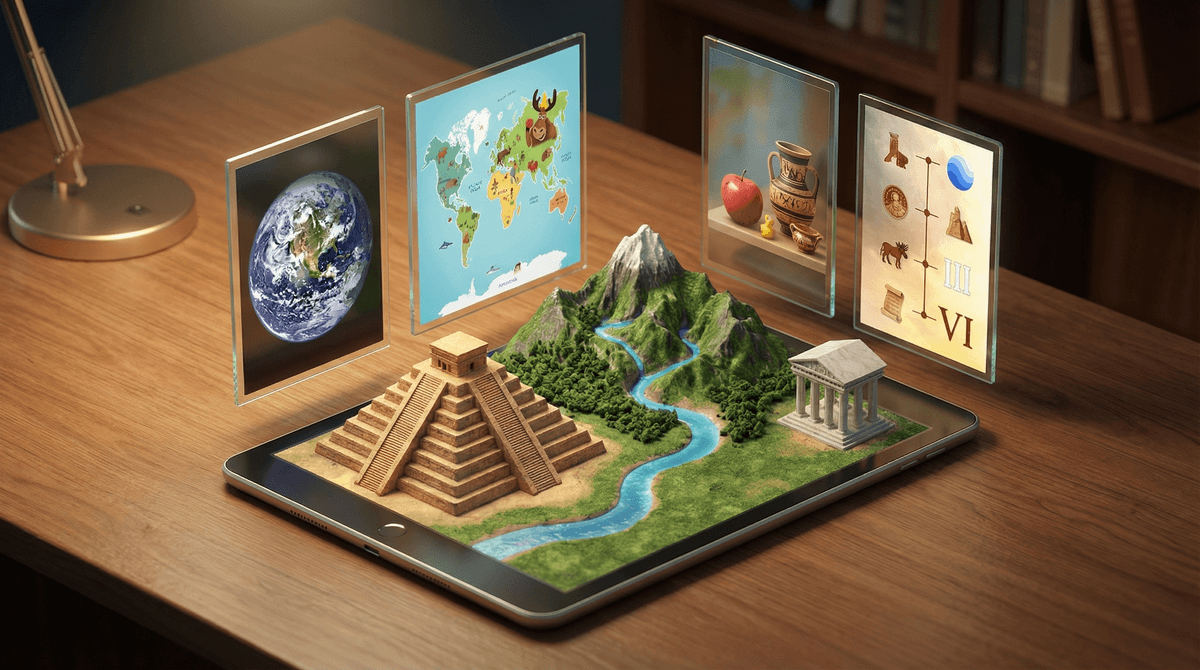
Social studies apps promise to make history, geography, and civics engaging through interactive games, quizzes, and challenges. The market is flooded with them—everything from Carmen Sandiego revivals to apps that gamify state capitals with cartoon mascots.
But here's the thing: most of these apps are just digital flashcards with better graphics. They're teaching kids to memorize that Montpelier is the capital of Vermont (a fact they'll forget in approximately 48 hours) rather than helping them understand why cities become capitals, how geography shapes culture, or what it means to be a citizen.
The good news? A handful of apps actually do teach critical thinking, cultural awareness, and historical context. The challenge is figuring out which ones are worth the download—and your kid's time.
Social studies gets the short end of the stick in most schools. It's squeezed between math and literacy, often reduced to memorizing dates and state names. When done well, though, social studies teaches kids how to think about the world: how societies work, why people make the choices they do, how the past shapes the present.
The best social studies apps don't just deliver facts—they help kids ask better questions. They encourage perspective-taking, pattern recognition, and connecting dots across time and place. The worst ones? They're basically Candy Crush with a Benjamin Franklin skin.
Let's talk about what most social studies apps actually do: gamified memorization. You know the ones—tap the right answer about which president is on the five-dollar bill, earn coins, unlock a new level, repeat.
These apps aren't bad, exactly. Kids might learn something. But they're teaching recognition, not understanding. Your child can ace a quiz about the three branches of government without having any idea what checks and balances actually mean in practice.
Apps like Stack the States or Presidents vs. Aliens fall into this category. They're fine for car rides or waiting rooms—low-stakes, mildly educational entertainment. But they're not building critical thinking skills.
Here's what to look for in a social studies app that goes deeper:
1. Context and narrative. Does the app tell stories, or just present isolated facts? [Mission US](https://screenwiseapp.com/media/mission-us-app (free, ages 10+) puts kids in historical scenarios—escaping slavery, surviving as a Native American during colonization, working in a factory during industrialization. Kids make choices and see consequences. That's how you learn history.
2. Multiple perspectives. Does the app show that history isn't one story, but many? Apps like Timeline: World History (ages 12+) help kids see how events connect across cultures and continents. It's not just "what happened in America"—it's what was happening everywhere, all at once.
3. Real-world application. Does it connect to current events or kids' lives? iCivics (free, ages 10+) was created by former Supreme Court Justice Sandra Day O'Connor, and it's genuinely excellent. Kids run campaigns, argue Supreme Court cases, and manage budgets. They're not memorizing the Bill of Rights—they're using it.
4. Open-ended exploration. Does the app let kids follow their curiosity? Google Earth isn't technically a social studies app, but it's one of the best tools for geography and cultural exploration. Kids can visit the Taj Mahal, explore the Amazon, compare cities. Pair it with conversations about what they're seeing, and it becomes powerful.
Ages 6-8: At this age, social studies is mostly about community, basic geography, and cultural awareness. Apps should be simple, visual, and tied to things kids can relate to.
- Little Passports (subscription) introduces world cultures through characters and activities
- Duck Duck Moose World (free) teaches basic geography through play
- Skip the memorization apps entirely—they're developmentally inappropriate and boring
Ages 9-12: This is the sweet spot for deeper social studies apps. Kids can handle multiple perspectives, cause-and-effect thinking, and connecting past to present.
- Mission US (free) for historical role-playing
- iCivics (free) for government and civics
- Civilizations AR (free) to explore artifacts from the British Museum in augmented reality
- National Geographic Kids (free) for geography and current events
Ages 13+: Teens can handle complexity, nuance, and controversial topics. Look for apps that challenge assumptions and encourage debate.
- Timeline: World History for seeing the big picture
- 1619 Project app (free) for reframing American history
- BBC Bitesize (free) for global perspectives on history and current events
Screen time isn't the enemy—passive consumption is. A kid playing iCivics and arguing about Supreme Court cases is learning more than a kid watching a documentary without engagement. The key is whether the app requires active thinking.
Most apps work best with conversation. Don't just hand over the iPad. Ask questions: "Why do you think they made that choice?" "What would you have done differently?" "How is this similar to something happening now?" That's where the learning happens.
Free doesn't mean low-quality. Some of the best social studies apps—Mission US, iCivics, Google Earth—are completely free. Paid apps aren't necessarily better; they're often just better marketed.
Watch for "educational" apps that are really just ads. Some apps are designed to funnel kids toward in-app purchases or collect data. Read up on app privacy before downloading.
Most social studies apps are glorified flashcards. A few are genuinely excellent tools for teaching kids how to think about the world, understand different perspectives, and connect past to present.
The best approach? Use apps as one tool among many. Pair them with books, conversations, documentaries, and real-world experiences. And prioritize apps that ask kids to think, not just tap the right answer.
If your kid is spending time on a social studies app and can't explain why something matters—just what happened—it's probably not worth the screen time.
- Try iCivics or [Mission US](https://screenwiseapp.com/media/mission-us-app—both free and excellent
- Learn how to evaluate educational apps beyond marketing claims
- Explore alternatives to screen-based learning
 for social studies