

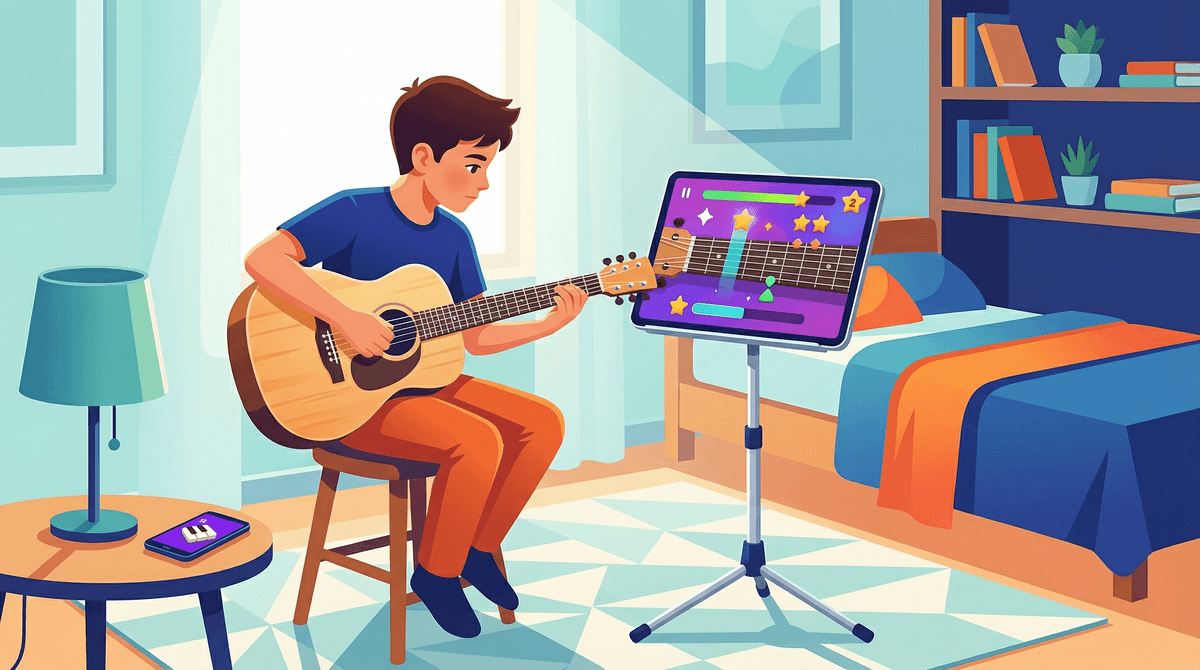
Simply Guitar App: Can Your Kid Really Learn Guitar from Their Phone?
TL;DR: Simply Guitar uses gamification and real-time audio feedback to teach guitar basics. It's legitimately effective for beginners (ages 8+) and way better than YouTube rabbit holes, but the $150/year subscription adds up fast. Best for motivated kids who need structure but aren't ready for in-person lessons, or as a supplement to traditional instruction. Not a magic bullet—you still need an actual guitar and consistent practice.
Simply Guitar is a mobile app (iOS and Android) from JoyTunes, the same company behind Simply Piano. It uses your phone's microphone to listen as you play, giving instant feedback on whether you're hitting the right notes and staying on rhythm. The app walks kids through bite-sized lessons covering chords, strumming patterns, fingerpicking, and eventually full songs.
The interface is bright, gamified, and designed to feel more like playing a mobile game than practicing scales. You earn stars, unlock new songs, and get those satisfying dopamine hits when you nail a section. It's basically Duolingo for guitar, complete with streak tracking and achievement badges.
Here's the thing about learning guitar: it's hard. Your fingers hurt, the chords sound terrible for weeks, and most kids give up before they can play a single song all the way through. Simply Guitar tackles this dropout problem head-on.
The gamification actually works. Instead of abstract exercises, kids are playing recognizable song fragments from day one. The app breaks everything down into 10-15 minute sessions—short enough that it doesn't feel like homework, long enough to build real skills.
The instant feedback is surprisingly accurate. The app listens through your phone's mic and tells you immediately if you're playing the right chord or if your timing is off. No waiting for next week's lesson to find out you've been practicing something wrong. For kids who hate feeling stupid or making mistakes in front of a teacher, this private feedback loop is huge.
It meets kids where they are. The song library includes actual songs kids want to play—not just "Twinkle Twinkle Little Star." We're talking Ed Sheeran, Billie Eilish, classic rock, pop hits. The motivation of "I want to play that song" is powerful.
Let's talk money because this is where things get real.
The app is free to download with a limited trial, but to actually use it you'll need a subscription:
- $59.99 for 3 months
- $119.99 per year (sometimes on sale for $89.99)
- $299.99 for lifetime access
For context, in-person guitar lessons typically run $30-60 per session, so $120/year breaks down to about $10/month—roughly the cost of 2-3 traditional lessons. If your kid practices consistently, the math works out.
But here's the catch: you still need a guitar. A decent beginner acoustic runs $100-200. Add the app subscription and you're looking at $250-350 upfront, then $120/year ongoing. Not nothing.
The lifetime option ($300) makes sense if you have multiple kids who'll use it over time, or if you're confident your kid will stick with it for 2+ years. Otherwise, start with the annual subscription and see if they're still playing in six months.
Ages 8-10: Can definitely use the app, but they'll need a smaller guitar (3/4 size) and probably some help getting started. Finger strength is a real issue at this age—those first chords HURT. Expect to sit with them for the first few weeks.
Ages 11-14: The sweet spot. Old enough to have the finger strength and coordination, young enough to still be excited about gamified learning. This is where Simply Guitar really shines.
Ages 15+: Still works great, though older teens might feel like the gamification is a bit childish. The actual instruction is solid regardless of age, but the aesthetic skews younger.
Adults: Honestly? It's excellent for adult learners too. The learn guitar as an adult journey is real, and this app makes it way less intimidating than trying to decipher YouTube tutorials.
Yes, with caveats.
Simply Guitar teaches fundamentals really well: chord shapes, strumming patterns, basic music theory, reading chord charts, timing and rhythm. Kids who stick with it for 3-6 months will absolutely be able to play recognizable songs and have legitimate guitar skills.
What it doesn't teach as well:
- Music theory depth: You'll learn what a chord is, but not necessarily why it works or how to build your own
- Improvisation: The app is very structured—great for learning, less great for creative exploration
- Performance skills: Playing alone in your room with an app is different from playing with others or in front of people
- Equipment knowledge: No guidance on gear, amp settings, electric vs. acoustic considerations
Think of it like this: Simply Guitar will teach your kid to play guitar. It won't necessarily make them a musician. For many families, that's totally fine! Not everyone needs to join a band or write original songs. Being able to play "Wonderwall" at a campfire is a legitimate goal.
vs. YouTube tutorials: Simply Guitar is infinitely better for beginners. YouTube is free but chaotic—you're jumping between different teachers, different teaching styles, no structured curriculum. Great for learning specific songs once you have basics down, terrible for starting from zero.
vs. In-person lessons: Traditional lessons win on personalization, immediate correction of bad habits, and music theory depth. Simply Guitar wins on cost, convenience, and not having to drag your kid to lessons every week. Many families do both—app for daily practice, occasional in-person lessons for guidance. Check out our guide on alternatives to Simply Guitar for more options.
vs. Simply Piano: Same company, similar approach. Piano is arguably easier to start (keys are keys, no finger pain), but guitar is more portable and has that cool factor. Pick based on which instrument your kid actually wants to play.
vs. Yousician: Yousician covers multiple instruments and has more gamification. Simply Guitar is more focused and has a cleaner interface. Both are solid—Yousician might be better if you want one subscription for multiple instruments.
This is active screen time, not passive consumption. Your kid is holding an instrument, reading music, coordinating hands and eyes, building a real-world skill. This is fundamentally different from scrolling TikTok or watching YouTube.
That said, the app wants daily engagement and uses all the standard retention tactics: streaks, notifications, "don't break your progress!" messaging. You'll want to have conversations about why they're practicing—intrinsic motivation (I want to play guitar) vs. extrinsic motivation (I need to maintain my streak).
No social features, no chat, no user-generated content. It's just you and the app, which from a safety perspective is about as low-risk as apps get. The biggest "danger" is the subscription auto-renewal—set a calendar reminder to evaluate whether it's still being used before it renews.
Simply Guitar is legitimately good at what it does. It's not going to replace music school or turn your kid into the next guitar virtuoso, but it's an excellent, structured way to learn guitar basics without the cost and commitment of weekly lessons.
It's worth the money if:
- Your kid is genuinely interested in learning guitar (not just your dream for them)
- They're willing to practice 10-15 minutes most days
- You're okay with the ongoing subscription cost
- You want structure and instant feedback
Skip it if:
- Your kid needs external accountability (a real teacher expecting them to show up)
- They're the type who downloads apps and never opens them again
- Budget is tight—there are free resources that work if you're willing to cobble together a curriculum
- They're already taking lessons and just need practice guidance (free resources might be enough)
- Download the free trial and let your kid mess around for a few days before committing to the subscription
- Get a proper beginner guitar—don't start with that dusty acoustic from your college days that's impossible to play. A properly set-up beginner guitar makes a huge difference
- Set realistic expectations: 10-15 minutes daily is way better than an hour once a week
- Check in after 30 days: Is your kid still opening the app? Are they getting frustrated or feeling successful? That's your signal for whether to continue
Want more options? Check out our guides on best apps for learning music and screen time that actually builds skills.